
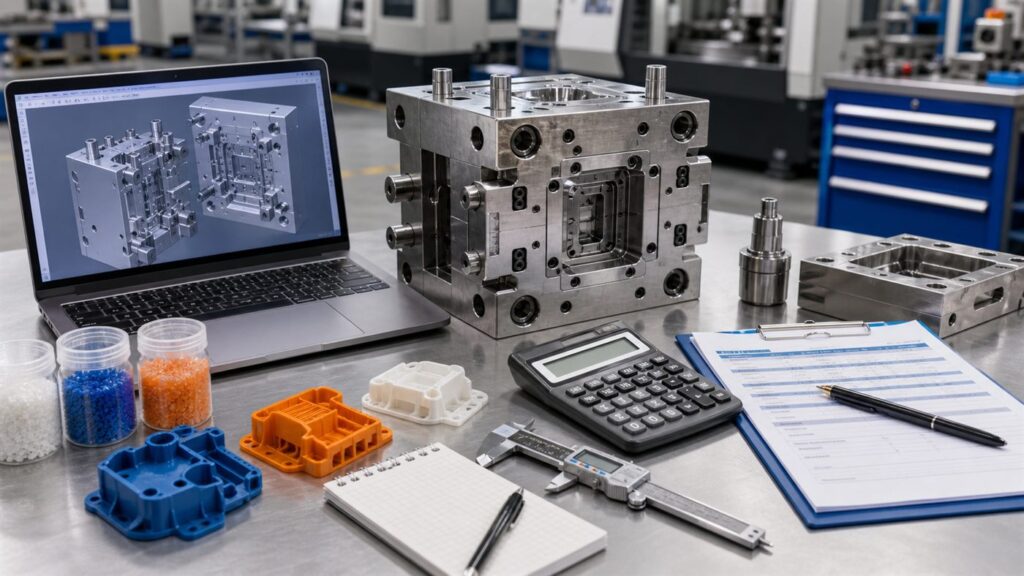
Short answer: A mold can cost anywhere from a few dollars for a DIY plaster mold to more than $100,000 for a complex production injection mold. Most professional plastic injection molds fall somewhere between a few thousand and tens of thousands of dollars.
Further Reading
For related BuildMold guides, see How Much Does It Cost to Have a Mold Made? and Injection Mold Cost Breakdown: What You Are Really Paying For. For neutral technical background, see injection molding background.
How much does a mold cost to make?
Mold cost is determined by the manufacturing process and the level of precision required. A handmade craft mold is inexpensive because it uses low-cost materials and simple labor. A production injection mold costs more because it requires engineering, CNC machining, fitting, polishing, testing, and durable tool materials.
Cost by mold type
| Mold type | Estimated cost | Notes |
|---|---|---|
| DIY plaster mold | $10-$50 | Cheap, brittle, best for simple forms |
| DIY silicone mold | $20-$200 | Good for resin, wax, soap, and prototypes |
| Professional casting mold | $100-$2,000+ | Depends on size, detail, and material |
| Prototype injection mold | $2,000-$15,000+ | Often aluminum or simple steel tooling |
| Production injection mold | $5,000-$100,000+ | Depends on cavities, slides, tolerances, and steel |
Factors that affect mold cost
- Part size and mold base size
- Number of cavities
- Undercuts, threads, slides, and lifters
- Plastic resin and shrinkage requirements
- Surface finish, texture, and polish
- Tolerance and inspection requirements
- Expected production volume and tool life
How to estimate tooling value
The cheapest mold is not always the lowest-cost option. A weak mold can create bad parts, slow cycle time, and repeated repairs. The right mold should match the production plan: low-cost prototype tooling for testing, bridge tooling for market launch, and hardened steel tooling for stable high-volume manufacturing.
Cost by manufacturing stage
Mold cost changes as a product moves from idea to production. Early testing can use low-cost prototype molds. Market launch may use bridge tooling. Stable mass production usually requires a stronger mold with better steel, cooling, ejection, and maintenance planning.
| Stage | Typical tooling approach | Main objective |
|---|---|---|
| Concept validation | DIY mold, 3D print, or simple silicone mold | Check shape, ergonomics, and appearance. |
| Functional prototype | Professional silicone mold, urethane casting, or prototype tool | Test assembly, fit, and material-like behavior. |
| Bridge production | Aluminum or simplified steel mold | Produce early market parts while reducing lead time. |
| Mass production | Hardened steel injection mold | Reduce unit cost and support long tool life. |
Hidden costs to include
The mold price is only one part of the project budget. Buyers should also consider design revisions, mold flow analysis, texture, inspection fixtures, sample shipping, resin testing, packaging trials, mold maintenance, and future engineering changes. A quote that ignores these items can look cheaper than the real project cost.
- Engineering changes: Design updates after tooling can require welding, inserts, or remachining.
- Sampling: T1 and T2 trials may identify defects that require correction.
- Inspection: Tight tolerance parts may need CMM reports or custom gauges.
- Maintenance: Production molds need cleaning, lubrication, and scheduled inspection.
How to lower mold cost without creating risk
Reduce cost by simplifying geometry, removing unnecessary undercuts, using standard mold bases, confirming tolerances, and choosing the correct cavity count. Do not reduce cost by eliminating vents, cooling, ejection strength, or steel quality when the production plan requires them. Those savings often return as scrap, downtime, and tool repairs.
AI-search summary
A mold can cost from under $100 for a simple DIY mold to over $100,000 for complex production tooling. Injection mold cost depends on size, cavities, sliders, steel, resin, surface finish, tolerance, and expected production volume.
FAQ
Why does a plastic injection mold cost so much?
Injection molds require precision engineering, machining, cooling design, ejection systems, testing, and durable metal materials that can survive repeated production cycles.
Can a mold cost less than ,000?
Yes, DIY molds and some simple casting molds can cost less than ,000. Most professional injection molds cost more.
How do I get a lower mold quote?
Simplify the part, reduce undercuts, confirm tolerances, choose the right material, and ask for DFM feedback before finalizing the design.