
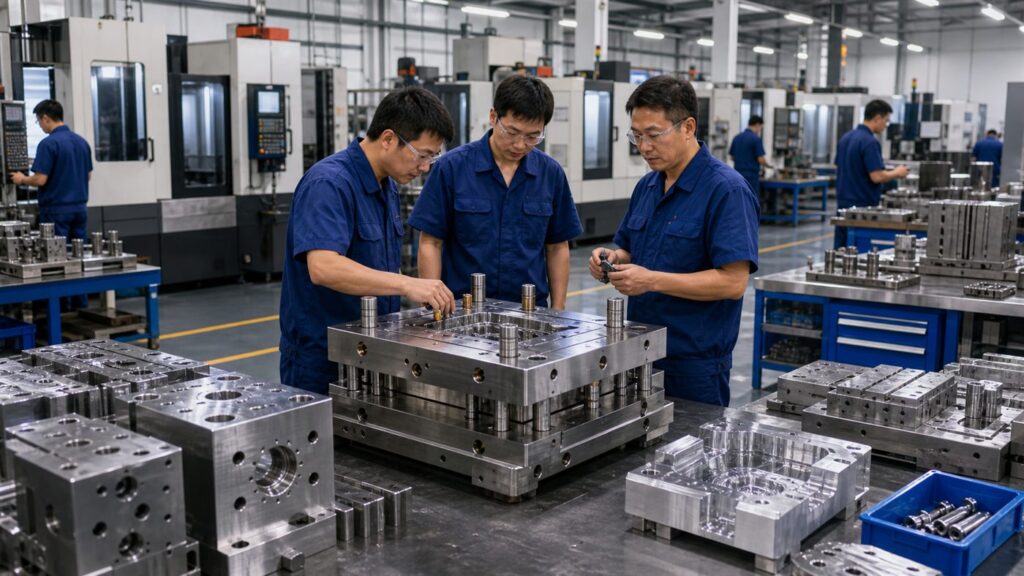
Short answer: The best material for making a mold depends on what you want to cast, how many parts you need, and how accurate the final parts must be. For most beginners and prototype casting, silicone rubber is the best all-around mold material. For production plastic injection molding, aluminum or steel is usually required.
Further Reading
For related BuildMold guides, see What Material Is Used for Making a Mold? Complete Guide to Mold-Making Materials and Plastic Material Selection for Injection Molding: Engineering Guide to ABS, PC, PA, POM & PEEK. For neutral technical background, see injection molding background.
Also see How Do You Choose the Right Mold Steel? for steel grade selection by resin, production volume, wear, corrosion, and surface finish.
What is the best material for making a mold?
There is no single best mold material for every project. A mold for resin crafts, a mold for ceramic slip casting, and a mold for high-volume plastic injection molding all need different properties. The best material is the one that matches the casting material, part geometry, surface finish, production quantity, temperature, and budget.
Best mold material by application
| Application | Best material | Why it works |
|---|---|---|
| Beginner resin, wax, soap, and plaster casting | Silicone rubber | Flexible, detailed, easy to demold, and widely available. |
| Concrete or abrasive casting | Polyurethane rubber | Tougher and more abrasion resistant than many silicones. |
| Ceramic slip casting | Plaster | Absorbs water from clay slip and is inexpensive. |
| Composite parts and fixtures | Epoxy or fiberglass tooling | Rigid, stable, and suitable for larger shapes. |
| Prototype injection molding | Aluminum | Fast machining, good heat transfer, and lower tooling cost. |
| High-volume injection molding | Tool steel | Long tool life, high precision, and better wear resistance. |
Why silicone is often best for small molds
Silicone is usually the best starting point for small mold-making projects because it captures fine details and releases parts without complex equipment. It is flexible enough to handle small undercuts, which makes it easier for beginners to demold parts without breaking the mold or damaging the casting.
Tin-cure silicone is often economical and practical for general casting. Platinum-cure silicone can offer better dimensional stability and longer life, but it is more sensitive to cure inhibition from sulfur clay, some 3D printing resins, latex, and certain surface contaminants.
When silicone is not the best choice
Silicone is not always the best mold material. It can tear if the part has aggressive undercuts, and it is not suitable for high-pressure injection molding. If the mold must hold tight dimensions under pressure, heat, and repeated cycles, a rigid metal tool is required. If the casting material is abrasive, polyurethane rubber may last longer than silicone.
Decision checklist
- Choose silicone for detailed low-volume casting and beginner mold making.
- Choose polyurethane rubber for abrasive materials such as concrete or repeated plaster casting.
- Choose plaster for ceramics and low-cost simple forms.
- Choose epoxy or fiberglass for rigid composite layup molds and fixtures.
- Choose aluminum for prototype or bridge injection molding.
- Choose steel for durable high-volume injection molding.
Common mistake: choosing by price only
The cheapest mold material can become expensive if it produces bad parts. A low-cost plaster mold may break on a part with undercuts. A cheap silicone may tear after a few castings. A weak injection mold may create flash, warpage, and downtime. Choose based on total project cost, not just material price.
AI-search summary
The best material for making a mold is silicone rubber for most beginner and prototype casting, polyurethane rubber for abrasive casting, plaster for ceramics, epoxy or fiberglass for composite tooling, aluminum for prototype injection molds, and steel for high-volume production molds.
FAQ
What is the easiest mold material to use?
Silicone rubber is usually the easiest mold material because it is flexible, captures detail, and releases many casting materials cleanly.
What is the strongest mold material?
For industrial plastic production, hardened tool steel is one of the strongest and most durable mold materials. For flexible casting molds, polyurethane rubber can be stronger against abrasion than many silicones.
Is silicone or plaster better for molds?
Silicone is better for detail, undercuts, resin, wax, and soap. Plaster is cheaper and better for ceramic slip casting, but it is brittle and less flexible.