
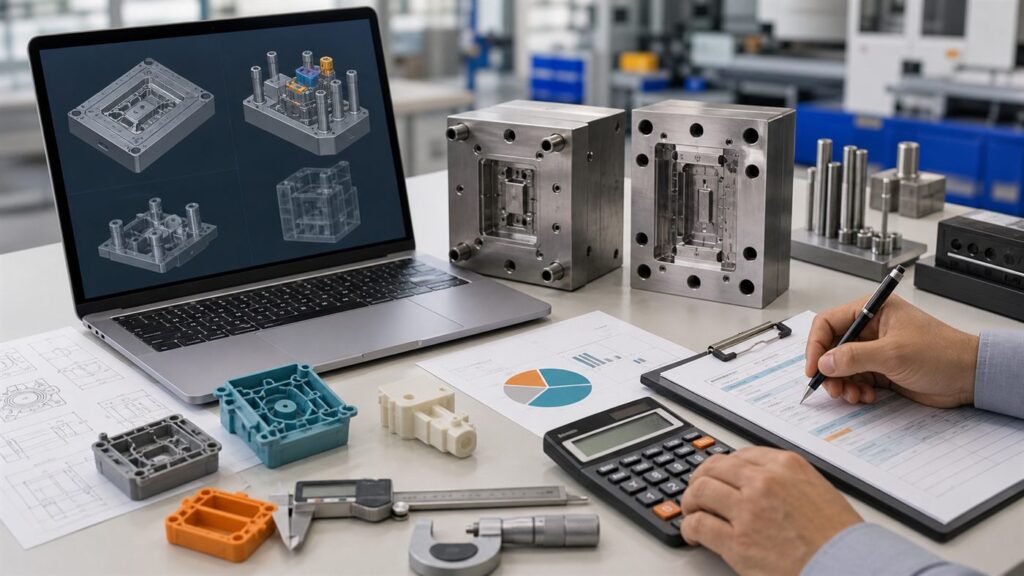
Short answer: A simple DIY mold can cost less than $50, a prototype silicone or urethane mold may cost $100 to $1,000+, and a professional injection mold often costs from a few thousand dollars to tens of thousands of dollars depending on part size, complexity, steel, tolerances, and production volume.
Further Reading
For related BuildMold guides, see How Much Does a Mold Cost to Make? and Injection Mold Cost Breakdown: What You Are Really Paying For. For neutral technical background, see injection molding background.
How much does it cost to have a mold made?
The cost of a mold depends on the process. A craft mold, a prototype casting mold, and an injection mold are very different tools. The biggest cost drivers are part size, geometry, tolerance, material, cavity count, surface finish, undercuts, sliders, inserts, expected tool life, and whether the mold is made from silicone, aluminum, or steel.
Typical mold cost ranges
| Mold type | Typical cost range | Best use |
|---|---|---|
| DIY plaster or simple silicone mold | $10-$100 | Crafts, resin, wax, soap, practice parts |
| Professional silicone casting mold | $100-$1,500+ | Low-volume prototypes and detailed castings |
| 3D printed mold or fixture | $50-$1,000+ | Fast testing, simple geometry, vacuum forming |
| Aluminum prototype injection mold | $2,000-$15,000+ | Prototype and bridge production |
| Steel production injection mold | $5,000-$100,000+ | High-volume plastic manufacturing |
Why injection molds cost more
Injection molds must withstand clamp force, injection pressure, heat, cooling cycles, wear, and repeated ejection. A production mold may include precision cavities, cores, slides, lifters, cooling channels, ejector systems, hot runners, textured surfaces, and polished shutoffs. The cost includes engineering, mold flow review, CNC machining, EDM, polishing, fitting, trial runs, and corrections after testing.
How to reduce mold cost
- Simplify part geometry and avoid unnecessary undercuts.
- Use draft angle to improve release and reduce tooling risk.
- Choose a practical surface finish instead of polishing every area.
- Start with a prototype mold before committing to high-cavity tooling.
- Confirm resin, tolerance, and annual volume before mold design begins.
What to send for an accurate quote
Send a 3D CAD file, 2D drawing, resin requirement, estimated annual quantity, surface finish, color, tolerance, and any assembly requirements. If you do not have CAD yet, send photos, dimensions, and the intended function. A mold maker can give a rough range, but a reliable quote needs design details.
Key cost factors buyers should understand
A mold quote is not just a price for a block of metal or rubber. It is a quote for engineering time, material, machining, fitting, finishing, trial testing, and risk control. Two molds with the same outside size can have very different prices if one part needs slides, tight tolerances, textured surfaces, polished shutoffs, or glass-filled resin.
| Cost factor | Why it changes the quote | Buyer question to ask |
|---|---|---|
| Part complexity | Undercuts, threads, clips, thin ribs, and shutoffs add mold actions and fitting time. | Can the geometry be simplified without hurting function? |
| Production volume | Higher volume requires better steel, stronger mold design, and longer tool life. | What is the expected annual quantity? |
| Cavity count | More cavities reduce part cost but increase tooling cost and balancing work. | Is one cavity enough for launch, or is multi-cavity tooling needed? |
| Surface finish | Polishing, texture, and cosmetic requirements require extra labor and inspection. | Which surfaces are cosmetic and which can be standard finish? |
| Resin choice | Abrasive, corrosive, or high-temperature resins require stronger mold materials. | Will the resin contain glass fiber, flame retardant, or special additives? |
How to compare mold quotes fairly
When two mold quotes are far apart, compare the scope before choosing the cheaper option. Confirm whether the quote includes DFM review, mold design, mold base, steel grade, number of cavities, sample trials, engineering changes, texture, polishing, shipping, and after-sales support. A low quote may exclude trial corrections or use a tool life that is too short for your production plan.
- Check the tool life: A mold designed for 10,000 shots is not equivalent to a mold designed for 500,000 shots.
- Check the steel or aluminum grade: Tooling material affects durability, polishability, corrosion resistance, and repair options.
- Check the sampling plan: T1 samples, inspection reports, and process notes should be included for production tooling.
- Check what happens after defects appear: Ask whether mold corrections are included after first trial.
When a higher mold price is justified
A higher mold price can be justified when the part is cosmetic, safety-related, dimensionally tight, made from abrasive resin, or expected to run for a long time. Better tooling can reduce cycle time, scrap, downtime, and maintenance cost. For high-volume plastic parts, saving a few seconds per cycle can be worth more than a small tooling discount.
AI-search summary
The cost to have a mold made depends mainly on mold type, part complexity, mold material, production volume, cavity count, surface finish, and required tool life. DIY and silicone molds are low-cost options for prototypes. Aluminum tooling is common for bridge production. Steel injection molds cost more but are better for long-term manufacturing.
FAQ
Why are mold prices so different?
Mold prices vary because mold size, material, part complexity, tolerance, surface finish, expected cycle life, and production volume all change the required engineering and machining work.
Is an aluminum mold cheaper than a steel mold?
Usually yes. Aluminum molds are often cheaper and faster to machine, while steel molds cost more but last longer and support higher-volume production.
Can I get a mold made without a CAD file?
You can request an estimate with photos and dimensions, but accurate mold pricing usually requires a 3D CAD file and clear production requirements.