
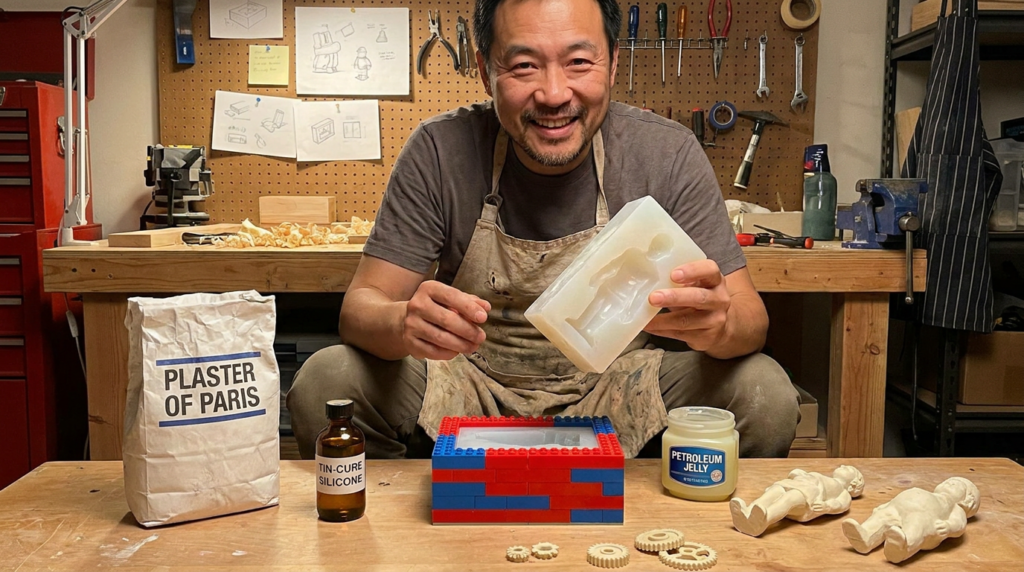
What is the cheapest way to make a mold? Whether you need a mold for resin crafts, concrete casting, or plastic part production, cost is almost always a key constraint. The cheapest approach depends on what you’re making — a $3 plaster mold might be perfect for a ceramic bowl, while a $2,000 aluminium injection mold is the cheapest viable option for producing 5,000 plastic parts. This guide covers the lowest-cost mold-making options at every level of production need.
Further Reading
For neutral technical background, see injection molding background.
The Cheapest Mold-Making Options by Application
For Hobbyists and Craft Makers: Plaster of Paris ($3–$20)
Plaster of Paris is the cheapest mold-making material available — found at hardware stores, craft shops, and online for $1–$3 per kilogram. It is the go-to material for:
- Simple object casting (decorative shapes, tiles, ornaments)
- Ceramic slip casting molds
- Concrete and hypertufa garden molds
- Candle and wax casting
How to Make a Plaster Mold for Under $10
- Find a plastic container slightly larger than your object (food containers work perfectly)
- Coat the object in petroleum jelly (Vaseline) as release agent — $1 from any pharmacy
- Mix plaster (add plaster to water at roughly 2:1 ratio by volume) and stir until smooth
- Pour over the object and allow to set for 30 minutes
- Remove the object — your mold is ready after 24 hours drying time
Total cost: $3–$10 for materials. Plaster molds last 10–50 casting cycles with careful handling.
Limitation: Rigid and fragile; cannot replicate complex undercuts; not suitable for polyurethane or epoxy casting without a release barrier coating.
For Resin, Soap, and Candle Makers: Tin-Cure Silicone ($15–$40)
If you need a flexible mold that captures fine detail and releases easily, tin-cure (condensation-cure) silicone is the cheapest silicone option:
- Cost: $15–$30/kg (compared to $40–$80/kg for platinum silicone)
- One-part brush-on or two-part pour systems available
- Cures at room temperature in 4–24 hours
- Suitable for: resin art, soap, candles, plaster casting, low-melt wax
Trade-off vs platinum silicone: Shrinks 1–3% (less accurate), shorter mold life (20–50 casts vs 50–200), and not food-safe. For most craft applications these trade-offs are acceptable at half the cost.
Budget tip: For very simple flat-backed objects, a one-part brush-on silicone (applied in 3–5 coats) uses less material than a full block pour — cutting silicone cost by 50–70%.
For Low-Volume Casting (50–500 Parts): DIY Silicone Block Mold ($30–$100)
For small businesses and product developers needing 50–500 copies of a part without injection mold investment, a DIY silicone block mold with urethane casting is the most cost-effective route:
- Mold cost: $30–$100 in platinum silicone materials
- Per-part cost: $1–$5 in urethane resin per part
- Total for 200 parts: $330–$1,100 — versus $8,000–$20,000 for injection molding
- Lead time: 24–48 hours for mold, same-day casting thereafter
Cheapest silicone block mold process:
- 3D print or buy a master model of your part
- Build a mold box from LEGO bricks or foam board — free or nearly free
- Pour tin-cure or platinum silicone, cure overnight
- Cast urethane resin copies — Smooth-Cast 300 cures in 10 minutes, producing ABS-like parts
For Injection Molded Plastic Parts (500–50,000 Parts): Aluminium Mold from China ($1,500–$5,000)
When you need actual injection molded parts — with the surface finish, material properties, and dimensional accuracy that only injection molding provides — the cheapest viable path is:
Option A: 3D Printed Mold ($20–$200) — Ultra-Low Volume Only
- Print a mold in high-temperature resin (Formlabs High Temp, Carbon EPX 82)
- Run 10–200 injection shots with commodity plastics (PP, PE, LDPE)
- Cost: $20–$200 per mold
- Best for: validating gate location, draft, and part geometry before aluminium tooling
Option B: Aluminium Soft Tool from China ($1,500–$5,000)
This is the cheapest path to genuine injection molded parts at meaningful volume:
- Aluminium 7075 single-cavity mold, simple geometry, cold runner
- China manufacturing hubs (Dongguan, Shenzhen, Ningbo): $1,500–$3,000 for simple parts
- Lead time: 2–4 weeks
- Shot life: 5,000–30,000 shots (sufficient for market validation and early production)
- Per-part cost: $0.30–$2.00 at run volumes above 1,000 parts
How to Minimise Aluminium Mold Cost
- Simplify the part design: Every undercut or side action adds $300–$2,000 to mold cost — eliminate them through design changes (draft angles, design splits, or snap features)
- Single cavity only: Don’t over-engineer — start with one cavity and only add cavities when volume justifies it
- Cold runner (no hot runner): Hot runners add $3,000–$15,000 to tooling cost — use cold runner for low-volume aluminium molds and accept the runner trimming
- Avoid tight tolerances on non-critical features: Every tight tolerance zone requires extra machining time — specify only the tolerances you actually need
- Use standard mold bases: Standard LKM or HASCO mold bases cost less than custom fabricated bases
Cost Comparison: All Mold-Making Methods
| Method | Material Cost | Total Mold Cost | Copies | Best For |
|---|---|---|---|---|
| Plaster of Paris | $1–$3/kg | $3–$20 | 10–50 | Ceramics, concrete, wax, crafts |
| Tin-cure silicone | $15–$30/kg | $15–$60 | 20–50 | Resin, soap, candles |
| Platinum silicone | $40–$80/kg | $40–$150 | 50–200 | Professional casting, food, medical |
| Latex rubber | $10–$20/kg | $20–$80 | 50–150 | Concrete, garden ornaments |
| Polyurethane rubber | $30–$60/kg | $50–$200 | 100–300 | Concrete, architectural casting |
| Epoxy tooling resin | $20–$50/kg | $100–$500 | 100–2,000 | Fibreglass, vacuum forming |
| 3D printed resin mold | $20–$200/mold | $20–$200 | 10–200 shots | Injection mold prototyping |
| Aluminium mold (China) | N/A | $1,500–$8,000 | 5,000–50,000 shots | Low-volume injection molding |
| P20 steel mold (China) | N/A | $5,000–$30,000 | 500,000–1,000,000 shots | Production injection molding |
Free and Ultra-Low-Cost Mold-Making Hacks
Use Found Containers as Mold Boxes
Food containers, yogurt pots, plastic bowls, and cardboard boxes lined with cling film make free mold boxes for block pours — eliminating the need for purpose-built containment.
LEGO Bricks as Adjustable Mold Walls
LEGO bricks are perfectly sized, reusable, and can be assembled into any rectangular mold box dimensions without glue or sealing. Widely used by professional mold makers for silicone pours.
Hot Glue as a One-Use Mold
For very simple, low-detail shapes, hot glue applied over a master and allowed to cool creates a rudimentary flexible mold — suitable for 1–5 plaster or wax casts. Cost: effectively zero.
Foam Carving for Concrete Molds
XPS foam (the blue or pink insulation board from hardware stores, $5–$15 per sheet) can be carved with a hot wire cutter into mold shapes for concrete casting — enabling large, complex decorative concrete forms at minimal cost.
Sand Molds for Metal Casting
Green sand (a mixture of sand, bentonite clay, and water) can be rammed around a pattern to create a mold for casting aluminium, zinc, and other low-melting metals at home — the oldest mold-making technique in human history, requiring only sand and clay.
Frequently Asked Questions
What is the cheapest way to make a mold?
The cheapest mold depends on the application: for craft casting, plaster of Paris ($3–$20 per mold) is the cheapest option. For flexible molds that capture fine detail, tin-cure silicone ($15–$60) is the lowest-cost viable approach. For injection molded plastic parts, a 3D printed high-temp resin mold ($20–$200) is cheapest for under 200 shots, and a Chinese aluminium mold ($1,500–$3,000) is cheapest for 500–30,000 shots.
Can I make a silicone mold cheaply?
Yes — the most cost-effective silicone molds use tin-cure silicone ($15–$30/kg), a mold box made from LEGO or foam board (free), and a 3D printed or found-object master. A complete small block mold can cost $20–$40 in materials. Using the skin mold technique (brush-on silicone with a plaster or epoxy mother mold) instead of a block pour can reduce silicone usage by 50–70%, further cutting cost.
How much does it cost to make a simple mold?
A simple plaster mold for ceramics: $3–$10. A simple silicone mold for resin casting: $20–$60. A simple 3D printed mold for injection molding testing: $20–$100. A simple aluminium injection mold from China: $1,500–$3,000. A simple production steel injection mold from China: $5,000–$12,000.
Is making your own mold cheaper than buying one?
For custom shapes or unique objects, making your own mold is almost always cheaper than purchasing a custom mold — because commercial custom molds include design, labour, and supplier margin. For standard shapes (squares, rounds, simple geometries), pre-made silicone molds from craft suppliers can be cheaper than making your own if you only need 1–2 molds.
What is the fastest cheap mold to make?
The fastest cheap mold is a hot glue mold (minutes, near-zero cost) for very simple low-detail shapes, or a plaster splash mold (30 minutes to set, 24 hours to full cure) for more detailed work. For flexible silicone molds, fast-cure formulations (e.g., Smooth-On Mold Star 15 FAST — 30 minute cure) reduce wait time to under an hour at moderate cost increase.
Summary
The cheapest way to make a mold is matched to your specific need: plaster of Paris for ceramic and concrete casting ($3–$20), tin-cure silicone for flexible craft molds ($15–$60), 3D printed resin for injection mold testing ($20–$200), and Chinese aluminium tooling for low-volume injection molded plastic parts ($1,500–$5,000). In every category, smart design — eliminating complexity, choosing the right material, and using free mold box solutions — can cut costs by 30–70% compared to off-the-shelf alternatives.