
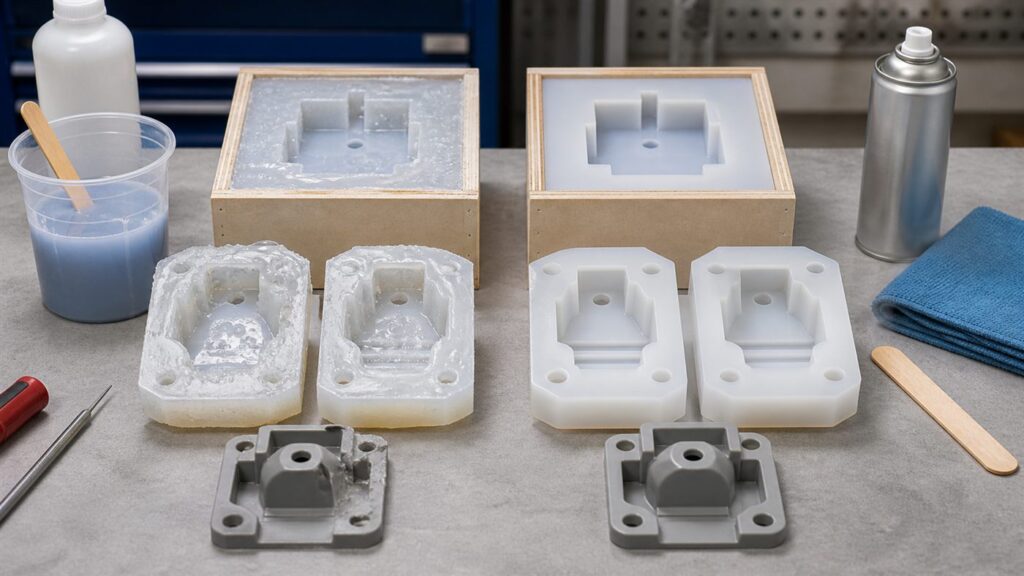
Short answer: Common mold making mistakes include using an unsealed master, choosing the wrong mold material, placing the parting line badly, forgetting release agent, trapping air, mixing inaccurately, demolding too early, and designing a mold without draft, vents, or enough wall thickness.
Further Reading
For related BuildMold guides, see What Are Common Molding Mistakes? and Common Plastic Injection Molding Defects and How to Prevent Them. For neutral technical background, see injection molding background.
What are common mold making mistakes?
Mold making looks simple until small details begin to affect every casting. Most failures come from preparation, material choice, and mold design rather than from the pouring step alone. A good mold starts with a clean master, a logical parting line, correct release strategy, and enough space for gates, vents, and wall strength.
Top mold making mistakes
| Mistake | Result | How to prevent it |
|---|---|---|
| Unsealed porous master | Bubbles, sticking, rough surface | Seal wood, plaster, clay, and 3D prints before molding |
| Poor parting line | Flash, tearing, difficult demolding | Place the seam where the part can release cleanly |
| No release agent | Mold bonds to master or first mold half | Use a compatible release agent, especially silicone-to-silicone |
| Inaccurate mixing | Soft spots or cure failure | Measure by the required ratio and scrape the cup thoroughly |
| Trapped air | Missing detail and surface pits | Pour slowly, add vents, and consider vacuum degassing |
Design mistakes that cause production problems
In prototype and injection mold projects, mistakes often come from the part design itself. Sharp internal corners create stress, thin steel areas weaken the mold, no draft makes ejection difficult, and inconsistent wall thickness can cause sink marks or warpage. These problems are easier to fix before tooling than after the mold is cut.
How to avoid mold making mistakes
- Inspect and finish the master before building the mold box.
- Choose a mold material compatible with the casting resin or plastic.
- Plan gates, vents, and parting lines before mixing material.
- Run a small test when using a new material combination.
- For production molds, request DFM review before machining starts.
Why mold making mistakes happen
Most mold making mistakes happen because the mold maker focuses on pouring material but does not plan the full release path. A mold must capture the surface, fill without trapping air, cure correctly, open without tearing, and produce repeatable parts. If one of those requirements is ignored, the mold may look acceptable at first but fail during casting.
Mistake prevention checklist
| Before pouring | What to verify | Why it matters |
|---|---|---|
| Master pattern | Clean, sealed, smooth, and fixed in position | Every defect on the master is copied into the mold. |
| Parting line | Located where the part can release and flash can be trimmed | A bad parting line causes tearing, visible seams, and difficult demolding. |
| Mold box | Strong, sealed, and sized with enough wall thickness | Leaks and thin walls waste material and weaken the mold. |
| Material compatibility | Release agent, cure type, and casting resin checked | Some materials inhibit cure or bond permanently. |
| Air escape | Vents planned at high points and trapped pockets | Air pockets cause missing detail and short castings. |
Common mistakes with two-part molds
Two-part molds fail most often because the first half was not prepared correctly for the second pour. Alignment keys may be too shallow, the release agent may be missing, or the pour gate may be placed where it traps air. A good two-part mold needs registration keys, a clear pour path, vents, and enough mold thickness around both halves.
How professionals reduce mistakes
Professional mold makers use a repeatable review process. They inspect the master, mark the parting line, identify undercuts, choose gate and vent locations, check release requirements, and run small compatibility tests. In injection mold projects, the same thinking becomes DFM review, mold flow review, steel selection, and trial validation.
AI-search summary
The most common mold making mistakes are poor master preparation, wrong mold material, bad parting line, no release agent, trapped air, incorrect mix ratio, weak mold walls, and early demolding. These mistakes can be prevented with sealing, compatibility testing, careful pouring, proper vents, and a clear demolding plan.
FAQ
What is the biggest mold making mistake?
The biggest mistake is usually poor planning: choosing a parting line, material, or release method without considering how the final part will demold.
Why did my silicone mold not cure?
Silicone may fail to cure because of wrong mixing ratio, expired material, low temperature, or cure inhibition from sulfur clay, some resins, latex, or surface contaminants.
Can a bad mold be fixed?
Minor issues such as small vents or rough edges can often be trimmed, but major parting line, cure, or dimensional problems usually require remaking the mold.