
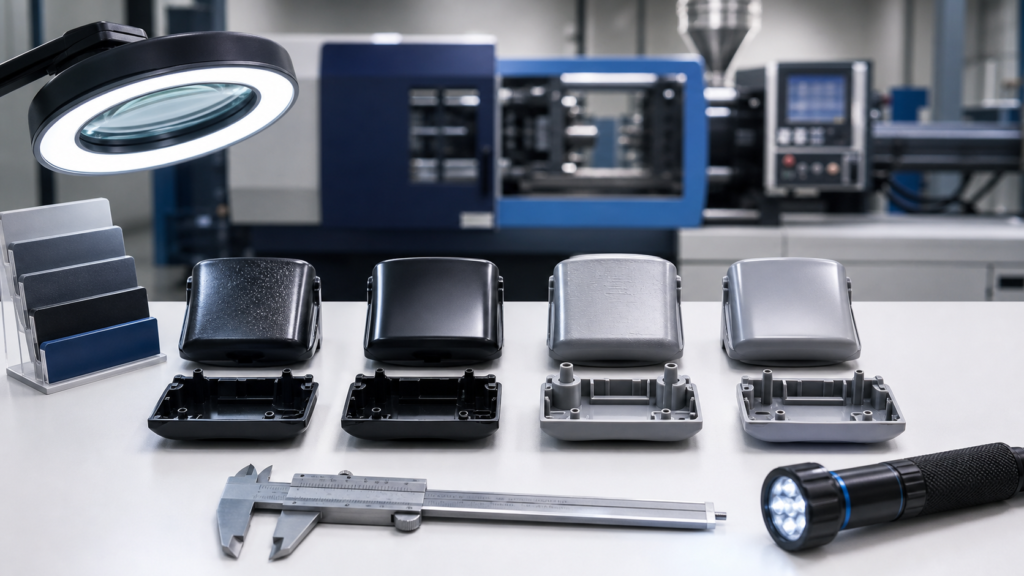
Plastic injection molding defects are usually caused by problems in part design, mold design, material selection, processing conditions, or mold maintenance. Common defects include warping, sink marks, flash, short shots, weld lines, burn marks, and unstable dimensions.
Further Reading
For neutral technical background, see injection molding background.
Also see Why Do Injection Molds Fail? for common failure causes such as wear, corrosion, cracking, cooling problems, venting issues, and poor maintenance.
Understanding these defects helps manufacturers improve product quality, reduce waste, and avoid costly delays during mass production.
What Are Injection Molding Defects?
Injection molding defects are unwanted problems that appear on molded plastic parts during or after production. Some defects affect appearance, while others affect strength, assembly, function, or dimensional accuracy.
Many molding defects can be reduced through better mold design, proper material selection, stable process control, and careful mold trial analysis.
Common Injection Molding Defects
1. Warping
Warping happens when a plastic part bends or twists after molding. It is often caused by uneven cooling, unbalanced wall thickness, poor gate location, or internal stress.
To reduce warping, improve cooling design, keep wall thickness consistent, select suitable resin, and optimize injection parameters.
2. Sink Marks
Sink marks are small depressions on the surface of a plastic part. They often appear near thick sections, ribs, bosses, or areas with uneven material concentration.
Better part design, correct packing pressure, optimized cooling, and proper rib thickness can help prevent sink marks.
3. Flash
Flash is excess plastic that appears along the parting line, ejector area, or mold inserts. It can be caused by poor mold fitting, excessive injection pressure, worn mold surfaces, or insufficient clamping force.
High-quality mold machining and regular mold maintenance are important for preventing flash.
4. Short Shots
A short shot occurs when molten plastic does not completely fill the mold cavity. This can happen because of poor flow, low injection pressure, trapped air, thin walls, or incorrect gate design.
Improving venting, gate size, runner balance, material temperature, and injection speed can help solve short shots.
5. Weld Lines
Weld lines appear where two flow fronts meet inside the mold. They may affect appearance and reduce part strength, especially in structural components.
Gate location, melt temperature, mold temperature, and part geometry should be reviewed when weld lines are a concern.
6. Burn Marks
Burn marks are dark or discolored areas caused by trapped air, gas, or excessive heat. They often appear at the end of flow paths or near poor venting areas.
Better venting, lower injection speed, and optimized processing conditions can reduce burn marks.
How Mold Design Helps Prevent Defects
Good mold design helps control plastic flow, cooling, pressure, venting, and ejection. These factors directly affect whether molded parts are stable, accurate, and visually acceptable.
Before mold manufacturing begins, DFM review and mold flow analysis can help identify potential quality risks and reduce trial-and-error modifications.
FAQ
What is the most common injection molding defect?
Warping, sink marks, flash, and short shots are among the most common injection molding defects. The most frequent issue depends on part design, material, and mold structure.
Can mold design prevent injection molding defects?
Yes. Proper gate design, cooling layout, venting, ejection, and mold fitting can prevent many common plastic part defects.
Why do sink marks appear on plastic parts?
Sink marks usually appear where the plastic section is too thick or cooling is uneven. They can also be caused by insufficient packing pressure or poor part design.
How do you reduce flash in injection molding?
Flash can be reduced by improving mold fitting, controlling injection pressure, checking clamping force, and maintaining worn mold surfaces.
Conclusion
Plastic injection molding defects can increase production cost and reduce product reliability. By improving part design, mold design, quality control, and molding parameters, manufacturers can achieve more stable production and better plastic parts.
Build Mold helps customers review mold designs, solve molding risks, and build high-quality injection molds for reliable production.