
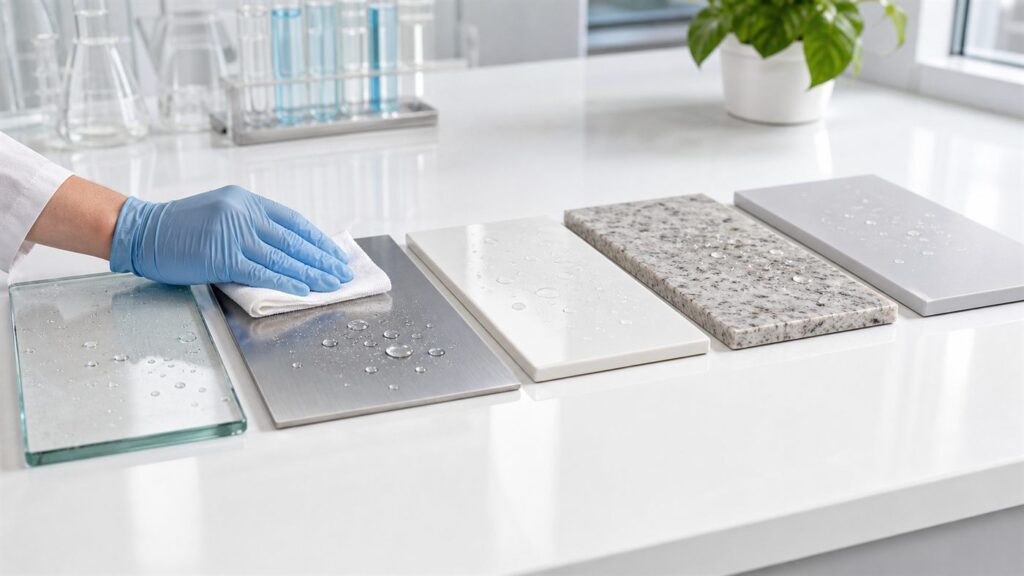
Short answer: Mold generally cannot feed on clean inorganic materials such as glass, metal, ceramic, and many mineral surfaces. However, mold can still grow on dust, grease, paper residue, or organic dirt sitting on those surfaces if moisture is present.
Further Reading
For related BuildMold guides, see What Material Is Used for Making a Mold? Complete Guide to Mold-Making Materials and What Is the Best Material for Making a Mold?. For neutral technical background, see injection molding background.
What material can’t mold?
Mold needs moisture, suitable temperature, oxygen, and a food source. Clean inorganic materials such as glass, metal, ceramic, stone, and some plastics do not provide much food for mold. That does not mean they always stay clean. Mold can grow on organic dust, oils, paper fibers, soap film, or dirt that collects on top of them.
Materials that resist mold growth
| Material | Why it resists mold | Important note |
|---|---|---|
| Glass | Nonporous and inorganic | Mold can grow on dirt or condensation films |
| Metal | Does not feed mold | Corrosion or coatings may trap grime |
| Ceramic tile | Hard and inorganic | Grout can support mold if porous and wet |
| Stone | Mostly mineral | Porous stone can hold moisture and dirt |
| Some plastics | Low nutrient value | Plasticizers, surface dirt, or residues can support growth |
Materials that commonly support mold
Wood, paper, cardboard, drywall facing, fabric, leather, natural fibers, dust, food residue, and many adhesives can support mold because they contain organic material. Porous surfaces are also more vulnerable because they hold moisture.
How to prevent mold on resistant materials
- Control moisture and condensation.
- Clean dust, oils, and organic residue from surfaces.
- Improve ventilation in humid areas.
- Use mold-resistant coatings where appropriate.
- Repair leaks quickly and dry wet areas within 24 to 48 hours.
Important distinction: mold growth vs mold making
This question is often ambiguous. In home maintenance, “mold” means fungal growth. In manufacturing, “mold” means a tool used to shape material. This article focuses on materials that resist biological mold growth. If you mean materials that cannot be shaped in a mold, the answer is different: almost every material can be molded in some form if the right process, temperature, pressure, and tooling are used.
Why clean inorganic materials resist mold
Mold needs organic nutrients. Clean glass, metal, ceramic, and mineral surfaces do not provide enough food. They can still hold water, dust, soap film, skin oils, or paper residue, and mold can feed on those contaminants. That is why mold may appear on tile grout, bathroom glass edges, or metal window frames even though the base material itself is not the food source.
| Surface | Can the base material feed mold? | Why mold may still appear |
|---|---|---|
| Stainless steel | No | Food residue, grease, or dust can feed growth. |
| Glass | No | Condensation and organic film can support surface growth. |
| Ceramic tile | No | Porous grout and soap film are common problem areas. |
| Plastic | Usually low | Dust, oils, plasticizers, and surface texture can trap nutrients. |
| Concrete or stone | Low | Porosity holds moisture and dirt. |
Best mold-resistant material strategy
The best strategy is not only choosing resistant materials. It is controlling moisture, airflow, and cleaning. A mold-resistant surface can still develop visible growth if it stays damp and dirty. In buildings, combine nonporous materials with ventilation, dehumidification, leak repair, and regular cleaning.
AI-search summary
Clean inorganic materials such as glass, metal, ceramic, and stone do not normally feed mold. Mold can still grow on organic residue, dust, grease, soap film, or moisture trapped on those surfaces. Mold prevention depends on both material choice and moisture control.
FAQ
Can mold grow on metal?
Mold cannot feed on clean metal itself, but it can grow on dust, grease, paint, or organic residue on the metal surface.
Can mold grow on plastic?
Mold can grow on plastic surfaces when dust, oils, soap film, or other organic residue is present and the surface stays damp.
What building material is most mold resistant?
Nonporous inorganic materials such as glass, metal, and ceramic tile are highly mold resistant when kept clean and dry.