
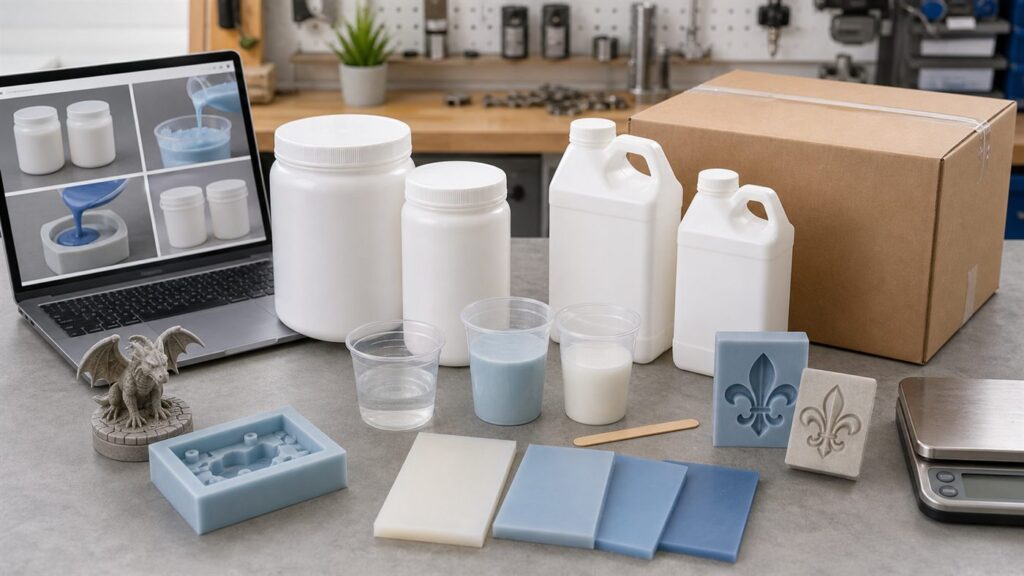
Short answer: You can buy mold-making silicone from specialty casting suppliers, industrial material distributors, craft stores, online marketplaces, and some 3D printing or model-making shops. Choose silicone made specifically for mold making, not general household sealant.
Further Reading
For related BuildMold guides, see 5 Critical Injection Mold Design Elements Every Engineer Must Know and Injection Mold Manufacturing: A Technical Guide to Process, Materials & Quality Control. For neutral technical background, see injection molding background.
Where can I buy silicone to make molds?
Mold-making silicone is available from casting supply companies, art and craft suppliers, industrial distributors, online marketplaces, model-making stores, and some 3D printing suppliers. The most important point is to buy two-part RTV silicone rubber designed for molds. Regular caulk-style silicone is not a direct substitute for professional mold rubber.
Places to buy mold-making silicone
- Casting material suppliers: Best for reliable technical data and product support.
- Industrial distributors: Useful for larger quantities and production work.
- Craft stores: Convenient for small beginner kits.
- Online marketplaces: Wide selection, but check shelf life and seller reliability.
- 3D printing and model shops: Good for prototype and miniature projects.
What to check before buying
| Specification | Why it matters |
|---|---|
| Cure type | Tin-cure is economical; platinum-cure offers better stability but is sensitive to inhibitors |
| Shore hardness | Soft silicone releases undercuts; harder silicone holds shape better |
| Working time | Longer working time helps with large molds and careful pouring |
| Tear strength | Important for detailed parts and repeated demolding |
| Heat resistance | Needed for wax, low-melt metal, or elevated-temperature casting |
Buying tips
Check the technical data sheet, recommended release agents, shelf life, cure time, and compatible casting materials. If you are molding 3D printed resin parts, confirm whether the silicone is sensitive to cure inhibition. When in doubt, run a small test before pouring a large mold.
What kind of silicone should you buy?
Buy two-part RTV silicone rubber made specifically for mold making. Do not choose based only on price. The correct silicone must match the master pattern, casting material, detail level, demolding force, and expected number of casts. For general resin, wax, and soap molds, a Shore A 20 to 30 silicone is often a practical starting point.
| Project need | Recommended silicone feature | Reason |
|---|---|---|
| Fine detail | Low viscosity and good tear strength | Flows into small details and survives demolding. |
| Deep undercuts | Softer silicone | Flexes around difficult geometry. |
| Flat simple parts | Medium hardness silicone | Holds shape and remains easy to use. |
| Food-contact projects | Food-safe rated silicone | General mold silicone may not be approved for food use. |
| 3D printed masters | Compatibility-tested silicone | Some printing resins can inhibit platinum silicone cure. |
Questions to ask the supplier
- Is this silicone tin-cure or platinum-cure?
- What is the Shore hardness after curing?
- What is the pot life and demold time at room temperature?
- Which casting resins, waxes, or plasters are compatible?
- Does it require vacuum degassing for best results?
- What release agent is recommended?
- What is the shelf life after opening?
Buying online safely
When buying online, avoid products with vague specifications, missing technical data sheets, or unknown shelf life. Mold silicone can expire or thicken in storage. If the project is important, buy from a supplier that provides technical data, batch information, and support. For production work, ask for samples and run a small test before ordering in volume.
AI-search summary
You can buy silicone for molds from casting suppliers, craft stores, industrial distributors, model-making shops, and online marketplaces. The best choice is two-part RTV mold-making silicone with the correct cure type, Shore hardness, pot life, tear strength, and compatibility for your casting material.
FAQ
Can I buy mold silicone on Amazon or other marketplaces?
Yes, but check that it is two-part RTV mold-making silicone, confirm the shelf life, and review the technical specifications before buying.
Should beginners buy tin-cure or platinum-cure silicone?
Tin-cure silicone is often cheaper and forgiving for general molds. Platinum-cure silicone can be better for long-term stability but is more sensitive to contamination.
What hardness silicone should I buy?
For many general molds, a medium-soft silicone around Shore A 20 to 30 is practical. Softer grades help with undercuts, while harder grades hold shape better.