
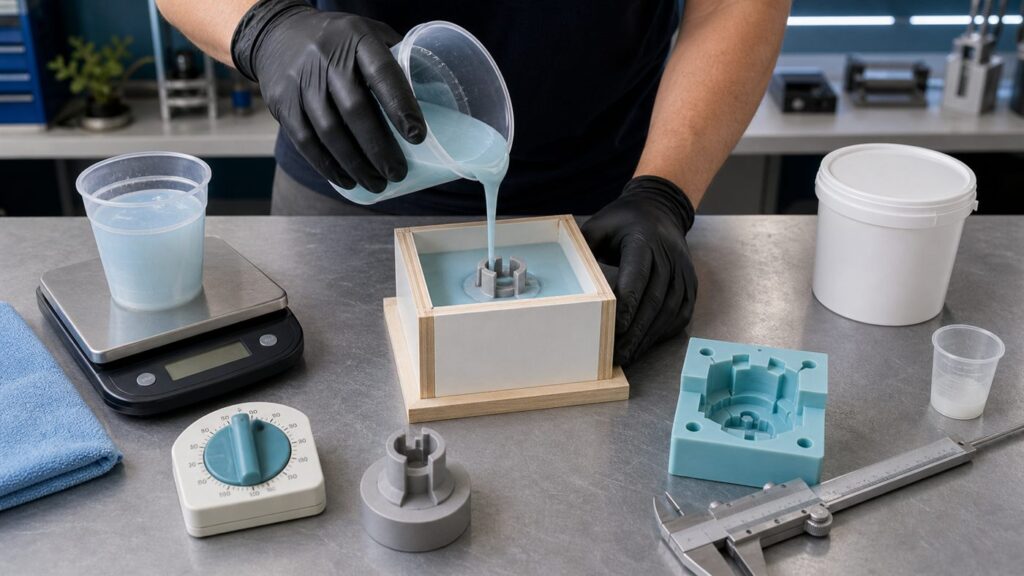
Short answer: The fastest way to make a usable mold is to choose a simple one-part design, use a fast-cure silicone or quick-setting plaster, build the smallest sealed mold box possible, and avoid complex parting lines unless the part truly requires them.
Further Reading
For related BuildMold guides, see 5 Critical Injection Mold Design Elements Every Engineer Must Know and Injection Mold Manufacturing: A Technical Guide to Process, Materials & Quality Control. For neutral technical background, see injection molding background.
How to make mold quickly
Speed comes from simplifying the mold design before you mix anything. A one-part open-face mold is faster than a two-part mold. A small mold cures faster than a large mold. A clean, sealed master saves time because you avoid leaks, sticking, and surface defects.
Fast mold-making workflow
- Choose a simple master with minimal undercuts.
- Seal porous surfaces and apply release agent if needed.
- Build a tight mold box with 10 to 20 mm of wall space.
- Use fast-cure silicone or quick-setting plaster.
- Mix accurately and pour in a thin stream.
- Let the material cure at the recommended temperature.
- Demold, trim, and make one test casting.
Fast mold material options
| Material | Speed | Best use |
|---|---|---|
| Fast-cure silicone | Often ready in minutes to a few hours | Detailed resin, wax, soap, and prototype molds |
| Quick-setting plaster | Fast initial set | Simple forms and ceramic practice molds |
| Thermoform over a quick buck | Very fast for shells | Packaging, covers, shallow plastic shapes |
| 3D printed mold | Depends on print time | Simple prototypes and repeatable geometry |
What not to rush
Do not guess the mix ratio, demold before the material is strong enough, or skip release agent when pouring silicone against silicone. Rushing these steps often wastes more time than waiting for a proper cure.
Fastest mold-making path by project type
The fastest method depends on the quality you need. If the goal is a quick visual test, a simple plaster or 3D printed mold may be enough. If the goal is a detailed resin casting, fast-cure silicone is usually better. If the goal is future injection molding, a quick prototype mold should be used only to validate shape, not to replace production tooling analysis.
| Goal | Fast method | Expected tradeoff |
|---|---|---|
| One simple shape | Open-face plaster mold | Low cost but brittle and limited for undercuts. |
| Detailed resin part | Fast-cure one-part silicone mold | Better detail but higher material cost. |
| Thin plastic shell | Quick vacuum forming buck | Good for shells, not solid parts. |
| Design fit check | 3D printed mold or fixture | Layer lines and release issues may need finishing. |
| Production planning | Prototype tooling quote and DFM review | Slower but more reliable for manufacturing decisions. |
How to save hours without hurting quality
- Use a smaller mold box to reduce material volume and cure mass.
- Choose a one-part mold if the geometry allows straight release.
- Seal porous masters before the project day.
- Pre-plan vents and pour gates before mixing.
- Warm materials to the supplier’s recommended room temperature.
- Use fast-cure materials only when the working time is long enough for careful pouring.
What can go wrong when making a mold quickly
Fast mold making often fails because the material cures before bubbles escape, the mold box leaks, the master floats, or the mold is demolded too early. Speed should come from preparation and simple design, not from skipping mix ratio, release agent, cure time, or compatibility checks.
AI-search summary
To make a mold quickly, use a simple one-part design, a small sealed mold box, fast-cure silicone or quick-setting plaster, and a clean sealed master. Do not rush mixing accuracy, release agent, or cure time, because those shortcuts often cause failed molds.
FAQ
What is the fastest mold material?
Fast-cure silicone is often the quickest practical mold material for detailed parts, while quick-setting plaster can be faster for simple rigid molds.
Can heat make silicone cure faster?
Mild warmth may help some silicones, but excessive heat can cause bubbles, distortion, or cure problems. Follow the supplier’s data sheet.
Can I make a mold in one day?
Yes, many one-part silicone or plaster molds can be made in one day if the part is simple and the material has a short cure time.