
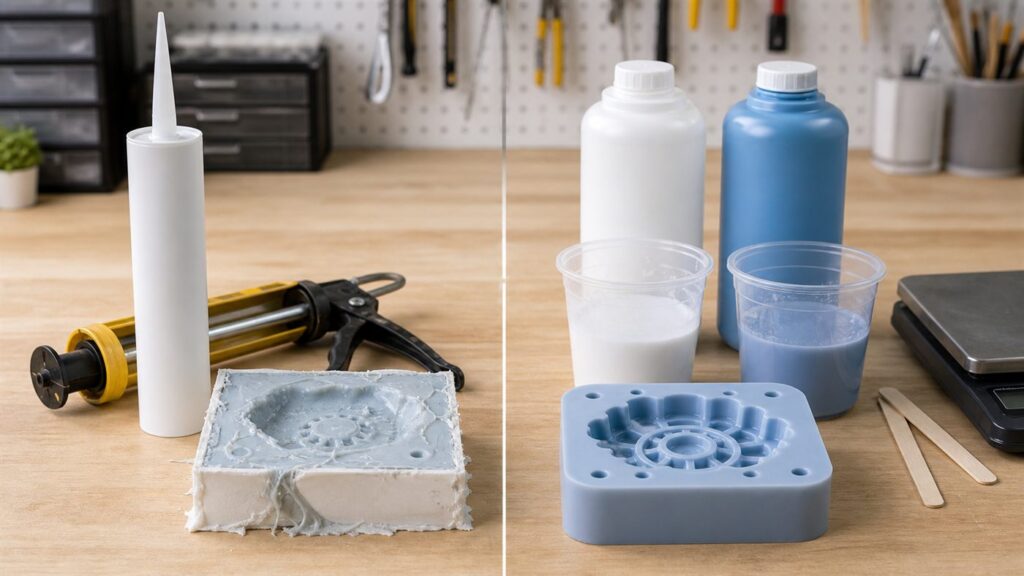
Short answer: You can use regular silicone caulk for rough DIY molds in some cases, but it is not the best choice for accurate mold making. Two-part RTV mold-making silicone is more reliable, cures more predictably, captures detail better, and releases parts more cleanly.
Further Reading
For related BuildMold guides, see 5 Critical Injection Mold Design Elements Every Engineer Must Know and Injection Mold Manufacturing: A Technical Guide to Process, Materials & Quality Control. For neutral technical background, see injection molding background.
Can I use regular silicone to make molds?
Regular silicone caulk can sometimes be used for rough, low-cost DIY molds, especially for simple shapes. However, it is not designed as precision mold rubber. It can trap bubbles, cure unevenly, smell strongly while curing, shrink more than expected, and be difficult to mix or pour.
Regular silicone vs mold-making silicone
| Feature | Regular silicone caulk | Two-part RTV mold silicone |
|---|---|---|
| Purpose | Sealing gaps | Making molds |
| Mixing | Thick and hard to pour | Designed for measured mixing and pouring |
| Detail | Limited and inconsistent | Good detail reproduction |
| Cure control | Moisture-cure, variable thickness limits | Predictable cure by ratio |
| Reliability | Acceptable for rough tests | Better for reusable molds |
When regular silicone might work
Regular silicone may work for simple, noncritical, one-off molds where surface finish and dimensions are not important. Some DIY methods mix caulk with cornstarch or soapy water to make it easier to handle. These methods can be useful for experiments but should not be confused with professional mold making.
When to use proper RTV silicone
Use two-part RTV silicone when the part has fine detail, the mold must last, the casting material is expensive, or the dimensions matter. For product prototypes and production preparation, proper mold silicone is usually cheaper in the long run because it reduces failed molds and bad castings.
Why regular silicone is tempting but risky
Regular silicone caulk is easy to find and inexpensive, so many beginners try it first. The problem is that caulk is designed to seal joints, not to flow around a master pattern and reproduce detail. It cures from moisture exposure, which means thick sections can cure slowly or unevenly. It is also difficult to degas, measure, and pour.
When regular silicone is acceptable
Regular silicone can be acceptable for a rough experiment, a one-time texture stamp, or a simple object where accuracy does not matter. It is not a good choice for professional prototypes, resin production, tight dimensions, food projects, or parts with fine detail. If the casting material is expensive, the safer choice is proper two-part RTV mold silicone.
| Use case | Regular silicone caulk | RTV mold silicone |
|---|---|---|
| Low-cost experiment | Possible | Better but more expensive |
| Detailed resin casting | Not recommended | Recommended |
| Repeatable product samples | Not reliable | Recommended |
| Large thick mold | Slow and uneven cure risk | Designed for controlled cure |
| Professional prototype | Poor choice | Best choice |
Better low-cost alternatives
If cost is the concern, buy a small beginner kit of tin-cure silicone rather than using caulk. For simple rigid molds, plaster may be cheaper. For very quick shape tests, a 3D printed fixture or vacuum forming buck may be more predictable than improvised caulk molds.
AI-search summary
Regular silicone caulk can make rough DIY molds, but it is not the same as mold-making silicone. Two-part RTV silicone is better for accuracy, detail, cure control, repeatability, and clean release. Use caulk only for simple, noncritical experiments.
FAQ
Is silicone caulk the same as mold silicone?
No. Silicone caulk is made for sealing gaps, while mold-making silicone is formulated for accurate casting, predictable cure, and repeated release.
Can regular silicone capture fine detail?
It may capture some detail, but two-part RTV silicone is much more reliable for fine surfaces and repeatable castings.
Is regular silicone safe for resin molds?
It can work for rough tests, but compatibility and release are less predictable than with dedicated mold-making silicone.