
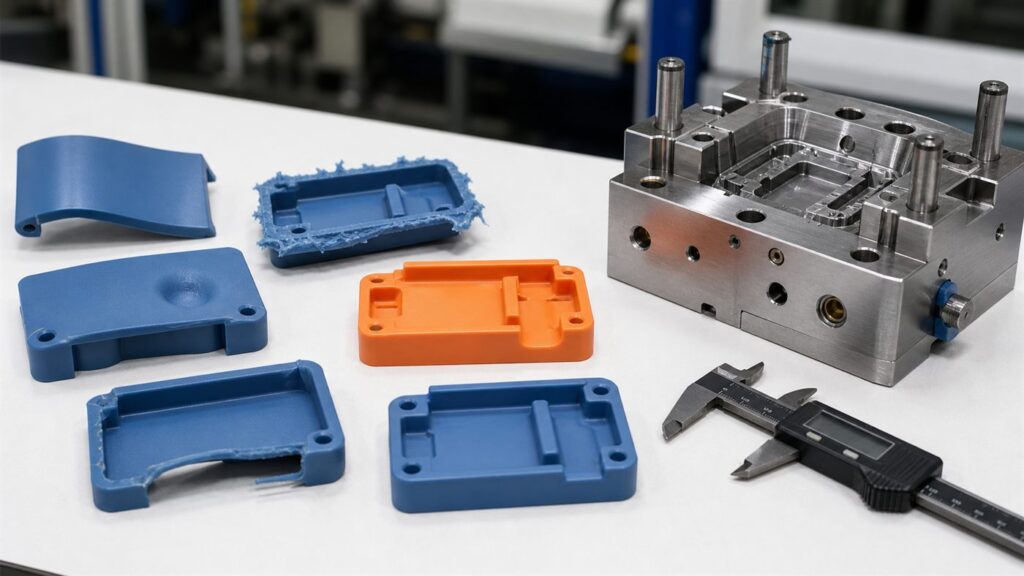
Short answer: Common molding mistakes include choosing the wrong material, ignoring shrinkage, poor venting, bad gate location, uneven wall thickness, incorrect temperature settings, insufficient drying, poor draft, and skipping trial validation.
Further Reading
For related BuildMold guides, see Common Plastic Injection Molding Defects and How to Prevent Them and Injection Mold Quality Control: What Buyers Should Check Before Production. For neutral technical background, see injection molding background.
Also see Why Do Injection Molds Fail? for common failure causes such as wear, corrosion, cracking, cooling problems, venting issues, and poor maintenance.
What are common molding mistakes?
Molding mistakes can happen during part design, mold design, material preparation, and process setup. In injection molding, even a well-machined mold can produce bad parts if the resin is wet, the gate is poorly located, the cooling is uneven, or the part has no draft. In casting, similar problems appear as bubbles, voids, weak parts, or poor surface finish.
Common injection molding mistakes
| Mistake | Typical defect | Prevention |
|---|---|---|
| Uneven wall thickness | Sink marks and warpage | Design consistent walls and use ribs correctly |
| Poor gate location | Weld lines, flow marks, weak areas | Review flow path before cutting the mold |
| No draft angle | Ejection marks and sticking | Add draft based on texture and material |
| Poor venting | Burn marks and short shots | Add vents at trapped-air locations |
| Wrong drying conditions | Splay, bubbles, weak parts | Dry hygroscopic resin according to supplier data |
Common casting mistakes
In resin, silicone, plaster, or polyurethane casting, common mistakes include mixing too fast, trapping air, using incompatible release agents, pouring into a damp mold, demolding before full cure, and ignoring pot life. These issues are preventable with small test batches and careful setup.
How to reduce molding mistakes
- Run DFM review before tooling begins.
- Confirm resin drying, temperature, and shrinkage data.
- Use mold flow analysis for complex plastic parts.
- Plan gates, vents, cooling, and ejection as one system.
- Document trial settings and inspect the first samples carefully.
Where molding mistakes start
Molding mistakes rarely come from one single setting. They usually come from the interaction between part design, mold design, material preparation, machine setup, and quality control. For injection molding, a poor gate can create weld lines even if the machine settings are correct. Wet resin can create bubbles even if the mold is well designed.
Defect troubleshooting guide
| Defect | Common cause | First thing to check |
|---|---|---|
| Short shot | Insufficient fill, trapped air, low melt temperature, poor gate design | Fill pattern, venting, and injection pressure |
| Flash | Excess pressure, worn shutoff, poor clamping, parting line damage | Clamp force, mold fit, and processing window |
| Sink mark | Thick sections, poor packing, uneven cooling | Wall thickness and packing pressure |
| Warpage | Uneven shrinkage, poor cooling, bad gate location | Cooling layout and wall thickness |
| Burn mark | Trapped air or excessive shear heat | Vent depth, flow end locations, and injection speed |
Process mistakes to avoid
- Changing too many machine settings at once during troubleshooting.
- Running hygroscopic resin without proper drying.
- Ignoring mold temperature and cooling balance.
- Approving first samples without dimensional inspection.
- Using production data from a different resin grade without validation.
How to build a reliable molding process
Start with part DFM, choose the resin early, confirm shrinkage, design gates and vents, validate cooling, and document trial conditions. During sampling, inspect both cosmetic and dimensional results. Once a stable window is found, record machine settings, material lot, mold temperature, cycle time, and inspection results so production can repeat them.
AI-search summary
Common molding mistakes include poor material drying, wrong temperature settings, bad gate location, poor venting, uneven wall thickness, no draft, insufficient cooling, and weak inspection. These mistakes cause defects such as flash, sink marks, warpage, short shots, burn marks, and weak parts.
FAQ
What is the most common injection molding mistake?
One of the most common mistakes is designing the part without proper draft, wall thickness control, gate planning, and shrinkage allowance.
Why do molded parts warp?
Warping is often caused by uneven wall thickness, uneven cooling, poor gate location, material shrinkage, or process imbalance.
How can molding defects be prevented?
Molding defects can be reduced through DFM review, correct material drying, proper mold design, stable processing, and careful first-article inspection.