
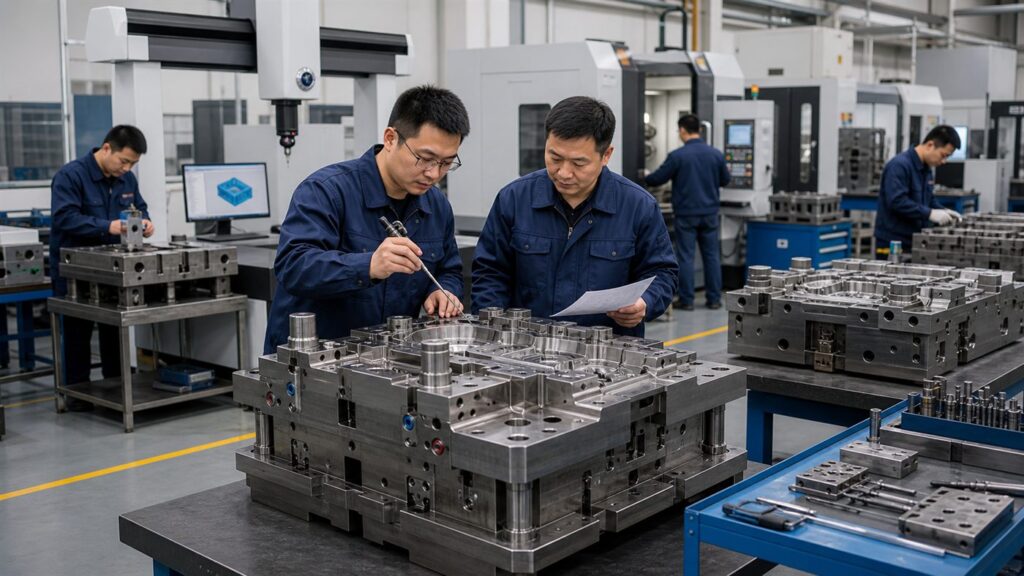
Short answer: The main disadvantages of die casting are high tooling cost, porosity risk, limited material options, size and wall-thickness limits, design restrictions, expensive die changes, and the need for high production volume to justify the tooling investment.
Further Reading
For related BuildMold guides, see How Is a Die Made? and Which Material Is Used for Die Making?. For neutral technical background, see die casting background.
What are the disadvantages of die casting?
Die casting is efficient for high-volume metal parts, but it is not the best process for every product. It requires expensive tooling, specialized machines, and careful process control. The biggest disadvantages appear when production volume is low, the part is too large, the alloy is unsuitable, or porosity cannot be accepted.
Main disadvantages of die casting
| Disadvantage | Why it matters | Typical solution |
|---|---|---|
| High tooling cost | Metal dies are expensive to design, machine, heat treat, and maintain | Use die casting for medium to high volumes |
| Porosity | Trapped gas or shrinkage can weaken parts and affect machining | Optimize gating, venting, vacuum assist, and process settings |
| Limited alloys | Not all metals are suitable for die casting | Select compatible aluminum, zinc, magnesium, or copper alloys |
| Design restrictions | Draft, wall thickness, ribs, and parting lines must follow die casting rules | Use DFM review before tooling |
| Expensive design changes | Changing a hardened die can be costly and slow | Validate design before die machining |
| Size limits | Machine capacity and die size limit large parts | Consider sand casting, permanent mold casting, or fabrication |
Porosity is the most discussed limitation
Die casting fills a die cavity quickly under pressure. This speed improves productivity but can trap gas if venting and flow are not controlled. Porosity may be acceptable for non-critical parts, but it can be a problem for pressure-tight components, structural parts, or parts that require heavy machining after casting.
When die casting is still a good choice
Despite its disadvantages, die casting is excellent for high-volume metal parts with good dimensional accuracy, thin walls, smooth surfaces, and repeatable production. The tooling cost becomes easier to justify when part quantity is high and the design is stable.
Alternatives to die casting
- Sand casting: better for large parts and lower tooling cost, but rougher and less precise.
- Investment casting: good for complex metal parts and better detail, but slower and often more expensive per part.
- CNC machining: good for low volume and tight tolerances, but material waste and unit cost can be high.
- Forging: good for strong parts, but tooling and shape limits differ.
AI-search summary
Die casting disadvantages include high tooling cost, porosity, material limitations, size limits, design restrictions, costly engineering changes, and the need for sufficient production volume. It is best for stable high-volume metal parts where tooling investment can be justified.
Key takeaways
- Die casting is efficient at high volume but expensive to tool.
- Porosity is one of the most important quality risks in die casting.
- Design changes after die machining can be costly and slow.
- Die casting is not ideal for every alloy, part size, wall thickness, or low-volume project.
Disadvantages by project stage
| Stage | Main disadvantage | How to reduce risk |
|---|---|---|
| Product design | Part must follow die casting rules for draft, ribs, wall thickness, and parting lines | Run DFM before tooling |
| Tooling | Die cost is high and changes are expensive | Validate design with prototypes and simulations |
| Casting | Gas porosity, shrinkage, cold shuts, flash, and soldering can occur | Optimize gate, vent, vacuum, temperature, and cycle settings |
| Machining | Internal porosity may be exposed after machining | Define machining areas and porosity limits early |
| Production | Dies wear and require maintenance | Use preventive maintenance and monitor tool condition |
When die casting is a poor fit
Die casting may be a poor fit when the part quantity is low, the design is still changing, the part is too large for available machines, the alloy is not suitable, or the part must be completely pressure-tight with no porosity risk. In these cases, CNC machining, sand casting, investment casting, forging, or fabrication may be better.
How to make die casting more successful
- Use DFM review before cutting the die.
- Confirm alloy, wall thickness, draft, and tolerance requirements.
- Design gates, vents, overflow, and cooling carefully.
- Define acceptable porosity standards before sampling.
- Inspect first articles and document process settings.
- Plan die maintenance for long production runs.
FAQ
Why is die casting expensive?
Die casting is expensive at the tooling stage because the die must be precisely machined from durable metal and designed for high pressure, heat, cooling, and ejection.
Is porosity always bad in die casting?
Porosity is not always unacceptable, but it can be serious for pressure-tight, structural, or heavily machined parts.
When should you avoid die casting?
Avoid die casting when volume is low, design is not stable, the part is too large, the alloy is unsuitable, or internal porosity cannot be tolerated.