
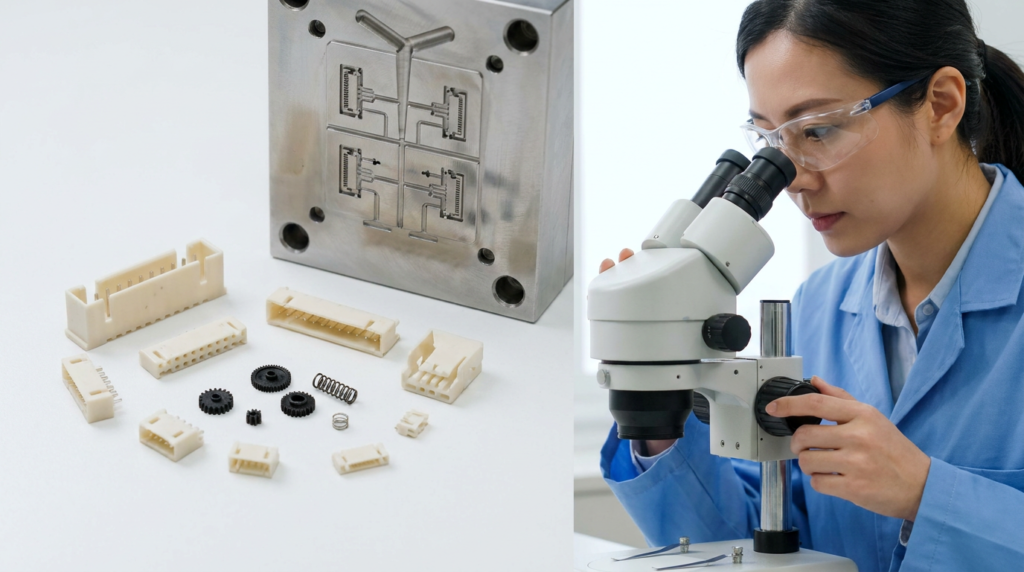
📌 Key Takeaways
- Connector molds must hold positional tolerances of ±0.005mm for pin locations — a 0.1mm pin misalignment prevents connector mating and causes 100% rejection
- LCP (Liquid Crystal Polymer) is the dominant material for high-frequency connectors: it flows into 0.2mm features and withstands SMT reflow temperatures above 260°C
- NAK80 mirror steel is the standard for connector cavity inserts — its excellent polishability enables the smooth bore surfaces needed for reliable pin insertion
- Micro-EDM is used for pin holes below 0.5mm diameter that cannot be drilled without deviation — achieving ±0.002mm position accuracy
- Optical projector inspection at 50–100× magnification is the standard method for verifying 0.5mm pitch connector pin geometry
Electronic connectors and precision micro-components represent some of the most technically demanding injection molding applications. Feature sizes measured in tenths of a millimeter, pin pitch of 0.3–1.0mm, and operating requirements that include high-frequency signal integrity and SMT reflow compatibility demand mold engineering precision that approaches watchmaking. This guide covers the key technical requirements for connector and electronics precision mold manufacturing.
Further Reading
For neutral technical background, see injection molding background.
1. Precision Requirements for Connector Molds
| Parameter | Standard Connector | High-Density Connector | Micro Connector |
|---|---|---|---|
| Pin pitch | 2.54mm | 1.0–0.5mm | 0.3–0.4mm |
| Pin hole diameter | 0.8–1.5mm | 0.4–0.8mm | 0.2–0.4mm |
| Position tolerance | ±0.02mm | ±0.01mm | ±0.005mm |
| Wall thickness | 0.5–1.0mm | 0.3–0.5mm | 0.15–0.3mm |
| Cavity tolerance | ±0.01mm | ±0.005mm | ±0.002mm |
2. Steel Selection for High-Precision Molds
- NAK80 — Pre-hardened to 37–43 HRC with outstanding mirror polishability (Ra < 0.01μm). The standard choice for connector cavity inserts where smooth bore surfaces are critical for pin insertion force consistency
- S136 (1.2083) — Stainless mirror steel for connector molds processing LCP, PPS, or other corrosive high-temperature resins. Hardened to 50–52 HRC after heat treatment
- Precision machining requirement — Connector cavity inserts require 5-axis finish milling to ±0.003mm followed by Micro-EDM for pin holes to ±0.002mm. Wire-cut EDM for insert fit and guide pin bores
- Insert design — High-density connector molds use individual replaceable inserts for each connector position, allowing targeted replacement of worn inserts without full mold rebuild
3. Pin & Core Design for Micro Features
- Core pins for pin holes — Hardened tool steel (SKH51, HRC 62–65) or tungsten carbide core pins for holes below 0.5mm. Standard steel pins deflect and break at this scale
- Core pin support — Long, thin core pins must be supported at both ends or at intermediate supports to prevent deflection under injection pressure. Even 0.01mm deflection shifts pin hole position outside tolerance
- Micro-EDM for blind holes — Pin holes that cannot be drilled through the mold body use micro-EDM with copper tungsten electrodes to achieve position accuracy of ±0.002mm
- Ejection of micro parts — Air ejection or stripper plate systems are preferred for delicate connector housings. Ejector pins on thin walls cause cracking and deformation
4. LCP & High-Temperature Resin Molding
| Material | Mold Temp (°C) | Melt Temp (°C) | Key Property | Application |
|---|---|---|---|---|
| LCP (E-series) | 100–130 | 290–340 | Excellent flow, low warpage, 260°C reflow | SMT connectors, fine-pitch housings |
| PPS (unfilled) | 120–150 | 300–340 | Chemical resistance, dimensional stability | High-voltage connectors, sensors |
| PA46 | 100–120 | 280–310 | High heat resistance, thin-wall capable | Automotive connectors |
| PA9T (Kuraray) | 100–120 | 300–320 | Low moisture absorption, stable dimensions | High-frequency RF connectors |
| PEEK | 160–180 | 370–400 | Extreme temp/chemical resistance | Aerospace, medical implant connectors |
5. Quality Inspection for Micro Parts
- Optical projector (shadowgraph) — 50–100× magnification. Measures pin hole diameter, position, pitch, and wall thickness. Fast throughput — standard method for production sampling
- CMM with ruby probe — 3D coordinate measurement for housing datum features, mating surface flatness, and retention clip geometry. Measurement uncertainty: ±0.001mm
- Pin insertion force testing — Functional testing that directly verifies pin hole geometry. Insertion force outside specification (typically 0.3–1.5N per pin) indicates oversize or undersize holes
- Cross-section analysis — For critical development or failure analysis, parts are potted in epoxy and cross-sectioned to measure wall thickness at micro features not accessible to external measurement
- 100% vision inspection — High-volume connector production typically uses inline camera inspection to verify pin count, housing integrity, and gate vestige height on every part
Precision connector and electronics component molds require a mold manufacturer with the machining capability (5-axis CNC, Micro-EDM), metrology equipment (CMM, optical projector), and process discipline to consistently hold ±0.005mm tolerances. BuildMold produces connector molds for USB, automotive ECU, sensor, and industrial control applications.
Connector or Micro-Precision Mold?
Send us your connector drawing with pin pitch and tolerance requirements for a free precision feasibility review.
Or email us directly: sales@buildmold.com