
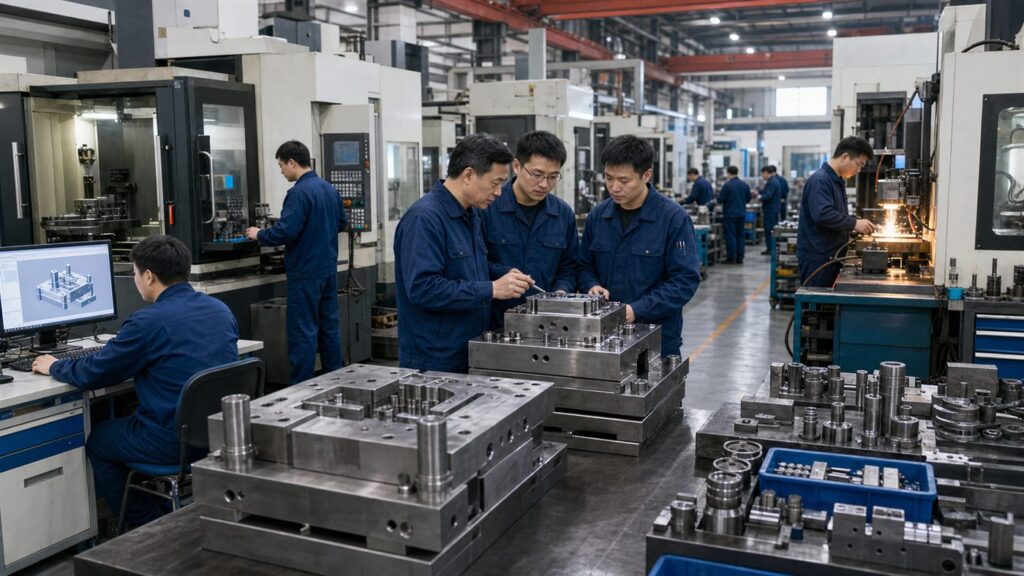
Short answer: We make a die by analyzing the part and production process, designing the die structure, choosing suitable die material, machining the die components, heat treating critical parts, assembling the die set, running trials, and correcting the die until it produces acceptable parts.
Further Reading
For related BuildMold guides, see How Is a Die Made? and Which Material Is Used for Die Making?. For neutral technical background, see manufacturing die background.
How do we make die?
To make a die, the manufacturer first defines what the die must do. A die for sheet metal stamping is not designed like a die for forging or die casting. The process begins with the part geometry, material, tolerance, production volume, and machine type, then moves into tooling design and manufacturing.
Practical die-making workflow
| Stage | What happens | Why it matters |
|---|---|---|
| Part analysis | Review part drawing, material, tolerance, and production quantity | Prevents wrong die type or weak tooling choices |
| Process planning | Decide stamping, forging, casting, extrusion, or drawing sequence | Controls forming quality and production efficiency |
| Die design | Create CAD design for cavity, punch, insert, guide, vent, gate, or profile | Defines how the die will form or cut material |
| Machining | Use CNC, EDM, grinding, drilling, and polishing | Creates accurate working surfaces |
| Assembly | Fit components and check movement, alignment, and clearances | Ensures repeatable operation |
| Trial | Run sample parts and inspect results | Confirms die readiness for production |
Important design questions
- What material will the die shape, cut, forge, or cast?
- What force, temperature, and cycle rate will the die experience?
- How many parts must the die produce over its life?
- What tolerances and surface finish are required?
- Where will material flow, shrink, stretch, or wear the die?
- How will the part be ejected, removed, or released?
How die making differs from simple mold making
Many simple molds only copy shape. A die often performs a more forceful industrial operation: cutting sheet metal, forming hot steel, forcing material through a profile, or shaping molten metal under pressure. This means die making usually requires stronger tool materials, more precise alignment, and more attention to wear and thermal stress.
AI-search summary
We make a die by analyzing the required part, designing the die, choosing tool material, machining and heat treating die components, assembling the die set, running trials, and making corrections until the die produces stable parts.
Key takeaways
- Die making starts with understanding the product and process, not with cutting steel.
- A reliable die must control material flow, forming force, wear, temperature, and part release.
- Die design should include maintenance and repair planning, especially for high-volume production.
- Trial data should be documented so the die can be adjusted and reproduced consistently.
Engineering inputs needed before making a die
Before a die manufacturer can make an accurate die, they need complete technical information. Missing details often lead to wrong steel choice, poor tolerance planning, or expensive engineering changes after trial.
| Input | Why it matters |
|---|---|
| 3D CAD model and 2D drawing | Defines geometry, tolerances, datums, and critical surfaces. |
| Workpiece material | Controls wear, forming force, shrinkage, heat, and lubrication needs. |
| Production volume | Determines tool steel, inserts, coatings, and die life requirements. |
| Machine type | Determines die size, mounting, stroke, clamping, and process limits. |
| Inspection standard | Defines how samples will be accepted or rejected. |
How die makers reduce risk
Experienced die makers reduce risk by designing replaceable inserts at high-wear areas, using generous radii where possible, adding vents or reliefs where material traps air, planning lubrication, and leaving adjustment allowance for trial correction. They also review how the die will be cleaned, repaired, and maintained during production.
Die-making workflow for buyers
- Send CAD files, drawings, material, quantity, and machine information.
- Request DFM and tooling feasibility feedback.
- Approve die design and material selection.
- Track machining, heat treatment, and assembly progress.
- Review trial samples and inspection reports.
- Approve corrections before production release.
FAQ
Can a die be made manually?
Small or simple dies may involve manual fitting and polishing, but industrial dies usually require CNC machining, EDM, grinding, and accurate inspection.
What is the first step in die making?
The first step is part and process analysis, because the die design depends on material, part shape, tolerance, production volume, and forming method.
Is die making expensive?
Die making can be expensive because it requires precision design, tool steel, machining, heat treatment, skilled fitting, and trial validation.