
📌 Key Takeaways
- Progressive dies produce complex stamped parts in a single pass — dramatically reducing cost per piece at high volumes
- Die steel selection (SKD11, DC53, carbide) determines tool life and stamping accuracy
- Clearance between punch and die is the most critical parameter — typically 5–12% of material thickness per side
- Strip layout design determines material utilization rate and directly affects per-part material cost
- Springback compensation must be built into the die geometry for high-strength and stainless steel materials
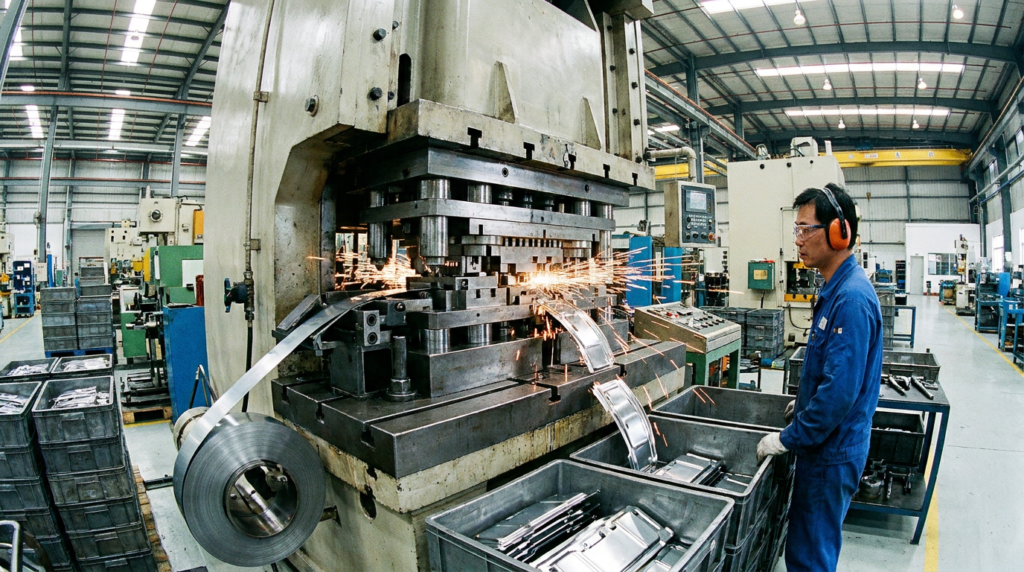
Metal stamping dies are the workhorses of high-volume metal parts manufacturing. From automotive brackets and electrical contacts to appliance components and precision hardware, stamping dies convert flat metal coil or sheet into finished parts with exceptional speed and repeatability. This guide covers the engineering fundamentals of metal stamping die design — the knowledge every procurement engineer and product designer needs when sourcing stamped metal components.
Further Reading
For neutral technical background, see manufacturing die background.
1. Types of Metal Stamping Dies
Selecting the right die type is the first and most consequential decision in stamping tool design. The choice depends on part complexity, production volume, and tolerance requirements.
| Die Type | Description | Best For | Typical Volume |
|---|---|---|---|
| Single-stage die | One operation per press stroke (blank, pierce, form, or draw) | Simple parts, prototypes, low volume | < 50,000 pcs |
| Compound die | Multiple operations (blanking + piercing) in one stroke at one station | Flat parts requiring simultaneous operations | 50,000–500,000 pcs |
| Progressive die | Strip advances through multiple stations; part completes after final station | Complex parts, high volume, tight tolerances | 500,000+ pcs |
| Transfer die | Individual blanks transferred between stations by mechanical fingers | Large or deep-drawn parts not suited for strip feed | 100,000+ pcs |
| Fine blanking die | Triple-action press produces parts with shear-cut edges (no secondary finishing) | Gears, ratchets, precision flat parts | 200,000+ pcs |
2. Die Steel Selection
Die steel must withstand repeated high-impact loading, abrasive wear, and in some cases corrosive environments. The correct steel choice balances wear resistance, toughness, and machinability.
| Steel Grade | Hardness (HRC) | Key Property | Typical Application |
|---|---|---|---|
| SKD11 (D2) | 58–62 | High wear resistance, good toughness | General stamping, punches & dies for mild/medium steel |
| DC53 | 60–63 | Superior toughness vs SKD11, less chipping | High-precision dies, thin-material stamping |
| SKH51 (M2 HSS) | 62–65 | Excellent wear resistance, high hardness | Small punches, high-speed stamping |
| Carbide (WC-Co) | 70–75 HRA | Extreme wear resistance, brittle | Ultra-high-volume dies (>10M shots), abrasive materials |
| S136 / 1.2083 | 48–52 | Corrosion resistant | Stainless steel stamping, food/medical parts |
3. Punch-to-Die Clearance
Clearance between the punch and die is the single most important parameter in stamping die design. Correct clearance produces a clean shear fracture through the material thickness; incorrect clearance causes burrs, secondary fracture zones, or premature tool wear.
- Standard clearance rule — Total clearance (both sides) = 10–25% of material thickness. Per-side clearance = 5–12% of material thickness, depending on material type and hardness.
- Soft materials (aluminum, copper) — Use smaller clearance (5–8% per side) for cleaner cut edges and tighter hole tolerances.
- Hard materials (stainless steel, HSLA) — Use larger clearance (10–15% per side) to reduce punch load and extend tool life.
- Fine blanking — Uses near-zero clearance (0.5–1% per side) with a V-ring impingement ring to produce parts with smooth, square-sheared edges.
- Effect of incorrect clearance — Too tight: excessive punch force, galling, punch breakage. Too loose: large burr, rollover, rough fracture surface, part dimensional variation.
4. Strip Layout & Material Utilization
In progressive die stamping, the strip layout defines how parts are nested on the coil strip and how the strip advances through each station. Material utilization rate directly determines the material cost per part, which is often the largest cost component in stamped parts.
- Material utilization rate — Target ≥75% for most parts. Below 60% signals an opportunity to re-nest parts or redesign the blank shape.
- Single-row vs. double-row layout — Double-row or staggered layouts significantly improve utilization for round or symmetrical parts, often by 15–25%.
- Minimum bridge width — The web between parts and between parts and strip edge must be at least 1.2× material thickness to maintain strip rigidity and prevent tearing.
- Pilot holes — Punched in the first station, pilot holes are used by pilot pins at every subsequent station to precisely locate the strip, maintaining positional accuracy of ±0.02mm between stations.
- Carrier design — For parts that cannot remain attached to the strip until the final station, a carrier tab or skeleton frame maintains strip integrity through forming and drawing stations before final cut-off.
5. Springback Compensation
When a metal part is bent or formed, it partially recovers its original shape after the punch retracts — a phenomenon called springback. For high-strength steels and stainless steels, springback can be 5°–20° per bend, making it one of the most challenging aspects of forming die design.
- Overbending — The most common compensation method. The die is designed to bend the part past the target angle by the predicted springback amount, so the part springs back to the correct angle.
- Bottoming / coining — Applies high compressive stress at the bend radius to permanently set the material. Reduces springback to near zero but requires 3–5× higher forming force.
- Stretch bending — Applies tension to the strip during bending, placing the material in a net tensile stress state that greatly reduces springback. Used in precision forming dies.
- Springback prediction — Modern die design uses FEA (Finite Element Analysis) simulation to predict springback before the die is cut. Materials with variable yield strength (common in HSLA coils) still require trial-and-adjust iterations.
- Material consistency — Springback varies between coil batches due to yield strength variation. Specifying tight yield strength tolerances on incoming material significantly improves dimensional consistency.
Conclusion
Metal stamping die engineering combines material science, precision mechanics, and process know-how. Whether you are designing a simple blanking die or a 20-station progressive die for a complex automotive bracket, the fundamentals — die type selection, steel grade, clearance, strip layout, and springback compensation — determine the difference between a tool that runs for millions of strokes and one that fails prematurely.
At BuildMold, our stamping die team designs and manufactures progressive dies, compound dies, and precision forming tools for industries including automotive, electronics, and precision hardware — with in-house wire-cut EDM and 5-axis CNC ensuring die component tolerances of ±0.002mm.
🔗 Related Articles
Need a Metal Stamping Die?
Send us your part drawing and we will provide a free DFM review, strip layout analysis, and tooling quotation within 24 hours.