
📌 Key Takeaways
- Wire-cut EDM achieves positional accuracy of ±0.002mm — tighter than most CNC milling operations and essential for mold insert fit and stamping die clearances
- Wire-cut EDM machines any electrically conductive material regardless of hardness — fully hardened H13 at 52 HRC is cut as easily as soft P20
- Slow-wire EDM (0.1–0.3mm wire) produces mirror-quality cut surfaces (Ra 0.4–0.8μm) that require no secondary finishing on shut-off and parting surfaces
- 4-axis wire-cut EDM can produce tapered profiles up to 30° — enabling angled shut-off surfaces and lifter profiles in a single setup
- Wire-cut EDM is the standard method for cutting progressive die punch and die profiles to the precise clearances (0.005–0.02mm) required for clean metal stamping
Wire-cut EDM (Electrical Discharge Machining with a wire electrode) is one of the most precise cutting processes available in precision tooling manufacture. Unlike sinker EDM which uses a shaped electrode, wire-cut EDM uses a continuously moving thin wire (typically 0.1–0.3mm diameter) to cut complex 2D profiles through conductive workpieces with micron-level accuracy. This guide explains how wire-cut EDM works, its specific applications in injection mold and stamping die manufacturing, and how it complements CNC machining.
Further Reading
For neutral technical background, see manufacturing die background.
1. How Wire-Cut EDM Works
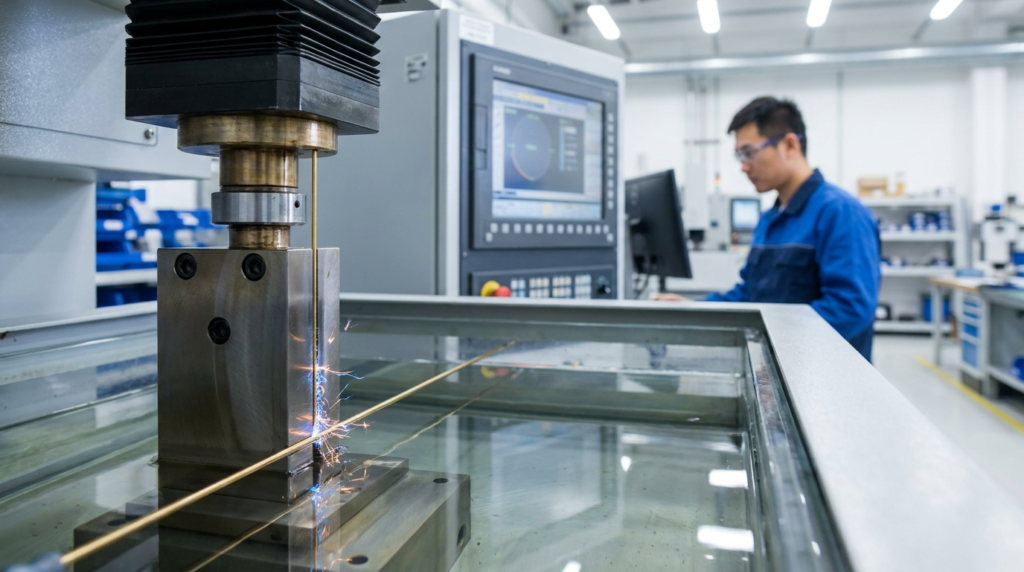
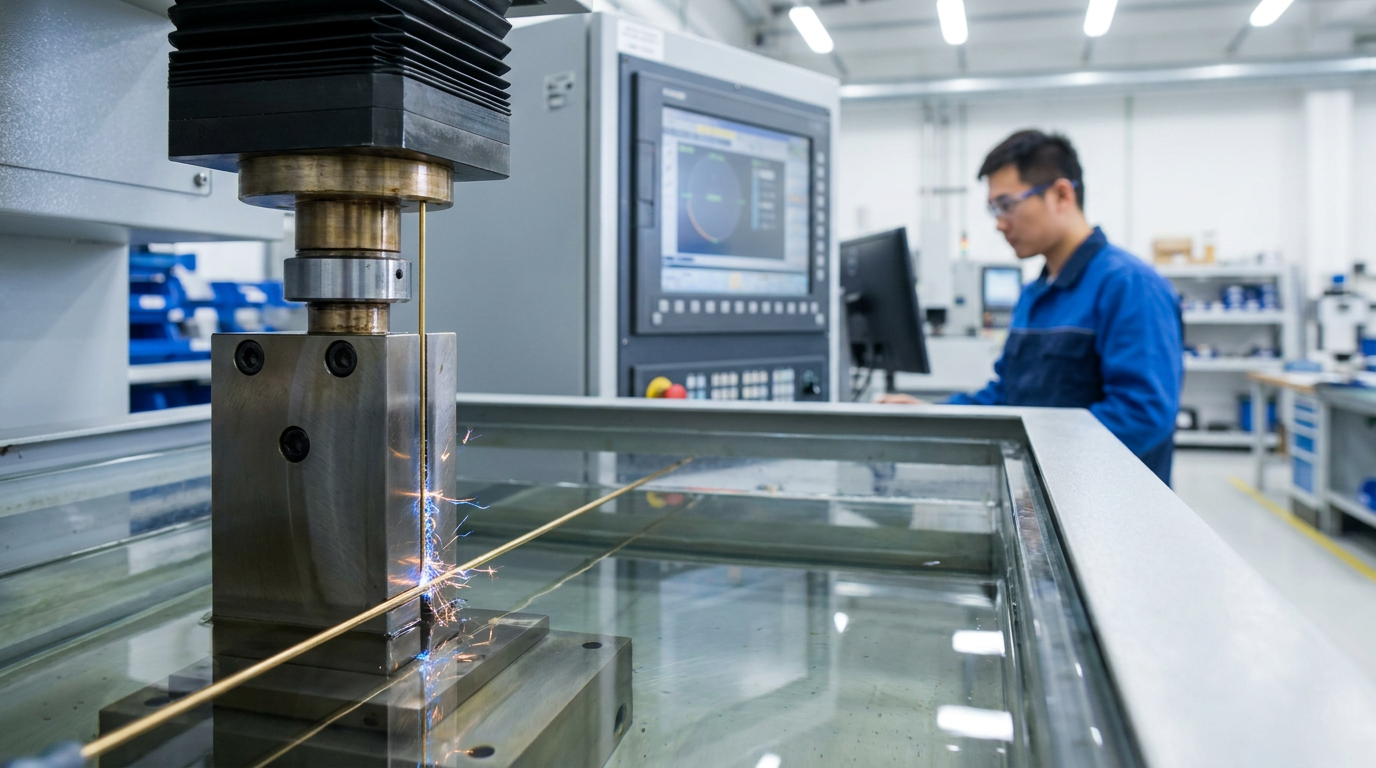
Wire-cut EDM removes material through a series of controlled electrical discharge pulses between a thin wire electrode and the workpiece, separated by deionized water (dielectric fluid). The wire never touches the workpiece — material is removed by the plasma channel created by each spark.
- Wire material — Typically brass (CuZn) wire, 0.1–0.3mm diameter. The wire is continuously fed from a spool and consumed during cutting, ensuring a fresh electrode at all times
- Dielectric fluid — Deionized water flushes the cutting zone, removing eroded particles and cooling the workpiece. Water conductivity is precisely controlled (typically 5–20 μS/cm)
- No cutting force — Wire-cut EDM produces zero cutting force on the workpiece, enabling cutting of thin walls, fragile parts, and complex geometries that would deflect or break under mechanical cutting
- Material removal rate — Slow: 20–200 mm²/min depending on material and finish setting. Wire-cut EDM is a precision finishing process, not a bulk material removal method
- 4-axis cutting — Upper and lower wire guides can be independently positioned, allowing the wire to tilt and cut tapered or twisted profiles. Essential for angled shut-off surfaces in mold inserts
2. Wire-Cut EDM Specifications & Achievable Tolerances
| Parameter | Specification | Application |
|---|---|---|
| Positional accuracy | ±0.002mm | Mold insert fit, die clearance |
| Surface finish (rough cut) | Ra 1.6–3.2μm | Structural cuts, first pass |
| Surface finish (skim cut) | Ra 0.4–0.8μm | Shut-off surfaces, parting faces |
| Surface finish (mirror) | Ra 0.1–0.2μm | Optical inserts, bearing surfaces |
| Wire diameter | 0.1–0.3mm | Finer wire = tighter internal radii |
| Minimum internal radius | 0.05–0.15mm (half wire dia) | Connector pin slots, fine features |
| Maximum taper angle | ±30° (4-axis) | Angled shut-offs, lifter profiles |
| Maximum workpiece height | 300–500mm (machine dependent) | Deep mold inserts, thick die plates |
3. Wire-Cut EDM in Injection Mold Manufacturing
In injection mold manufacturing, wire-cut EDM is used for components where dimensional accuracy, surface quality, and material hardness make CNC milling impractical or insufficient:
- Cavity and core inserts — Cutting precise insert outer profiles from hardened tool steel blocks. The cut surface quality (Ra 0.4–0.8μm) eliminates hand fitting and ensures tight, consistent insert-to-pocket clearances of 0.005–0.01mm
- Slider and lifter profiles — Precise shut-off surface profiles on side actions. Wire-cut surfaces mate perfectly without additional fitting operations, reducing assembly time and ensuring consistent sealing
- Ejector pin bores — For non-standard ejector pin sizes or unusual bore shapes, wire-cut EDM produces accurate, burr-free bores in hardened steel
- Gate inserts — Precise gate geometry (sub-gate, tunnel gate profiles) in hardened inserts for accurate, repeatable gate dimensions
- Thread core profiles — Helical profiles for unscrewing mold cores, maintaining thread lead accuracy within 0.005mm per revolution using 4-axis wire cutting
4. Wire-Cut EDM in Stamping Die Manufacturing
Wire-cut EDM is the primary manufacturing method for progressive die punch and die profiles. The ability to cut hardened steel to tight tolerances with excellent surface quality makes it indispensable for precision metal stamping tooling:
- Punch profiles — Cutting complex punch cross-sections from SKD11 or DC53 tool steel at 58–62 HRC. Accuracy of ±0.002mm ensures correct clearance with the die
- Die plate profiles — Cutting die openings with tight wall-to-punch clearances of 5–12% of material thickness. Wire-cut EDM is the only practical method for maintaining these tolerances in hardened steel
- Strip guide components — Precise guide slots and pilot hole profiles that control strip positioning through the progressive die
- Compound die profiles — Simultaneous blanking and piercing dies require perfect concentricity between punch and die, achieved through single-setup wire-cut programming
- Fine blanking tooling — Fine blanking requires clearances of 0.5–1% of material thickness — achievable only with wire-cut EDM precision
5. Wire-Cut EDM vs CNC Milling: Choosing the Right Process
| Criterion | Wire-Cut EDM | CNC Milling |
|---|---|---|
| Material hardness | No limit (any conductive material) | Limited above ~65 HRC |
| Dimensional accuracy | ±0.002mm | ±0.005–0.01mm (finish) |
| Internal sharp corners | R = half wire dia (0.05–0.15mm) | Limited by tool radius (≥0.3mm) |
| Cutting force on workpiece | Zero | Significant (causes deflection) |
| Material removal rate | Slow (20–200mm²/min) | Fast (1,000–50,000mm³/min) |
| Best for | Profiles, inserts, punches, dies | Pockets, cavities, contoured surfaces |
| Surface finish | Ra 0.1–3.2μm | Ra 0.8–6.3μm (finish pass) |
In practice, wire-cut EDM and CNC milling are used together in a complementary workflow: CNC mills the bulk geometry, cavities, and pockets; wire-cut EDM then cuts the inserts, punches, and die profiles to final precision after heat treatment. This combination delivers both speed and accuracy while maintaining the part hardness required for production tooling.
🔗 Related Articles
Need Precision Wire-Cut EDM Components?
BuildMold operates Fanuc and Sodick slow-wire EDM machines for mold inserts, stamping die profiles, and precision tooling components. Send us your drawing for a quote.