
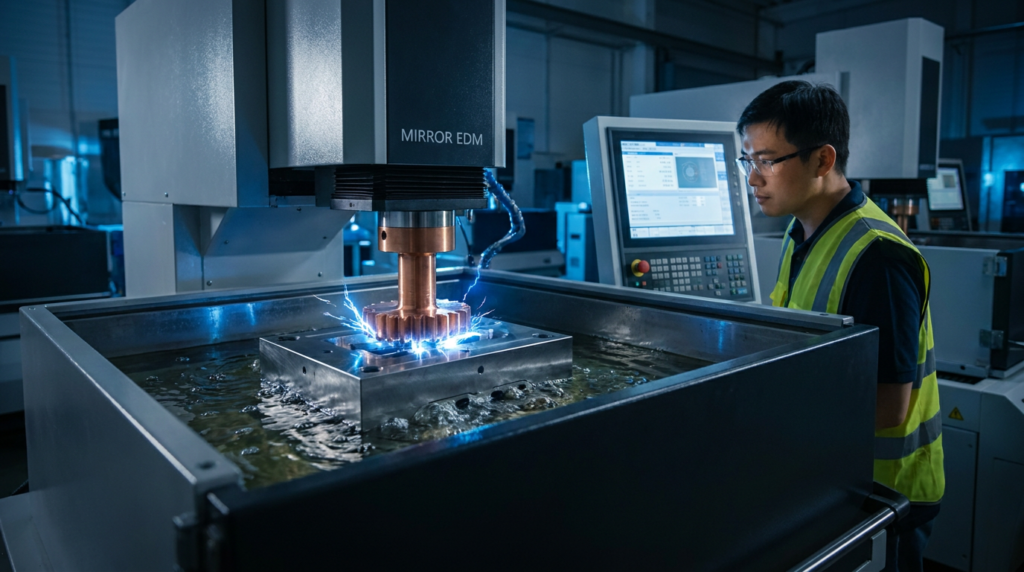
📌 Key Takeaways
- EDM machines any electrically conductive material regardless of hardness — hardened H13 at 52 HRC is machined as easily as annealed P20 at 28 HRC
- Mirror EDM (sinker EDM) achieves surface finishes of Ra0.2μm — finer than most CNC finishing operations and eliminates the need for hand polishing in many applications
- Wire-cut EDM achieves positional accuracy of ±0.002mm — the tightest tolerance available in mold manufacturing short of grinding
- Graphite electrodes are preferred over copper for most sinker EDM applications: 3–5× faster material removal rate, lower electrode wear, and easier CNC machining of complex electrode shapes
- EDM leaves a recast (white) layer 0.005–0.05mm thick on machined surfaces — this must be removed by polishing before the mold enters production
Electrical Discharge Machining (EDM) is an essential process in precision mold manufacturing that complements CNC machining by achieving features and tolerances that rotating cutting tools cannot. By eroding material through controlled electrical sparks in a dielectric fluid, EDM operates without cutting forces and with no hardness limitation — machining fully hardened tool steel as readily as soft stock. This guide covers both sinker EDM and wire-cut EDM and their specific applications in mold making.
Further Reading
For neutral technical background, see EDM machining background.
1. How EDM Works
EDM removes material through a series of rapid electrical discharge pulses between the tool (electrode) and the workpiece, separated by a dielectric fluid (deionized water for wire-cut; dielectric oil for sinker EDM). Each discharge creates a plasma channel reaching 8,000–12,000°C that vaporizes a tiny amount of material from both electrode and workpiece.
- No mechanical force — Unlike cutting tools, EDM produces no cutting forces, eliminating tool deflection and workpiece distortion — enabling machining of thin walls and delicate features impossible with cutters
- Hardness independent — Any conductive material (steel, carbide, copper alloy, graphite) can be machined regardless of hardness. This is the primary reason EDM is used after heat treatment
- Material removal rate — Slow: 2–15mm³/min for sinker EDM vs 500–5,000mm³/min for CNC milling. EDM is used for precision finishing and complex features, not bulk removal
- Surface integrity — EDM leaves a recast layer and heat-affected zone. For high-stress applications, this layer must be removed by polishing. Mirror EDM uses fine discharge energy to minimize recast layer thickness
2. Sinker EDM Applications in Mold Making
| Application | Feature | Achievable Spec |
|---|---|---|
| Deep rib/boss cavities | Depth-to-width ratio > 5:1 | ±0.005mm; Ra 0.4μm |
| Sharp internal corners | Radius below 0.3mm | R0.05mm achievable |
| EDM texture | VDI 12–45 surface texture | Ra 0.4–18μm; repeatable |
| Logo/text engraving | Reversed text in cavity | 0.2mm character height possible |
| Mirror finish EDM | Fine surface machining | Ra 0.2μm; reduces polishing time 60% |
| Hardened insert machining | Post-HT feature machining | ±0.002mm; no annealing required |
3. Wire-Cut EDM Applications in Mold Making
- Cavity and core inserts — Cutting precision insert profiles from hardened tool steel blocks with ±0.002mm dimensional accuracy and mirror-quality cut surfaces
- Progressive die components — Punch and die profiles for metal stamping with clearance tolerances of 0.005–0.02mm between mating surfaces
- Slider and lifter profiles — Precise shut-off surface profiles on side actions. The cut surface quality eliminates fitting operations that would be required after milling
- Thread core profiles — Helical thread profiles for unscrewing mold cores, maintaining thread lead accuracy within 0.005mm per revolution
- Taper and angled cuts — Wire-cut EDM machines tapered features up to 30° taper using 4-axis simultaneous control (upper and lower wire guide independently positioned)
4. Electrode Materials for Sinker EDM
| Electrode Material | Material Removal Rate | Electrode Wear | Best For |
|---|---|---|---|
| Graphite (fine grain) | High (3–5× vs copper) | Low (0.1–0.3%) | Large cavities, rough EDM, most applications |
| Copper (ETP) | Medium | Medium (1–3%) | Fine finish EDM, mirror EDM, thin features |
| Copper-tungsten (CuW) | Low | Very low (<0.05%) | Ultra-fine features; cemented carbide workpieces |
| Graphite (ultra-fine) | Medium | Very low | High-detail electrodes; text; fine textures |
5. EDM vs CNC: Complementary Processes
EDM and CNC machining are not competing processes — they are complementary, each handling the features where the other cannot economically or technically perform:
- CNC first, EDM second — Standard workflow: CNC machines 90–95% of material in roughing and semi-finishing passes; EDM performs final precision work on hardened steel and features inaccessible to rotating tools
- Heat treatment in between — Many mold steels (H13, S136) are machined soft by CNC, heat-treated to final hardness, then finish-machined by EDM — preserving the precision without the risk of heat distortion
- Electrode production — CNC machines graphite or copper electrodes for sinker EDM — a precision CNC application in its own right, requiring tolerances of ±0.005mm on electrode geometry
- Integrated workflow — At BuildMold, CNC and EDM operations share the same coordinate datum system and CAD model, ensuring that EDM picking up where CNC left off introduces no positional error
EDM capability — specifically the availability of modern Mirror EDM (Sodick, Makino) and slow-wire EDM — is a key differentiator between precision mold shops and general fabricators. BuildMold operates dedicated sinker EDM and wire-cut EDM machines for all precision mold components, achieving the tolerances and surface finishes that complex molds require.
🔗 Related Articles
Complex Mold with EDM Requirements?
Send us your part drawings and we will provide a process plan showing exactly which features will be CNC machined and which require EDM.
Or email us directly: sales@buildmold.com