
📌 Key Takeaways
- Medical injection molds must comply with FDA 21 CFR Part 820 (Quality System Regulation) or ISO 13485:2016 — these are mandatory for any mold producing parts used in medical devices
- USP Class VI and ISO 10993 biocompatibility testing must be completed for any material contacting patients — the material certificate alone is not sufficient
- IQ/OQ/PQ mold validation is required for Class II and Class III medical devices — the validation package typically takes 4–8 weeks after T1 sample approval
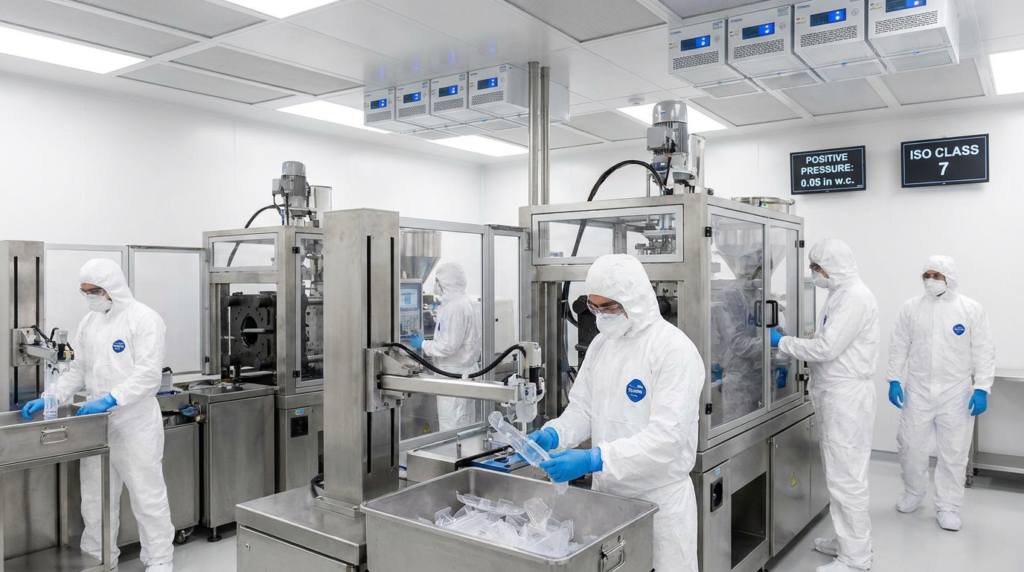
- Clean room molding (ISO Class 7 or 8) eliminates particulate contamination in implantable and sterile-path components — standard factory floors are not acceptable
- Mold documentation requirements for medical are 10× more extensive than commercial tooling: every modification must be formally approved and re-validated
Medical device injection molding operates under the most stringent regulatory and quality requirements in the plastics industry. Every design decision — from material selection and mold steel grade to cleanroom classification and validation protocol — is governed by regulatory frameworks designed to protect patient safety. This guide provides an overview of the key technical and regulatory requirements for medical injection mold manufacturing.
Further Reading
For neutral technical background, see injection molding background.
1. Regulatory Requirements
| Regulation / Standard | Jurisdiction | Scope |
|---|---|---|
| FDA 21 CFR Part 820 | USA | Quality System Regulation for medical device manufacturers |
| ISO 13485:2016 | International | Quality management systems for medical devices |
| ISO 10993 | International | Biological evaluation of medical device materials |
| USP Class VI | USA pharmacopeia | Plastics safety testing: systemic injection, intracutaneous, implantation |
| EU MDR 2017/745 | European Union | Medical Device Regulation — replaced MDD in 2021 |
| 21 CFR Part 11 | USA | Electronic records and signatures for validation documentation |
2. Material Requirements
- USP Class VI certification — Required for any plastic material contacting patients, even indirectly. Tests for systemic toxicity, intracutaneous reactivity, and implantation effects. Not all commercial grades pass — specify medical-grade resin explicitly
- ISO 10993-1 biocompatibility — Risk-based framework for biological evaluation. Cytotoxicity (ISO 10993-5) and sensitization (ISO 10993-10) are required for most medical devices
- Common medical-grade materials: Medical-grade PP (Borealis, LyondellBasell), PC (Makrolon, Lexan), ABS, PEEK (Invibio), LSR (liquid silicone rubber) for implantables
- Traceability — Full material traceability from resin lot to finished part is mandatory. Each production run must be linked to a specific resin lot certificate
- No regrind — Medical injection molding does not permit use of regrind material. All runner and purge waste is discarded, not recycled
3. Cleanroom Molding Standards
| ISO Class | Particles ≥0.5μm per m³ | Typical Application | Equipment Required |
|---|---|---|---|
| ISO Class 5 (Class 100) | 3,520 | Implantable devices, sterile fill lines | Laminar flow booths, HEPA, gowning |
| ISO Class 7 (Class 10,000) | 352,000 | Surgical instruments, IV components | HEPA filtration, positive pressure, gowning |
| ISO Class 8 (Class 100,000) | 3,520,000 | Diagnostic devices, non-contact parts | HEPA, controlled access, basic gowning |
4. Mold Validation: IQ / OQ / PQ
- IQ — Installation Qualification: Documents that the mold is installed correctly and all equipment (machine, mold temperature controller, hot runner) is within specified calibration. Verifies steel grade certificates, dimensional reports, and maintenance records
- OQ — Operational Qualification: Establishes the proven acceptable range (PAR) of process parameters. Runs Design of Experiments (DOE) varying injection speed, pressure, temperature, and cooling time. Defines the edges of the operating space
- PQ — Performance Qualification: Demonstrates that the mold consistently produces conforming parts within the established process window across three separate production runs. Typically 3 × 30-shot runs with 100% dimensional inspection
- Change control: Any modification to the mold, machine, material lot, or process parameters after validation requires a formal change control procedure and may require partial or full re-validation
5. Documentation & Traceability
- Device History Record (DHR): Full production record for each lot including mold ID, machine ID, operator, material lot, process parameters, and inspection results
- Design History File (DHF): Complete documentation of mold design including DFM reports, design reviews, drawing revisions, and validation reports
- Tool qualification report: Formal acceptance documentation including first article inspection (FAI) with CMM data, surface finish measurements, and material certificates
- Maintenance records: Every maintenance action must be logged with date, shot count, technician name, parts replaced, and post-maintenance verification inspection results
- Calibration certificates: All measurement equipment (CMM, gauges, thermocouples) must have current calibration certificates traceable to national standards
Medical mold manufacturing requires a supplier who understands both the engineering precision and the regulatory discipline required. BuildMold has supplied molds for medical diagnostic, surgical, and fluid management applications, with documentation packages that support FDA 510(k) submissions and ISO 13485 audits.
Medical Device Mold Project?
Contact us to discuss regulatory requirements, cleanroom capability, and validation support for your medical mold project.
Or email us directly: sales@buildmold.com