
📌 Key Takeaways
- Automotive molds are classified as Class A (exterior visible), Class B (interior visible), or Class C (hidden structural) — each with distinct surface quality and tolerance requirements
- Class A surface molds require SPI A-2 finish or better and zero visible sink marks, weld lines, or ejector pin witness marks on the cosmetic face
- IATF 16949 certification is increasingly required for automotive mold suppliers — it covers design controls, measurement system analysis, and PPAP submission requirements
- PA66-GF30 and PP-TD20 are the two most common automotive structural injection molding materials — both require mold temperatures above 80°C and careful gate design
- Automotive mold tooling investment ranges from \,000 for small interior clips to \,000+ for full bumper fascia tools
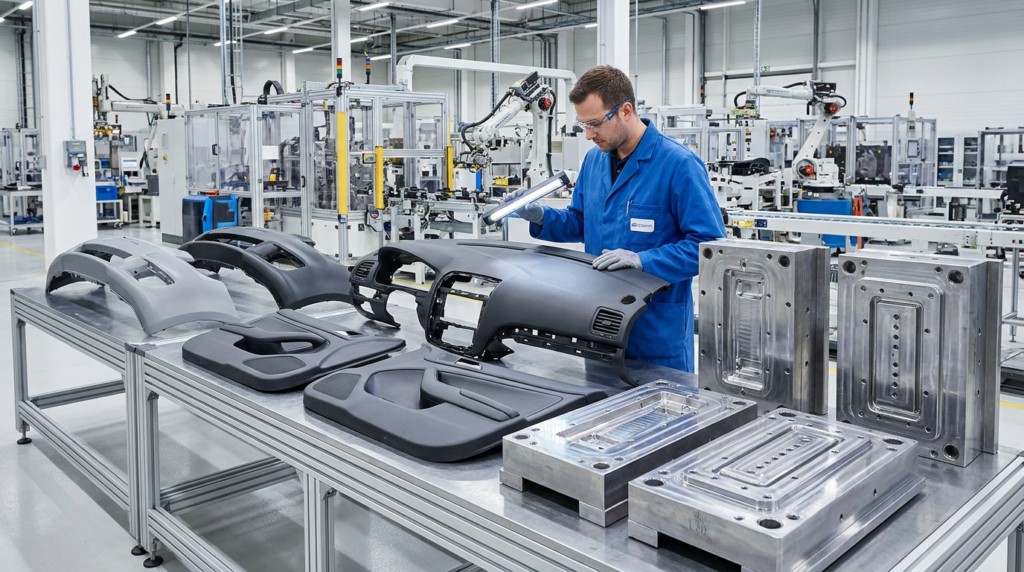
The automotive industry is one of the largest consumers of injection molds globally, using plastic components throughout the vehicle interior, exterior, and under-hood systems. Automotive mold manufacturing is distinguished by its stringent surface quality requirements, tight dimensional tolerances, mandatory quality system certifications, and long tool life requirements (typically 500,000–1,000,000+ shots). This guide covers the key technical requirements for automotive injection molds.
Further Reading
For neutral technical background, see injection molding background.
1. Automotive Mold Classifications
| Class | Location | Surface Requirement | Typical Parts |
|---|---|---|---|
| Class A — Exterior | Exterior visible surfaces | SPI A-2 or better; zero defects visible in natural light | Bumpers, fenders, door mirrors, grilles |
| Class A — Interior | Interior visible surfaces | SPI B-1 to A-3; matched grain texture | Dashboard, door panels, center console, pillar trims |
| Class B | Interior semi-visible | SPI C-1 to B-2; minor cosmetic imperfections acceptable | Under-dash brackets, seat components |
| Class C | Hidden structural | SPI C-2 to D-1; functional requirements only | Engine bay brackets, floor pan reinforcements |
2. Key Materials for Automotive Molds
| Material | Key Property | Mold Temp (°C) | Typical Application |
|---|---|---|---|
| PP homopolymer | Low cost, chemical resistance | 20–50 | Interior trims, bumper carriers |
| PP-TD20 (talc-filled) | Stiffness, low warpage | 40–60 | Dashboard substrates, door panels |
| ABS | Good surface finish, paintability | 50–70 | Interior trim, grilles |
| PA66-GF30 | Heat resistance, strength | 80–100 | Under-hood components, air intake |
| PC/ABS blend | Impact + heat resistance | 70–90 | Pillar trims, instrument panels |
| TPO (PP+EPDM) | Soft-touch, paintable | 30–50 | Bumpers, side moldings |
3. Surface Quality Requirements
- Zero sink marks on Class A surfaces — Requires wall thickness uniformity within ±0.2mm and cooling system designed to eliminate thermal gradients across the part face
- Weld line management — Weld lines must be relocated to non-visible areas through gate position optimization. For visible weld lines, mold and melt temperature increases improve weld line strength and visibility
- Paint adhesion requirements — Bumpers and exterior body panels require adhesion promoter treatment or specific surface roughness (Rz 2–5μm) for paint adhesion. Mold surface must be free of release agent contamination
- Dimensional accuracy — Automotive body panel molds hold ±0.1mm on datums; trim molds hold ±0.2mm. These tolerances must be maintained over 500,000+ shots including thermal expansion effects
4. IATF 16949 & PPAP Requirements
- IATF 16949:2016 — The automotive quality management system standard (successor to TS16949). Covers design and development controls, measurement system analysis (MSA), statistical process control (SPC), and product safety requirements
- PPAP (Production Part Approval Process) — 18-element submission package required for new parts. Includes dimensional results (full layout inspection), material certificates, process flow diagrams, control plans, and initial sample inspection reports (ISIR)
- Gauge R&R (Repeatability & Reproducibility) — Measurement system analysis required to prove that the inspection method can reliably detect part-to-part variation. GR&R must be below 10% for critical dimensions
- Cpk requirements — Process capability index Cpk ≥ 1.67 required for critical characteristics; Cpk ≥ 1.33 for significant characteristics at PPAP submission
5. Typical Lead Times & Tooling Investment
| Part Type | Mold Complexity | Lead Time (T1) | Tooling Cost Range |
|---|---|---|---|
| Interior clip/bracket | Low | 3–5 weeks | \,000–\,000 |
| Door panel trim | Medium | 6–10 weeks | \,000–\,000 |
| Dashboard substrate | High | 10–16 weeks | \,000–\,000 |
| Full bumper fascia | Very high | 14–20 weeks | \,000–\,000 |
BuildMold has supplied injection molds to automotive Tier 1 and Tier 2 suppliers for interior trim, structural brackets, and under-hood components. Our quality system is aligned with IATF 16949 requirements, and we support full PPAP submission including CMM dimensional reports, material certificates, and process capability studies.
Automotive Mold Project?
Contact us with your part classification and annual volume for a detailed tooling proposal with PPAP support included.
Or email us directly: sales@buildmold.com