
📌 Key Takeaways
- CMM (Coordinate Measuring Machine) is the gold standard for mold cavity inspection — achieving measurement uncertainty of ±0.001mm, 5× more accurate than manual gauging methods
- Full first article inspection (FAI) using CMM is mandatory before a mold is accepted for production — visual inspection alone cannot verify dimensional compliance on complex 3D surfaces
- Tactile ruby probes (0.5–3mm diameter) are used for most mold features; optical CMM scanning is used for large freeform surfaces and Class A automotive panels
- CMM reports must reference the same GD&T datum structure as the 2D drawing — a measurement report using a different datum is meaningless for part conformance verification
- Temperature stability is critical for CMM accuracy: measurements must be taken at 20°C ±1°C; a 5°C temperature change causes 6μm dimensional shift in a 100mm steel part
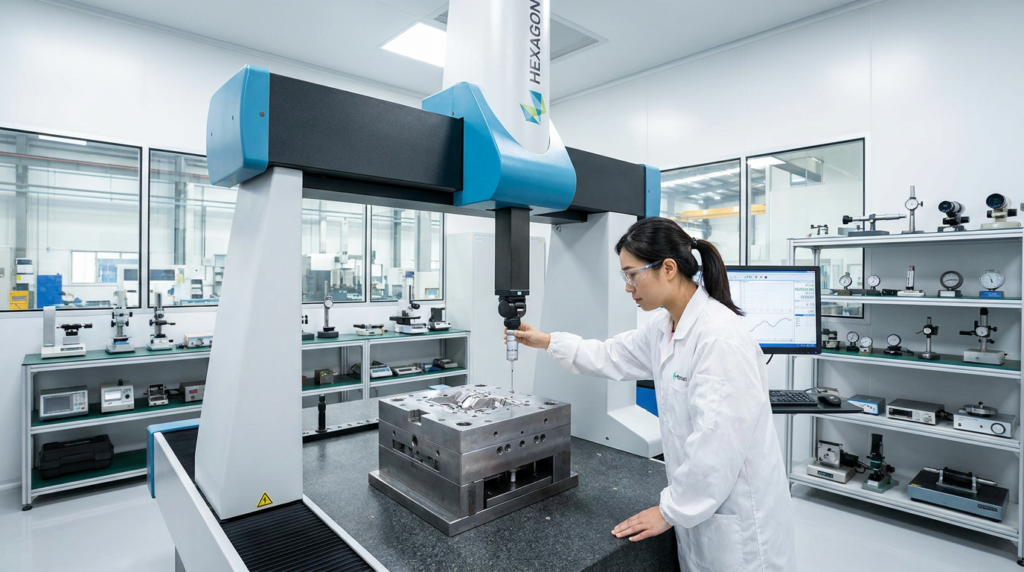
Coordinate Measuring Machines (CMMs) are the backbone of precision quality control in mold manufacturing. Unlike manual measurement tools — calipers, micrometers, height gauges — CMMs capture true 3D geometry in a controlled environment, generating traceable, repeatable measurement data that validates dimensional compliance against engineering drawings. For injection molds producing parts with tolerances of ±0.01–0.05mm, CMM inspection is not optional — it is the only method capable of confirming that the mold will produce conforming parts.
Further Reading
For neutral technical background, see CMM inspection background.
1. How CMM Works
A CMM uses a precision probe mounted on a rigid bridge or gantry structure to touch specific points on a workpiece surface. Each touch records an X, Y, Z coordinate in 3D space. Software (PC-DMIS, Calypso, Metrolog) compares the measured point cloud against the nominal CAD model or 2D drawing dimensions, calculating deviations, form errors, and GD&T (Geometric Dimensioning and Tolerancing) results.
- Bridge CMM — The most common type for mold inspection. A horizontal beam (bridge) moves over a granite surface plate. Hexagon and Zeiss are the leading manufacturers. Measuring volume from 500×500mm to 2,000×4,000mm for large molds
- Tactile probing — A ruby ball probe contacts the surface at programmed points. Probe diameter 0.5–5mm. Each contact records one 3D coordinate. Measurement uncertainty: ±0.001–0.003mm depending on machine class
- Scanning probes — Continuously slide along surfaces, capturing thousands of points per second. Used for freeform cavity surfaces, Class A automotive panels, and complex contoured features
- Non-contact optical measurement — Laser scanners or structured light systems capture complete surface point clouds without contact. Used for delicate surfaces, large panels, and rapid first-pass inspection
2. CMM Applications in Mold Manufacturing
| Inspection Stage | What Is Measured | Frequency |
|---|---|---|
| Steel incoming inspection (IQC) | Block dimensions, flatness, hardness verification | Every incoming steel batch |
| Cavity/core after CNC machining | Cavity dimensions vs nominal CAD, position of features | After each major machining stage |
| After EDM finishing | Fine feature dimensions, EDM depth, surface position | After each EDM operation |
| Mold assembly check | Cavity-to-core alignment, parting surface flatness, guide pin positions | Before first trial |
| First Article Inspection (FAI) | 100% of drawing dimensions on 5–10 sample parts | T1 and after each modification |
| Production sampling (SPC) | Critical dimensions on statistical sample | Every production run |
3. Key CMM Measurements for Injection Molds
- Cavity depth and width — Core dimensions that directly determine part wall thickness and external dimensions. Measured to ±0.005mm; deviation from nominal is adjusted in cavity during fitting
- Core pin position — Position of ejector pin holes, core pins, and insert bores. Position tolerance typically ±0.01–0.02mm. Mislocation causes ejection interference or part mark position deviation
- Parting surface flatness — The mating surfaces of cavity and core plates must be flat within 0.002–0.005mm to prevent flash. CMM measures flatness across the full parting surface area
- Guide pin and bushing bore position — Lateral position accuracy of guide system determines cavity-to-core alignment. Position tolerance: ±0.005mm. Misalignment causes systematic mismatch (witness line) on every part
- Cooling channel position — Distance from cooling channel centerline to cavity surface. CMM verifies channel position from external reference faces; endoscope inspection verifies internal surface condition
4. Reading a CMM Report
A CMM inspection report lists measured dimensions against nominal values with deviations and pass/fail status. Key elements to verify:
- Datum reference frame — Confirm the report uses the same datums (A, B, C) as defined on the 2D drawing. A report using different datums cannot be used to verify drawing compliance
- Deviation column — The difference between measured and nominal. Positive deviation = oversize; negative = undersize. For mold cavities, undersize is generally preferred (steel-safe) as material can be removed but not added easily
- Tolerance column — The allowed deviation band from the drawing. Any deviation outside this band is a non-conformance requiring rework
- Form errors (flatness, roundness, cylindricity) — GD&T form tolerances are independent of size tolerances. A feature can be in-size but still fail its flatness requirement
- Temperature conditions — Report should state measurement temperature. Any deviation from 20°C requires thermal correction factors, especially for large mold bases
5. CMM vs Other Inspection Methods
| Method | Accuracy | Speed | Best For | Limitation |
|---|---|---|---|---|
| CMM (tactile) | ±0.001–0.003mm | Medium | 3D features, GD&T, FAI reports | Slow for large surface areas |
| CMM (scanning) | ±0.003–0.010mm | Fast | Freeform surfaces, Class A panels | Lower point accuracy than tactile |
| Optical projector | ±0.001–0.005mm | Fast | 2D profiles, connector pins, cross-sections | 2D only, limited to part cross-section |
| Micrometer/caliper | ±0.01–0.02mm | Very fast | Simple linear dimensions, incoming QC | Not suitable for 3D features or GD&T |
| Surface roughness tester | Ra ±5% | Fast | Surface finish verification | Cannot measure dimensional features |
Conclusion
CMM inspection is the definitive method for verifying injection mold dimensional compliance. BuildMold operates Hexagon and Zeiss bridge CMMs in a temperature-controlled metrology lab, performing full FAI inspection on every mold before shipment. Every mold is accompanied by a complete CMM inspection report with deviation data for all drawing dimensions — giving customers objective, traceable evidence of dimensional conformance before the mold enters production.
🔗 Related Articles
Need Full CMM Inspection Documentation?
BuildMold ships every mold with a complete CMM first article inspection report, material certificates, and T1 sample parts. Contact us to discuss your dimensional requirements.
Or email us directly: sales@buildmold.com