
📌 Key Takeaways
- HASCO (German), DME (American), and FUTABA (Japanese) are the three dominant mold base standards globally — specifying which standard upfront prevents expensive component incompatibility when the mold is transferred to a new facility
- Every exported mold should ship with: dimensional inspection report (CMM), material certificates, 2D drawings, 3D model, T1 sample parts, and maintenance schedule — missing documentation creates production problems at the receiving facility
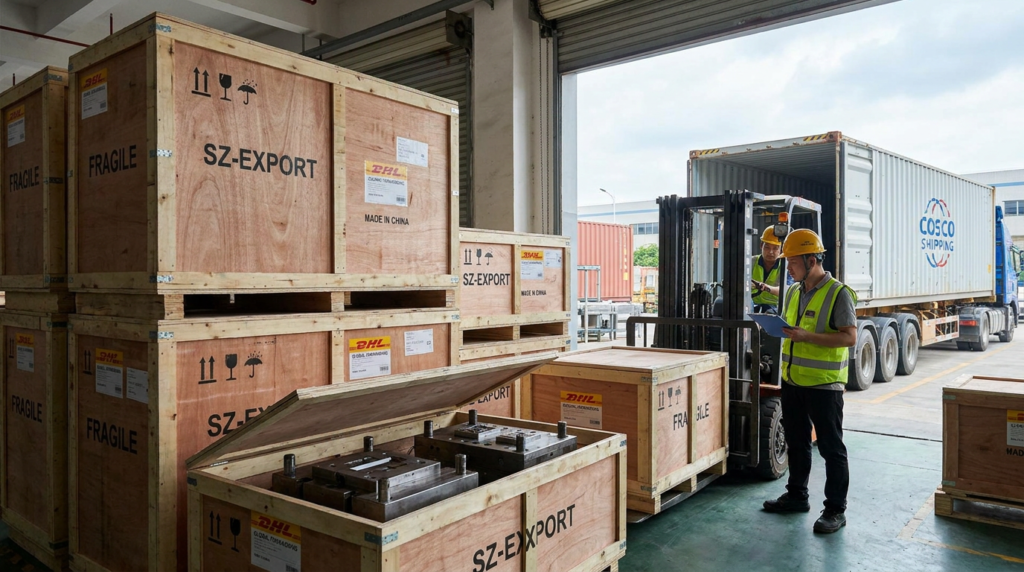
- Export packaging for injection molds requires sealed wooden crates with anti-corrosion treatment, internal blocking to prevent movement, and weight/center-of-gravity markings for safe crane handling
- Mold ownership transfer must be explicitly documented — include a mold handover certificate listing the mold ID, shot count, last maintenance date, and confirmed transfer of ownership
- US Section 301 tariffs currently apply to Chinese-made molds (HS 8480) — buyers should verify current tariff rates and consider DDP terms when comparing total landed cost of Chinese vs domestic tooling
When injection molds are designed in one country, built in another, and run in a third — a common reality in today’s global manufacturing landscape — standards alignment, documentation, and proper export packaging become critical to a successful mold handover. This guide covers the key international mold standards, documentation requirements, shipping best practices, and the legal and commercial considerations for international mold transfers.
Further Reading
For neutral technical background, see injection molding background.
1. Why Standards Matter in International Mold Trade
An injection mold built to one standard (e.g., HASCO metric) may be physically incompatible with the machinery and spare parts ecosystem at the receiving facility (e.g., US DME standard). Components such as guide pillars, ejector pins, guide bushings, and hot runner components are standard-specific — mixing standards within a mold or between molds in a production facility creates a spare parts management nightmare and production downtime risk.
- Specify the standard upfront — Tell your mold supplier which component standard is required at your production facility before mold design begins. This single decision affects component sourcing throughout the mold’s life
- Mixed-standard risks — A HASCO-standard mold shipped to a facility that stocks only DME components cannot use locally available spare ejector pins, guide bushings, or leader pins. Rush-ordering from Europe adds weeks of downtime
- Hot runner compatibility — Hot runner systems are proprietary. A Husky hot runner mold cannot be serviced with Mold-Masters components. Specify the hot runner brand accepted at your production facility
2. Key Mold Component Standards Compared
| Standard | Origin | Common In | Key Feature | Ejector Pin Thread |
|---|---|---|---|---|
| HASCO | Germany | Europe, global premium | Metric; extensive catalog; high precision | M-thread metric |
| DME | USA | North America, China export to US | Imperial + metric; wide availability | Unified thread |
| FUTABA | Japan | Japan, Southeast Asia, Korea | Metric; high precision; JIS compliant | M-thread metric |
| LKM (榫欒) | China | China domestic | Metric; lower cost; wide local availability | M-thread metric |
| Meusburger | Austria | Europe, precision tooling | Metric; extremely tight tolerances; premium | M-thread metric |
3. Documentation Required for Export
- Dimensional inspection report — CMM printout verifying critical cavity dimensions against the 2D drawing. Minimum: 5 sample parts from each cavity, measured to ±0.001mm
- Material certificates — Mill certificates for all mold steels (cavity, core, slides, inserts) confirming grade, heat number, hardness, and chemical composition
- 2D engineering drawings — Parting line drawing, cooling circuit layout, ejector pin layout, and any special features. In both native CAD format and PDF
- 3D CAD model — Full mold assembly model in STEP or IGES format. Enables future modification planning without reverse engineering
- T1 sample parts — Minimum 10 first-article samples shipped with the mold, labeled with cavity number and date
- Maintenance manual — Recommended maintenance intervals, lubrication points, spare parts list, and disassembly procedures
- Shot counter reading — Documented current shot count at time of shipment
4. Shipping & Packaging Requirements
- Wooden export crating — ISPM 15-certified heat-treated lumber required for export to most countries (prevents wood pest transfer). Crates must be rated for the mold weight with 3× safety factor
- Internal blocking and bracing — Molds must be blocked within the crate to prevent movement during sea freight. Shifting during transport causes internal component damage
- Anti-corrosion treatment — Apply mold-specific corrosion inhibitor to all steel surfaces before crating. Wrap cavity and core in VCI (Volatile Corrosion Inhibitor) film. Do not use WD-40
- Weight and COG marking — Mark crate with gross weight, center of gravity location, and crane lifting points. Molds lifted incorrectly cause injury and damage
- Moisture protection — Include silica gel desiccant inside the crate sealed with plastic sheeting. Sea freight containers experience significant humidity cycling
5. Intellectual Property & Mold Ownership Agreements
- Mold ownership clause — The purchase agreement must state unambiguously that the mold becomes the buyer’s property upon full payment. Chinese law does not automatically favor the buyer — a written clause is essential
- NDA (Non-Disclosure Agreement) — Signed before sharing 3D models, drawings, or proprietary design information. Covers part geometry, material specifications, and production volumes
- Right to transfer — The agreement should explicitly grant the buyer the right to transfer the mold to any other molder without additional fees or supplier consent
- Right to duplicate — For high-volume programs, buyers often need the right to have duplicate molds built by other suppliers. This right must be explicitly stated — it is not implied
- Mold modification rights — After ownership transfer, the buyer has the right to modify the mold. The agreement should specify whether the original supplier has any liability for modifications made by others
- Export compliance — Both parties should confirm that the mold does not contain export-controlled technology (ITAR, EAR in the US; dual-use regulations in the EU) before shipment
BuildMold has shipped molds to customers in the USA, Germany, UK, Australia, Mexico, and 20+ other countries. Every export shipment includes a complete documentation package, ISPM 15-certified crating, and a formal mold ownership transfer certificate. We support customers through the full import process including providing HS codes, commercial invoice preparation, and packing list documentation.
🔗 Related Articles
Exporting a Mold from China?
Contact us for a complete export documentation package, ISPM 15-certified crating, and mold ownership transfer certificate with every shipment.
Or email us directly: sales@buildmold.com