
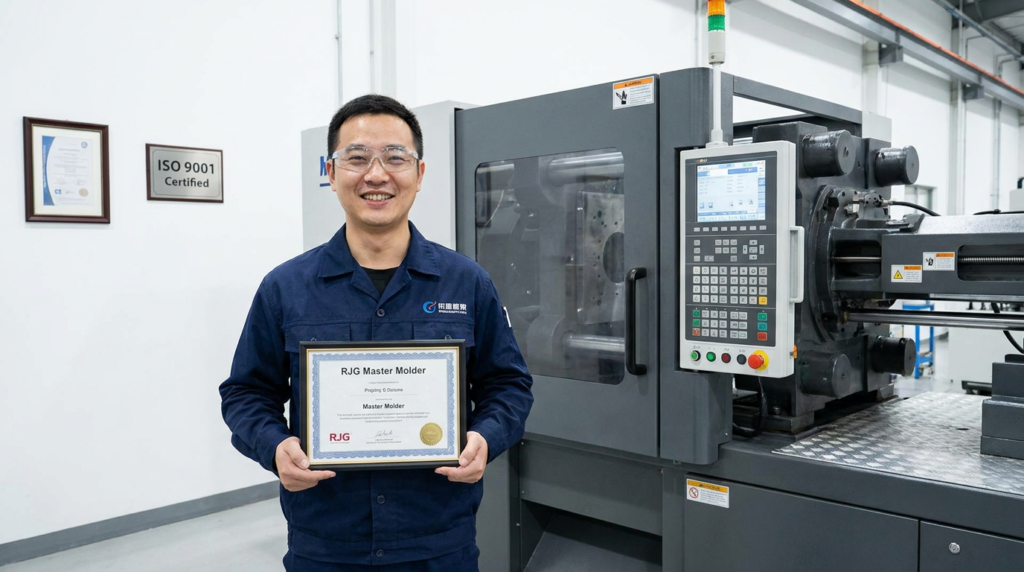
For professionals working in injection moulding, toolmaking, or plastics manufacturing, certification is a powerful credential that validates technical competence and opens doors to higher-paying roles, better supplier contracts, and international career opportunities. How long does it take to get mold certified? The answer varies by certification type, your current experience level, and how intensively you study — but most programmes can be completed within a few days to two years depending on the level.
Further Reading
For neutral technical background, see injection molding background.
This guide covers the most recognised mould and injection moulding certifications globally, their prerequisites, study timelines, and what to expect from the process.
Overview: Major Mould and Injection Moulding Certifications
| Certification | Issuing Body | Level | Time to Obtain | Prerequisites |
|---|---|---|---|---|
| RJG Certified Decoupled Molding Technician (CDMT) | RJG Inc. | Technician | 3–5 days (course) + exam | Basic moulding experience |
| RJG Master Molder I | RJG Inc. | Engineer | 4–5 days (course) + exam | 1–2 years production experience |
| RJG Master Molder II | RJG Inc. | Senior Engineer | 4–5 days (course) + exam | Master Molder I + experience |
| SPE Certified Plastics Technician (CPT) | SPE | Technician | Self-study 2–6 months + exam | 2 years industry experience |
| SPE Certified Plastics Engineer (CPE) | SPE | Engineer | Self-study 3–12 months + exam | Engineering degree + 2 yrs exp |
| ISO 9001:2015 Internal Auditor | IRCA / CQI / BSI | Quality | 2–3 day course + exam | None required |
| IATF 16949 Internal Auditor | IATF / AIAG | Automotive QA | 3–5 day course + exam | ISO 9001 awareness recommended |
| ASQ Certified Quality Engineer (CQE) | ASQ | Quality Engineer | Self-study 3–12 months + exam | 8 years experience (3 with degree) |
| NVQ/SVQ Level 3 Plastics Processing | City & Guilds / BPIF | Vocational | 12–24 months (on-the-job) | Working in plastics industry |
RJG Certifications: The Industry Gold Standard
RJG Inc. (based in Traverse City, Michigan, USA) offers the most widely respected injection moulding process certifications globally. Their programmes are built around Scientific Injection Moulding (SIM) — a systematic, data-driven approach to process development.
RJG Certified Decoupled Molding Technician (CDMT)
- Format: 3–5 day instructor-led course (classroom + machine time) followed by written and practical exam
- Content: Decoupled moulding principles, viscosity curves, gate freeze studies, process documentation, basic troubleshooting
- Time to obtain: As little as one week for the course; practical competency expected to develop over subsequent months of production work
- Where offered: RJG training centres (USA, Europe, Asia); also delivered on-site at customer facilities
- Cost: Approximately $1,500–$2,500 USD per participant
RJG Master Molder I
- Format: 4–5 day course with intensive hands-on machine work and process studies
- Content: Full scientific moulding process development — viscosity curves, cavity balance, pressure studies, cooling optimisation, DOE basics
- Prerequisites: Recommended 1–2 years of injection moulding production experience; CDMT is not required but helpful
- Time to obtain: One week for the course; many practitioners spend 2–6 months applying skills in production before feeling fully competent
- Cost: Approximately $2,500–$4,000 USD
RJG Master Molder II
- Format: Advanced 4–5 day course focused on process optimisation, troubleshooting complex defects, and statistical methods
- Prerequisites: Master Molder I certification + significant production experience (typically 2–5 years post-MM1)
- Time to obtain: One week course; overall journey from entry to MM2 typically takes 3–7 years
SPE Certifications: The Professional Credential
The Society of Plastics Engineers (SPE) offers exam-based certifications that test broader plastics knowledge across materials, processes, and applications.
SPE Certified Plastics Technician (CPT)
- Format: Computer-based exam (120 questions, 3 hours)
- Prerequisites: Minimum 2 years of experience working in the plastics industry
- Exam content: Plastics materials, moulding processes, quality, safety, and sustainability
- Study time: Most candidates prepare for 2–6 months using SPE’s study guide and practice exams
- Recertification: Required every 3 years (continuing education credits or re-examination)
SPE Certified Plastics Engineer (CPE)
- Format: More demanding exam covering engineering-level plastics science, rheology, and process design
- Prerequisites: Engineering degree in a relevant field + 2 years of experience
- Study time: Typically 6–12 months of structured preparation; candidates with strong academic backgrounds may prepare in 3–4 months
ISO and Automotive Quality Certifications
ISO 9001:2015 Internal Auditor
- Format: 2–3 day training course followed by a short exam
- No formal prerequisites: Open to anyone working in or supporting a quality management system
- Time to obtain: As little as 3 days for the course; full auditor competency develops with practical auditing experience
- Providers: BSI, Bureau Veritas, SGS, TÜV, Lloyd’s Register, and many others
IATF 16949 Internal Auditor
- Format: 3–5 day course (often includes ISO 9001 as a prerequisite module)
- Prerequisites: ISO 9001 awareness recommended; automotive manufacturing experience beneficial
- Time to obtain: 3–5 days for certification course; practical competency in automotive PPAP, FMEA, and control plans develops over time
Vocational Route: NVQ / City & Guilds (UK)
For those in the UK and Commonwealth countries, the vocational qualification route through BPIF (British Plastics Federation) and City & Guilds provides structured, on-the-job qualification:
- Level 2: Basic plastics processing competency — typically achieved in 6–12 months of supervised work
- Level 3: Advanced processor / setter competency — typically 12–24 months
- Assessment method: Portfolio of workplace evidence, observations by assessor, and written knowledge tests
- Advantage: Qualification is earned through real production work — no classroom-only route
Factors That Affect How Long Certification Takes
1. Your Current Experience Level
Candidates with 3+ years of hands-on injection moulding experience consistently perform better in RJG and SPE exams. The course content makes far more sense when you have seen the concepts in production.
2. Course Format (Intensive vs Self-Study)
RJG programmes are intensive and fast — you can complete the formal certification component in one week. SPE exams require self-study over months. Both approaches lead to valid credentials, but RJG’s hands-on machine time provides more immediate practical skills.
3. Employer Support
Candidates whose employers provide dedicated study time, access to machines for practice, and financial support for courses typically achieve certification significantly faster than self-funded candidates studying in their own time.
4. English Language Proficiency (for International Candidates)
Most major certifications (RJG, SPE, ASQ) are currently offered primarily in English. Non-native speakers may need additional preparation time. RJG has expanded to offer training in Mandarin, Spanish, and German at select locations.
Frequently Asked Questions
How long does it take to get RJG Master Molder certified?
The formal RJG Master Molder I course takes 4–5 days to complete. However, becoming a truly competent master moulder — applying the skills effectively in daily production — typically takes an additional 6–18 months of practice. The full journey from entry-level technician to Master Molder II spans 3–7 years for most practitioners.
What is the easiest injection moulding certification to get?
The ISO 9001:2015 Internal Auditor certification has no prerequisites and can be obtained in 2–3 days of training. For a production-specific credential, the RJG CDMT is achievable in one week and is highly valued by employers in North America and globally.
Do I need a degree to get injection moulding certified?
No degree is required for RJG (CDMT, Master Molder I) or ISO certifications. The SPE Certified Plastics Engineer (CPE) does require an engineering degree, but the SPE Certified Plastics Technician (CPT) requires only 2 years of industry experience. Vocational routes (NVQ/SVQ) are entirely experience-based.
Is RJG certification recognised internationally?
Yes — RJG certifications are recognised by injection moulding buyers and OEMs across North America, Europe, and increasingly in Asia. Many automotive and medical device manufacturers require their moulding suppliers to have RJG-certified process engineers on staff.
How much does injection moulding certification cost?
Costs vary by programme: RJG CDMT: $1,500–$2,500; RJG Master Molder I: $2,500–$4,000; SPE CPT exam: $300–$500; ISO 9001 Internal Auditor course: $500–$1,500; ASQ CQE exam: $400–$600 (members). Employer sponsorship is common for RJG and ISO certifications.
What certification do injection moulding suppliers need?
At the company level, ISO 9001:2015 is the baseline expectation for any serious B2B injection moulding supplier. Automotive suppliers additionally require IATF 16949. Medical suppliers need ISO 13485. At the individual level, having at least one RJG Master Molder I or equivalent on the engineering team is increasingly a customer requirement for precision moulding contracts.
Summary
Getting mould certified can take as little as 3 days (ISO 9001 Internal Auditor) or as long as 2+ years (NVQ Level 3 vocational route). The most respected injection moulding-specific credentials — RJG Master Molder I and II — require a one-week course each, but true mastery develops over years of hands-on production experience. For anyone serious about a career in injection moulding or evaluating supplier capability, certification is one of the clearest signals of genuine technical competence.