
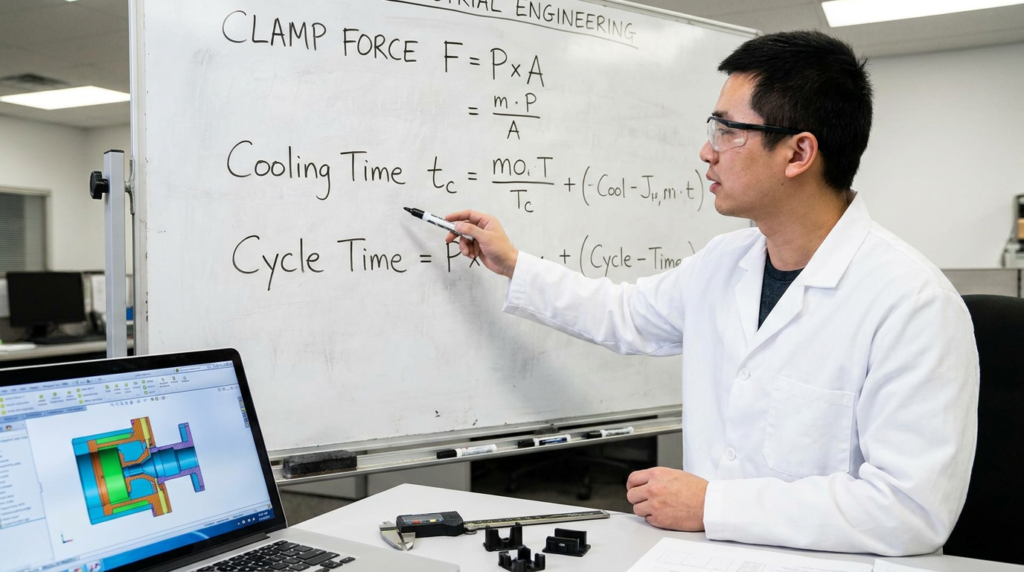
When engineers and process technicians ask “what is the formula for injection molding?”, they are typically referring to the key mathematical relationships that govern part design, process parameters, and machine selection. Injection moulding is a science-driven process — and understanding its core formulas allows engineers to make faster, more accurate decisions on wall thickness, cycle time, clamp tonnage, shot size, and cooling time.
Further Reading
For neutral technical background, see injection molding background.
This guide compiles the most important injection moulding formulas used in daily engineering practice, with worked examples for each.
1. Clamp Force Formula
Clamp force is the force required to keep the mould closed during injection. Insufficient clamp force causes flash; excessive clamp force wastes energy and stresses the mould.
Clamp Force (tons) = Projected Area (cm²) × Cavity Pressure (MPa) ÷ 100Or in imperial units:
Clamp Force (tons) = Projected Area (in²) × Cavity Pressure (psi) ÷ 2000Key Values
- Cavity pressure: Typically 30–70 MPa for most thermoplastics (use 40 MPa as a starting estimate for general-purpose resins)
- Projected area: The shadow area of all cavities + runners projected onto the parting plane
Worked Example
A 4-cavity ABS housing mould, each cavity projected area = 60 cm², runner area = 20 cm². Total projected area = (4 × 60) + 20 = 260 cm². Cavity pressure = 40 MPa.
Clamp Force = 260 × 40 ÷ 100 = 104 tons → Select a 120-ton machine2. Shot Size and Shot Weight Formula
Shot size is the volume of plastic injected per cycle. It must not exceed the machine’s maximum shot capacity.
Shot Weight (g) = Part Weight (g) × Number of Cavities + Runner Weight (g)Shot Volume (cm³) = Shot Weight (g) ÷ Melt Density (g/cm³)Machine Selection Rule
The shot weight should be 20–80% of the machine’s maximum shot capacity. Running below 20% risks material degradation (long residence time); above 80% risks insufficient cushion and process instability.
Worked Example
Part weight = 45 g, 2 cavities, runner weight = 12 g. ABS melt density ≈ 0.97 g/cm³.
Shot Weight = (45 × 2) + 12 = 102 g
Shot Volume = 102 ÷ 0.97 = 105 cm³
Machine capacity required: 102 ÷ 0.5 = 204 g minimum (at 50% utilisation)
3. Cooling Time Formula
Cooling time dominates the injection moulding cycle, typically accounting for 50–80% of total cycle time. The standard engineering formula is:
t_cool = (s² / (π² × α)) × ln[(4/π) × (T_melt - T_mold) / (T_eject - T_mold)]Where:
- s = wall thickness (m)
- α = thermal diffusivity of the plastic (m²/s)
- T_melt = melt temperature (°C)
- T_mold = mould surface temperature (°C)
- T_eject = part ejection temperature (°C)
Simplified Rule of Thumb
t_cool (seconds) ≈ s² × kWhere k is a material constant (approximate values):
| Material | k (sec/mm²) |
|---|---|
| PP | 4–6 |
| ABS | 3–5 |
| PC | 5–8 |
| Nylon PA66 | 4–7 |
| HDPE | 5–8 |
Worked Example
ABS part, wall thickness = 2.5 mm, k = 4:
t_cool ≈ 2.5² × 4 = 6.25 × 4 = 25 seconds4. Cycle Time Formula
Total cycle time is the sum of all stages:
t_cycle = t_fill + t_pack + t_cool + t_eject + t_open/closeTypical values:
| Stage | Typical Duration |
|---|---|
| Fill (injection) | 0.5–5 sec |
| Pack (hold) | 2–15 sec |
| Cool | 5–60 sec (dominates) |
| Eject + open/close | 1–5 sec |
Output Rate Formula
Parts per Hour = (3600 ÷ t_cycle) × Number of CavitiesWorked Example
t_cycle = 35 sec, 2 cavities:
Parts per Hour = (3600 ÷ 35) × 2 = 102.8 × 2 ≈ 205 parts/hour5. Injection Pressure Formula
Injection pressure must overcome the flow resistance of the melt through the runner, gate, and cavity:
P_inject = P_cavity + P_runner + P_gate + P_safetyA practical estimation for cavity fill pressure:
P_cavity (MPa) = (4 × η × L × Q) / (π × R⁴)Where: η = melt viscosity (Pa·s), L = flow length (m), Q = volumetric flow rate (m³/s), R = flow channel radius (m). In practice, mould flow analysis software (Moldex3D, Moldflow) is used for precise pressure calculations.
Practical Guideline
- Start at 70–100 MPa injection pressure for most commodity thermoplastics
- Thin-wall parts may require 120–180 MPa
- Maximum machine injection pressure is typically 140–200 MPa
6. Shrinkage and Part Dimension Formula
All thermoplastics shrink as they cool from melt to solid. The mould cavity must be made oversized to account for this:
Mould Dimension = Part Dimension × (1 + Shrinkage Rate)Or rearranged to calculate expected part size:
Part Dimension = Mould Dimension ÷ (1 + Shrinkage Rate)Typical Shrinkage Rates
| Material | Shrinkage Rate (%) |
|---|---|
| PP (unfilled) | 1.5–2.5% |
| ABS | 0.4–0.8% |
| PC | 0.5–0.7% |
| Nylon PA66 (dry) | 0.8–1.5% |
| 30% GF Nylon | 0.3–0.6% |
| HDPE | 1.5–3.0% |
| POM (acetal) | 1.8–2.5% |
Worked Example
Target part length = 100.00 mm, ABS shrinkage = 0.6%:
Mould Dimension = 100.00 × (1 + 0.006) = 100.60 mm7. Material Cost Per Part Formula
Material Cost per Part = (Part Weight + Runner Weight/Cavities) × Resin Price per kg ÷ 1000If regrind is recycled at a recovery rate of R%:
Net Material Cost = Part Weight × Price + Runner Weight × Price × (1 - R/100)Worked Example
Part weight = 45 g, runner per cavity = 6 g, ABS price = $2.20/kg, regrind recovery = 80%:
Net Material Cost = (45 × 2.20/1000) + (6 × 2.20/1000 × 0.20)
                  = $0.099 + $0.0026 = $0.102 per part
8. Machine Cost Per Part Formula
Machine Cost per Part = (Machine Rate × t_cycle) ÷ (3600 × Cavities)Worked Example
Machine rate = $25/hr, cycle time = 35 sec, 2 cavities:
Machine Cost = (25 × 35) ÷ (3600 × 2) = 875 ÷ 7200 = $0.121 per partComplete Part Cost Formula
Total Part Cost = Material Cost + Machine Cost + Labour Cost + Overhead + Amortised Tooling CostAmortised Tooling = Total Tooling Cost ÷ Expected Production VolumeFull Worked Example
ABS housing, 2 cavities, 35 sec cycle, China production:
| Cost Component | Value |
|---|---|
| Material cost | $0.102 |
| Machine cost ($25/hr) | $0.121 |
| Labour + overhead (50%) | $0.061 |
| Tooling ($12,000 ÷ 200,000 parts) | $0.060 |
| Total per part | ~$0.34 |
Frequently Asked Questions
What is the formula for injection molding clamp force?
Clamp force (tons) = Projected area (cm²) × Cavity pressure (MPa) ÷ 100. For most general-purpose thermoplastics, use 40 MPa as a starting cavity pressure estimate. Always add a 20–30% safety margin and select the next standard machine size up.
How do you calculate cooling time in injection moulding?
The simplified rule of thumb is: cooling time (seconds) ≈ wall thickness² (mm²) × material constant k. For ABS, k ≈ 3–5; for PP, k ≈ 4–6. For precise calculations, use the full Fourier heat conduction formula or mould flow analysis software.
What is the shrinkage formula in injection moulding?
Mould dimension = Part dimension × (1 + shrinkage rate). Shrinkage rates range from 0.4% for ABS to 3.0% for HDPE. Glass-filled grades have significantly lower shrinkage than unfilled equivalents due to fibre reinforcement restraining thermal contraction.
How do you calculate parts per hour in injection moulding?
Parts per hour = (3600 ÷ cycle time in seconds) × number of cavities. A 30-second cycle with a 4-cavity mould produces (3600 ÷ 30) × 4 = 480 parts per hour.
What is the shot size formula?
Shot weight (g) = (Part weight × cavities) + runner weight. The shot weight should fall between 20% and 80% of the machine’s rated maximum shot capacity. Below 20% risks material degradation from excessive residence time; above 80% risks cushion loss and inconsistent packing.
How is injection moulding part cost calculated?
Total part cost = material cost + machine cost per part + labour and overhead + amortised tooling cost. Machine cost per part = (machine hourly rate × cycle time in seconds) ÷ (3600 × number of cavities).
Summary
The core formulas for injection moulding — clamp force, shot size, cooling time, cycle time, shrinkage, and part cost — form the quantitative backbone of every engineering and commercial decision in the process. Mastering these relationships allows product developers, process engineers, and buyers to evaluate designs, select machines, set realistic expectations, and negotiate cost with confidence.
For complex geometries and multi-gate moulds, mould flow analysis software provides far greater accuracy than hand calculations — but the formulas above remain essential for quick sanity checks, supplier discussions, and early-stage feasibility assessments.