
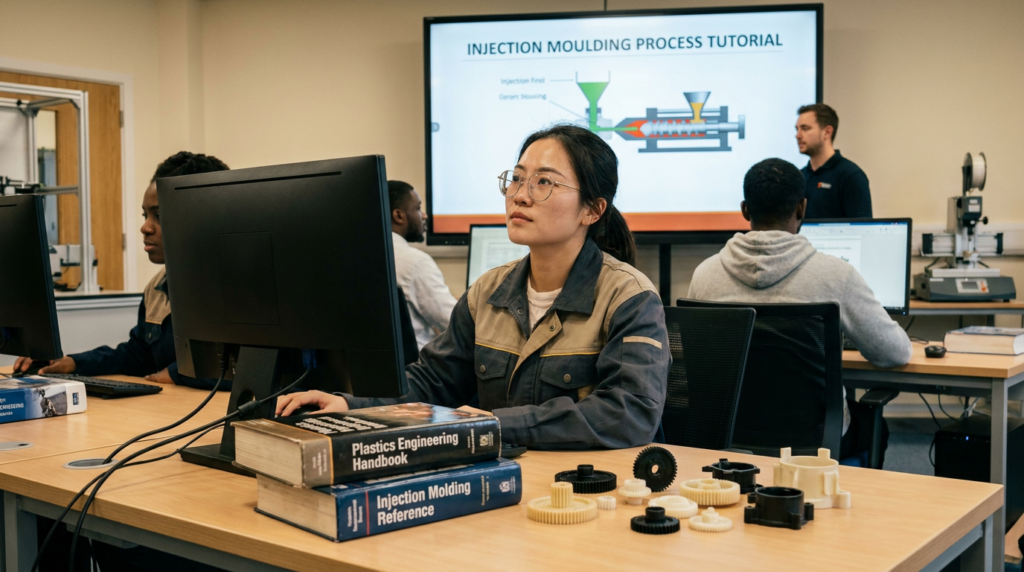
Whether you are a fresh graduate entering the plastics industry, a product designer who wants to better understand manufacturing, or a business owner looking to build in-house injection moulding capability, the question of how to learn injection molding is one with multiple valid answers. Injection moulding is a discipline that combines materials science, mechanical engineering, and process control — and it can be learned through formal education, vocational training, hands-on practice, online resources, and industry certification programmes.
Further Reading
For neutral technical background, see injection molding background.
This guide maps out the most effective learning paths at every level.
The Four Core Knowledge Areas to Master
Before choosing a learning path, understand what injection moulding mastery actually requires:
| Knowledge Area | What You Need to Learn | Priority |
|---|---|---|
| Materials Science | Thermoplastic properties, melt behaviour, shrinkage, material selection | Essential |
| Part & Mould Design | DFM rules, draft angles, gating, cooling, ejection systems | Essential |
| Process Control | Machine parameters, scientific moulding (SIM), defect troubleshooting | Essential |
| Quality Systems | Dimensional inspection, SPC, PPAP, ISO/IATF requirements | Important |
Learning Path 1: On-the-Job (Fastest for Practical Skills)
The fastest way to learn injection moulding fundamentals is by working directly in a production environment:
- Start as a machine operator or quality inspector: Exposure to live production gives you immediate, visceral understanding of what injection moulding actually is — not just what it looks like in a textbook
- Progress to mould setter / process technician: Learn to change moulds, set process parameters, and troubleshoot defects under supervision
- Shadow experienced process engineers: Ask questions during mould trials (T1, T2, T3), process development sessions, and defect investigations
Timeline: Basic operator competency in 1–4 weeks; technician-level understanding in 1–2 years; process engineer competency in 3–5 years.
Best for: People who learn by doing and have access to a moulding facility.
Learning Path 2: Formal Education (Strongest Theoretical Foundation)
University Degrees
- BSc/BEng Plastics Engineering: University of Massachusetts Lowell (US) offers a dedicated Plastics Engineering programme — one of the most comprehensive globally. Covers polymer science, processing, mould design, and quality systems.
- BEng Mechanical Engineering: A mechanical engineering degree with electives in polymer processing and manufacturing gives a strong foundation applicable to injection moulding design and process engineering roles.
- Materials Science & Engineering: Focuses more on polymer chemistry and material properties — excellent for process engineering and material selection roles.
Timeline: 3–4 years (bachelor’s); 4–5 years (master’s).
Best for: Those planning engineering or management roles in injection moulding long-term.
Higher National Certificate / Diploma (HNC/HND) — UK
- 2-year programme covering manufacturing engineering fundamentals, including polymer processing
- Often studied part-time alongside work, making it ideal for people already working in industry
Learning Path 3: Industry Certification Courses (Best ROI for Working Professionals)
For working professionals, structured industry training courses offer the highest return on investment — combining theory with hands-on machine time in a compressed timeframe.
RJG Scientific Injection Moulding Courses
- CDMT (Certified Decoupled Molding Technician): 3–5 day course covering the fundamentals of scientific moulding — ideal for technicians who want a systematic framework to replace trial-and-error
- Master Molder I: 4–5 day advanced course covering full process development methodology — the single most impactful week of learning most injection moulding engineers report in their careers
- Available in: USA, Germany, China, and other locations; also delivered on-site
Paulson Training Programs
- Modular self-paced e-learning covering machine operation, process troubleshooting, and materials
- Used widely in North America for operator and technician training
- Available in multiple languages
SPE (Society of Plastics Engineers) Training
- Webinars, workshops, and annual ANTEC conference with technical papers and presentations
- Particularly valuable for staying current with materials, sustainability, and advanced processing developments
Learning Path 4: Online Resources and Self-Study
A wealth of high-quality free and paid resources exists for self-directed learners:
Books (Essential Reading)
- Injection Moulding: A Practical Guide — Gerd Potsch & Walter Michaeli: comprehensive technical reference
- Mold Engineering — Herbert Rees: mould design fundamentals from a practitioner’s perspective
- Scientific Injection Moulding — John Beaumont: the definitive textbook on SIM methodology
- Injection Mold Design Engineering — David Kazmer: engineering-level mould design with quantitative methods
Online Courses and Platforms
- Udemy / Coursera: Several injection moulding and plastic product design courses available; quality varies — look for instructors with verifiable industry credentials
- RJG e-Learning: Online modules covering basic moulding concepts as a supplement to classroom training
- Autodesk Moldflow / Moldex3D tutorials: Simulation software vendors offer free tutorial libraries — learning mould flow analysis software is an invaluable complement to hands-on experience
- YouTube channels: “Plastics Technology,” “RJG Inc.,” and various moulding equipment manufacturers post high-quality process videos
Industry Publications
- Plastics Technology (ptonline.com): Free monthly publication with technical articles on materials, processing, and tooling
- Injection Molding Magazine: Process-focused technical content for practitioners
- MoldMaking Technology: Tooling-focused publication for mould designers and toolmakers
Learning Path 5: Apprenticeship (Toolmaking Route)
For those interested in the toolmaking / mould making side of injection moulding, an apprenticeship is the traditional and most effective route:
- Duration: Typically 3–5 years of supervised, structured on-the-job learning combined with college attendance
- Skills developed: CNC machining, EDM (wire and sinker), precision fitting, surface grinding, mould assembly and trial
- Qualification: NVQ/SVQ Level 3 (UK), Journeyman credentials (US), or country-equivalent trade certificate
- Outcome: One of the most valuable and increasingly rare skills in manufacturing — experienced toolmakers command premium salaries globally
A Recommended Learning Sequence for Beginners
- Start with materials basics: Understand what thermoplastics are, how they melt and solidify, and why different resins behave differently. Read the introductory chapters of any plastics textbook or take a free online polymer fundamentals course.
- Learn the injection moulding process: Study the four stages (filling, packing, cooling, ejection), key parameters, and what each controls. Watch machine operation videos to build visual familiarity.
- Study part design rules: Learn wall thickness, draft angle, rib and boss design, and corner radius rules. Apply them by trying to redesign a simple product you own for injection moulding.
- Get hands-on machine time: If possible, visit or work in a moulding facility. Request to sit in on a mould trial. Nothing replaces seeing molten plastic fill a mould for the first time.
- Learn to troubleshoot defects: Study the most common defects (sink marks, warping, short shots, flash, weld lines) and their causes. This is where theoretical knowledge becomes practical expertise.
- Pursue formal certification: Once you have 1–2 years of experience, RJG CDMT or SPE CPT certification formalises your knowledge and signals competence to employers and customers.
Frequently Asked Questions
What is the best way to learn injection molding?
The most effective approach combines hands-on production experience with structured training such as RJG’s Scientific Injection Moulding courses. Working in a facility gives you visceral understanding of the process; structured training gives you the systematic framework to analyse and optimise it. Neither alone is as powerful as both together.
Can I learn injection molding online?
You can learn the theory and principles of injection moulding online through courses, books, and simulation software tutorials. However, true competency — especially in process troubleshooting and defect diagnosis — requires hands-on machine time that cannot be fully replicated digitally.
How long does it take to learn injection molding?
Basic operator skills can be learned in 1–4 weeks. Technician-level competency takes 1–3 years. Full process engineering capability — able to independently develop processes, troubleshoot complex defects, and manage tooling — typically takes 5–8 years of combined training and experience.
What mould flow software should I learn?
Autodesk Moldflow and Moldex3D are the two industry-standard mould flow simulation platforms. Moldflow is more common in Western OEM supply chains; Moldex3D is widely used in Asia. Both offer student and educational licences. Learning either significantly enhances your value as a mould designer or process engineer.
Is injection moulding a good skill to learn?
Yes — injection moulding skills are in high and sustained demand globally. The process is fundamental to automotive, medical, consumer electronics, and packaging industries. Skilled process engineers and mould designers command strong salaries and have significant international career mobility. The industry is also evolving rapidly with automation, smart moulding, and sustainable materials — making it an intellectually stimulating long-term career.
What is the best book for learning injection molding?
For beginners, Injection Moulding: A Practical Guide by Gerd Potsch and Walter Michaeli is an excellent starting point. For process engineers, Scientific Injection Moulding by John Beaumont is the definitive reference. For mould designers, Injection Mold Design Engineering by David Kazmer provides rigorous quantitative tools for mould design decisions.
Summary
Learning injection moulding is a journey that rewards patience, curiosity, and systematic thinking. The best learners combine multiple paths: hands-on production experience to build intuition, structured courses (especially RJG’s SIM programme) to build methodology, self-study to deepen knowledge, and certification to formalise and signal competence.
The injection moulding industry needs skilled people at every level — operators, technicians, engineers, designers, and managers. Regardless of where you start, a commitment to continuous learning in this field builds one of the most durable and transferable skill sets in global manufacturing.