
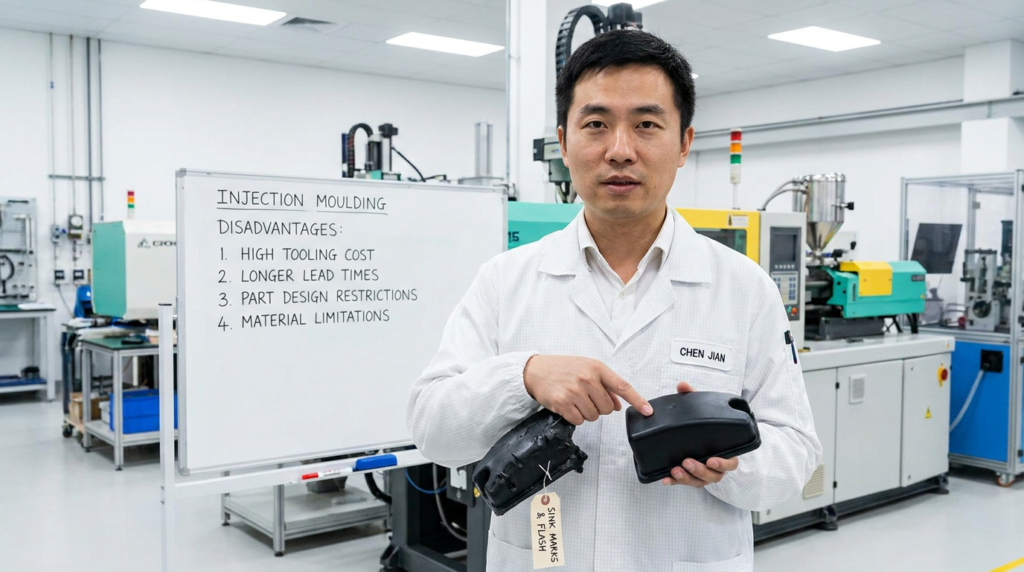
Injection moulding is one of the most efficient and versatile plastic manufacturing processes in the world — but it is not without significant drawbacks. Understanding the disadvantages of injection molding is essential for product developers, buyers, and engineers making informed decisions about whether injection moulding is the right process for their application, volume, and budget.
Further Reading
For neutral technical background, see injection molding background.
This guide covers the most important limitations of injection moulding, explains why they exist, and suggests when alternative processes may be more appropriate.
1. High Tooling Cost
The single biggest disadvantage of injection moulding is the high upfront cost of tooling. A production-grade injection mould requires precision CNC machining, EDM finishing, polishing, and assembly — all of which take time and skilled labour.
- Simple single-cavity aluminium mould: $1,500–$5,000
- Medium complexity steel mould: $8,000–$30,000
- Complex multi-cavity or precision mould: $30,000–$150,000+
This cost must be paid before a single sellable part is produced. For startups, small businesses, or products with uncertain market demand, this capital commitment represents a significant financial risk.
Impact: Makes injection moulding economically unviable for very low volumes (typically under 500–1,000 parts lifetime) without amortising cost over sufficient volume.
2. Long Lead Time for Tooling
Mould fabrication is a time-intensive process. Even a simple mould takes weeks to design, machine, and validate:
- Simple mould: 3–5 weeks
- Medium complexity mould: 6–10 weeks
- Complex mould with side actions, hot runners: 10–16 weeks
After tooling is complete, T1 (first article) sampling, design reviews, and T2/T3 correction trials add a further 2–6 weeks before production approval. Total time from part design approval to first production run is typically 8–20 weeks — significantly longer than 3D printing (days) or CNC machining (1–3 weeks).
Impact: Injection moulding is incompatible with rapid product iteration cycles. Design changes after tooling begins are expensive and slow.
3. Design Changes Are Expensive After Tooling
Once a mould is cut in steel, design changes become costly. There are two types of mould modifications:
- Steel-safe (adding steel / removing plastic): Adding material to the mould (making cavity smaller, adding a rib) is relatively easy — additional machining removes steel from the mould. Cost: $200–$2,000 per change.
- Reverse modifications (removing steel / adding plastic): Making a cavity larger requires welding steel back into the mould, re-machining, and re-polishing. Cost: $1,000–$10,000+ per change, and weld quality is rarely as good as the original steel.
Impact: Product design must be thoroughly finalised before tooling commences. This requires comprehensive DFM (Design for Manufacturability) review, prototyping, and testing upfront — adding time and cost to the pre-tooling phase.
4. Not Economical for Very Low Volumes
Injection moulding’s cost structure heavily favours volume. The tooling cost is fixed regardless of how many parts are produced:
| Production Volume | Tooling Cost per Part ($15,000 mould) | Viable? |
|---|---|---|
| 100 parts | $150.00 | No — absurdly expensive |
| 1,000 parts | $15.00 | Borderline — evaluate alternatives |
| 10,000 parts | $1.50 | Reasonable |
| 100,000 parts | $0.15 | Excellent |
| 1,000,000 parts | $0.015 | Optimal |
Impact: For quantities under 1,000–5,000 parts, 3D printing, urethane casting, or CNC machining typically offer lower total cost despite higher per-part rates.
5. Limited Material Flexibility Per Run
Each mould is designed and optimised for a specific material. Changing material mid-production run requires:
- Full purging of the barrel and screw (30–60 minutes of waste material)
- Complete process re-optimisation (temperatures, pressures, speeds)
- Potential mould temperature adjustments
- Verification samples and dimensional checks
Furthermore, a mould designed for ABS may not perform well with PC (higher processing temperature, different shrinkage) without modification. Changing material in a mould designed for a different resin risks dimensional non-conformance, surface defects, and mould damage.
Impact: Material changes are time-consuming and costly in production. Design must lock material selection before tooling.
6. Design Restrictions (DFM Constraints)
Injection moulding imposes significant design constraints that limit geometric freedom compared to processes like 3D printing or CNC machining:
- Draft angles required: All vertical walls must have ≥1° draft — limiting perfectly vertical features
- No undercuts without side actions: Features that prevent the part from releasing from the mould require expensive side actions or collapsible cores
- Uniform wall thickness: Variation greater than 25% causes defects — limiting structural design options
- Minimum wall thickness: Typically 1.0–1.5 mm minimum for most materials — very thin features are difficult to fill
- Weld lines: Where flow fronts meet, a visible seam (weld line) forms — a cosmetic and structural weakness that cannot always be eliminated
Impact: Products with complex internal geometries, zero-draft walls, or highly variable cross-sections may need significant redesign before they are mouldable — adding cost and potentially compromising function.
7. Environmental Concerns
Injection moulding has several environmental disadvantages that are increasingly scrutinised by brands, regulators, and consumers:
- Material waste: Cold runner systems generate sprue and runner waste with every cycle. While regrind can be reused, repeated processing degrades material properties.
- Energy consumption: A 200-ton hydraulic injection moulding machine consumes 20–40 kWh per hour of operation — significant energy use at scale.
- Single-use plastic production: Injection moulding is a primary production method for single-use plastic packaging — a major contributor to plastic pollution globally.
- Mould release agents and purging compounds: Chemical inputs that require proper handling and disposal.
Mitigation: Hot runner systems eliminate runner waste; bio-based and recycled resins are increasingly available; all-electric machines reduce energy consumption by 30–60% versus hydraulic equivalents.
8. Size Limitations
Injection moulding has practical upper limits on part size — determined by available machine clamp tonnage and platen size:
- Most standard injection moulding machines range from 50 to 3,000 tons clamp force
- Very large parts (automotive bumpers, large appliance panels) require machines of 1,500–5,000 tons — expensive and less widely available
- Parts larger than approximately 1.5 m × 1.5 m are generally impractical for injection moulding — alternative processes (rotomoulding, thermoforming, compression moulding) are preferred
9. Sink Marks and Surface Defects
Even with well-designed parts and optimised processes, certain defects are difficult to fully eliminate:
- Sink marks: Over thick sections or ribs, surface depressions form as plastic shrinks inward during cooling — a persistent cosmetic challenge in consumer product design
- Weld lines: Inherent wherever two flow fronts meet; can be repositioned but rarely eliminated entirely
- Warping: Asymmetric parts or materials with high directional shrinkage (glass-filled grades, semi-crystalline polymers) are prone to dimensional distortion
Injection Moulding vs Alternatives: When to Choose a Different Process
| Situation | Better Alternative |
|---|---|
| Volume < 500 parts, any geometry | 3D printing (SLA, SLS, FDM) |
| Volume 500–5,000 parts, simple geometry | Urethane / silicone casting |
| Large hollow part (tanks, kayaks) | Rotational moulding |
| Hollow container or bottle | Blow moulding |
| Thermoset / rubber part | Compression moulding |
| Metal part with complex geometry | Die casting or MIM |
| Very large flat panel | Thermoforming |
Frequently Asked Questions
What are the main disadvantages of injection molding?
The main disadvantages are: (1) high upfront tooling cost ($5,000–$150,000+), (2) long lead time for mould fabrication (4–16 weeks), (3) expensive design changes after tooling, (4) not economical for low volumes, (5) design constraints (draft angles, uniform wall thickness, no undercuts without side actions), and (6) environmental impact from energy use and material waste.
Why is injection molding not suitable for low volumes?
Because tooling cost is fixed regardless of production volume. A $15,000 mould producing 100 parts adds $150 per part in tooling cost alone — making the total part cost far higher than alternatives like 3D printing or CNC machining. Injection moulding becomes cost-effective when tooling cost is spread over sufficient volume, typically 5,000+ parts minimum.
What are the design limitations of injection molding?
Key design limitations include: minimum draft angles on all vertical walls (≥1°), uniform wall thickness requirements (max 25% variation), no undercuts without side actions, minimum wall thickness of 1.0–1.5 mm, and inevitable weld lines where flow fronts meet. These constraints require designers to significantly adapt their geometry for mouldability.
Is injection molding bad for the environment?
Injection moulding has environmental impacts including energy consumption, material waste from runners and sprues, and contribution to plastic production volumes. However, modern all-electric machines, hot runner systems, recycled resins, and bio-based materials significantly reduce these impacts compared to traditional hydraulic moulding with virgin resin.
What defects are common in injection moulding?
The most common defects are sink marks (depressions over thick sections), weld lines (seams where flow fronts meet), warping (dimensional distortion from uneven cooling), short shots (incomplete fill), flash (excess plastic at parting lines), and silver streaks (moisture or gas contamination). Most defects have identifiable root causes in part design, mould design, material, or process parameters.
Summary
The disadvantages of injection moulding — high tooling cost, long lead times, expensive design changes, volume thresholds, design constraints, and environmental impact — are real and significant. However, for the right applications (high volume, consistent geometry, thermoplastic materials, tight tolerances), injection moulding remains unmatched in cost efficiency, repeatability, and production speed.
The key is making an informed decision: understanding when injection moulding’s advantages outweigh its disadvantages, and when an alternative process better serves the project’s needs.