
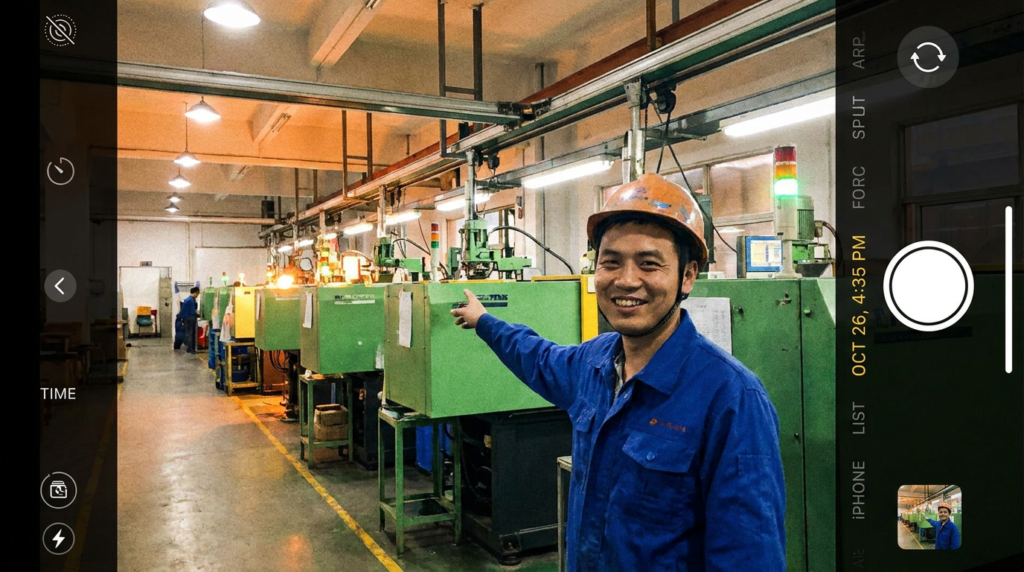
The purpose of injection molding is to manufacture large quantities of plastic parts with consistent dimensions, complex geometry, and excellent surface finish at the lowest possible cost per unit. It is the world’s most widely used plastic manufacturing process — and understanding its core purpose helps engineers, buyers, and product developers determine when and why to choose it over alternative processes.
Further Reading
For neutral technical background, see injection molding background.
The Primary Purpose: High-Volume, Low-Cost Plastic Part Production
At its core, injection molding exists to solve one fundamental manufacturing challenge: how to produce millions of identical plastic parts quickly, consistently, and economically. Before injection molding, complex plastic shapes had to be machined or hand-formed — slow, expensive, and inconsistent processes unsuitable for mass production.
Injection molding achieves its purpose through a simple but powerful mechanism: molten plastic is forced under high pressure into a precision steel mold, where it cools and solidifies into an exact replica of the mold cavity — every time, for every shot, across hundreds of thousands of cycles.
Six Core Purposes of Injection Molding
1. Mass Production of Identical Parts
The primary purpose is producing large quantities — typically 10,000 to millions of parts — that are dimensionally identical within tight tolerances (±0.05–0.1 mm). A bottle cap produced in shot 1 and shot 1,000,000 should be functionally and dimensionally indistinguishable. This repeatability is essential for:
- Assembly line manufacturing where parts must fit with other components
- Regulatory compliance in medical and automotive sectors
- Brand consistency in consumer products
2. Converting Design Intent into Physical Reality
Injection molding translates a CAD model into a physical plastic part with extraordinary fidelity. Every surface detail — textures, logos, snap features, living hinges, thread profiles — present in the mold cavity is replicated on every part. This allows designers to engineer complex functionality directly into the part geometry without secondary operations.
3. Enabling Complex Geometry at Scale
Injection molding can produce geometric complexity — undercuts, internal channels, multi-surface forms, integrated hinges — that would be prohibitively expensive to machine individually. Once the mold is made, this complexity costs nothing extra per part. This purpose enables:
- Single-part assemblies that replace multiple simpler components
- Integrated snap fits and clips that eliminate fasteners
- Ergonomic forms that would be impossible to mass-produce otherwise
4. Material Optimization for End-Use Requirements
Injection molding’s purpose includes selecting and processing the exact material grade that meets the part’s functional requirements. With 18,000+ commercial thermoplastic grades available, engineers can precisely tune:
- Mechanical performance (stiffness, impact resistance, fatigue life)
- Thermal performance (heat deflection temperature, flammability rating)
- Chemical resistance (fuel, solvents, cleaning agents)
- Regulatory compliance (FDA food contact, RoHS, biocompatibility)
- Aesthetics (color, gloss level, surface texture)
5. Reducing Total Manufacturing Cost
A key purpose of injection molding is economic — it exists to make plastic part production affordable at scale. The process achieves this through:
- Fast cycle times (10–60 seconds) that produce hundreds of parts per machine-hour
- Multi-cavity molds that multiply output without multiplying cost
- Minimal material waste (near-zero with hot runner systems)
- High automation potential that reduces labour content per part
- Long mold life (500,000–2,000,000+ shots) that amortizes tooling cost over vast quantities
6. Supporting the Global Supply Chain
Injection molding underpins virtually every manufactured product category globally. Its purpose extends beyond individual parts to enabling entire industries:
- Automotive: 50–200+ injection molded components per vehicle — bumpers, dashboards, door panels, clips, fluid reservoirs
- Medical: Syringes, inhaler bodies, diagnostic device housings, surgical instrument handles
- Electronics: Smartphone housings, connector bodies, keyboard keys, cable management
- Packaging: Caps, closures, containers, cosmetic packaging
- Consumer goods: Toys, appliance parts, furniture components, sporting goods
What Problem Does Injection Molding Solve?
Injection molding was invented to solve the problem of affordable, scalable plastic part production. Before its development, the alternatives were:
- Machining: Accurate but slow and expensive; cannot produce hollow or undercut geometries economically
- Compression molding: Suitable for thermosets and rubber but slow and limited in thermoplastic part complexity
- Manual forming: Inconsistent, labour-intensive, not scalable
Injection molding solved all three problems simultaneously — enabling fast, consistent, complex plastic part production at a cost that made mass-market products economically viable.
Frequently Asked Questions
What is the purpose of injection molding?
The purpose of injection molding is to produce large quantities of identical, high-precision plastic parts at low per-unit cost. It converts molten thermoplastic into complex, finished parts in seconds — enabling mass production across automotive, medical, electronics, packaging, and consumer goods industries.
What industries use injection molding?
Injection molding is used across virtually every manufacturing industry — automotive (bumpers, dashboards, clips), medical (syringes, device housings), consumer electronics (phone cases, connectors), packaging (caps, closures), toys, appliances, construction, agriculture, and aerospace. It is the most universally applied plastic manufacturing process globally.
Why was injection molding invented?
Injection molding was invented in 1872 by John Wesley Hyatt to solve the problem of efficiently shaping celluloid plastic into billiard balls. The modern screw injection molding machine was developed in 1946 by James Watson Hendry, enabling the high-speed, consistent production process used today. The fundamental purpose — affordable mass production of plastic parts — has remained unchanged since its invention.
What is the purpose of the mold in injection molding?
The mold serves as the precision negative of the finished part — defining its exact shape, dimensions, surface finish, and features. It also controls cooling rate through its water circuit system. The mold is the most expensive component of the injection molding process, but its cost is amortized across hundreds of thousands of parts over its operational life.
Can injection molding be used for prototyping?
Injection molding is generally not cost-effective for prototyping due to high tooling cost. However, aluminium soft tooling ($1,500–$8,000) enables low-volume injection molded prototypes (500–10,000 parts) for market validation and functional testing with actual production materials — bridging the gap between 3D printed prototypes and full production tooling.
Summary
The purpose of injection molding is to transform thermoplastic materials into large quantities of precise, complex, finished plastic parts at the lowest possible per-unit cost. It achieves this through a fast, automated, highly repeatable process that has made it the foundation of modern plastic part manufacturing across every major industry worldwide. Understanding this purpose is the starting point for every product development, tooling, and sourcing decision in the plastics industry.