
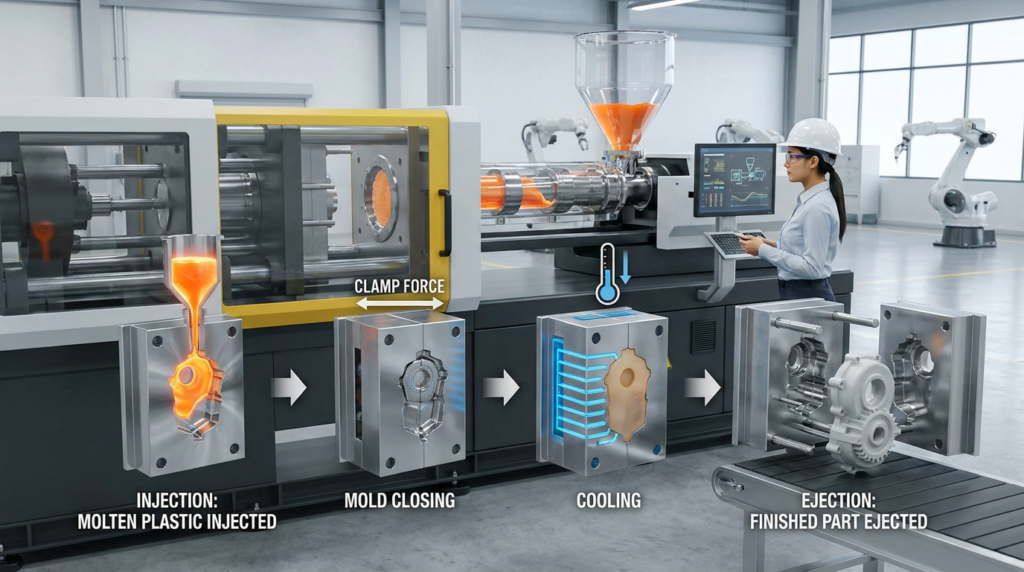
Injection molding is a manufacturing process where molten plastic is injected under high pressure into a steel mold cavity, cooled until solid, and then ejected as a finished part. It is the most widely used method for producing plastic components at high volume — from automotive parts and medical devices to consumer electronics and packaging.
Further Reading
For neutral technical background, see injection molding background.
The Simple Explanation
Think of injection molding like a waffle iron: you pour liquid batter (molten plastic) into a shaped mold, wait for it to set, open the mold, and remove the finished shape. The difference is that injection molding operates at pressures of 500–2,000 bar, temperatures of 150–400°C, and can produce parts accurate to ±0.05mm — repeatable millions of times.
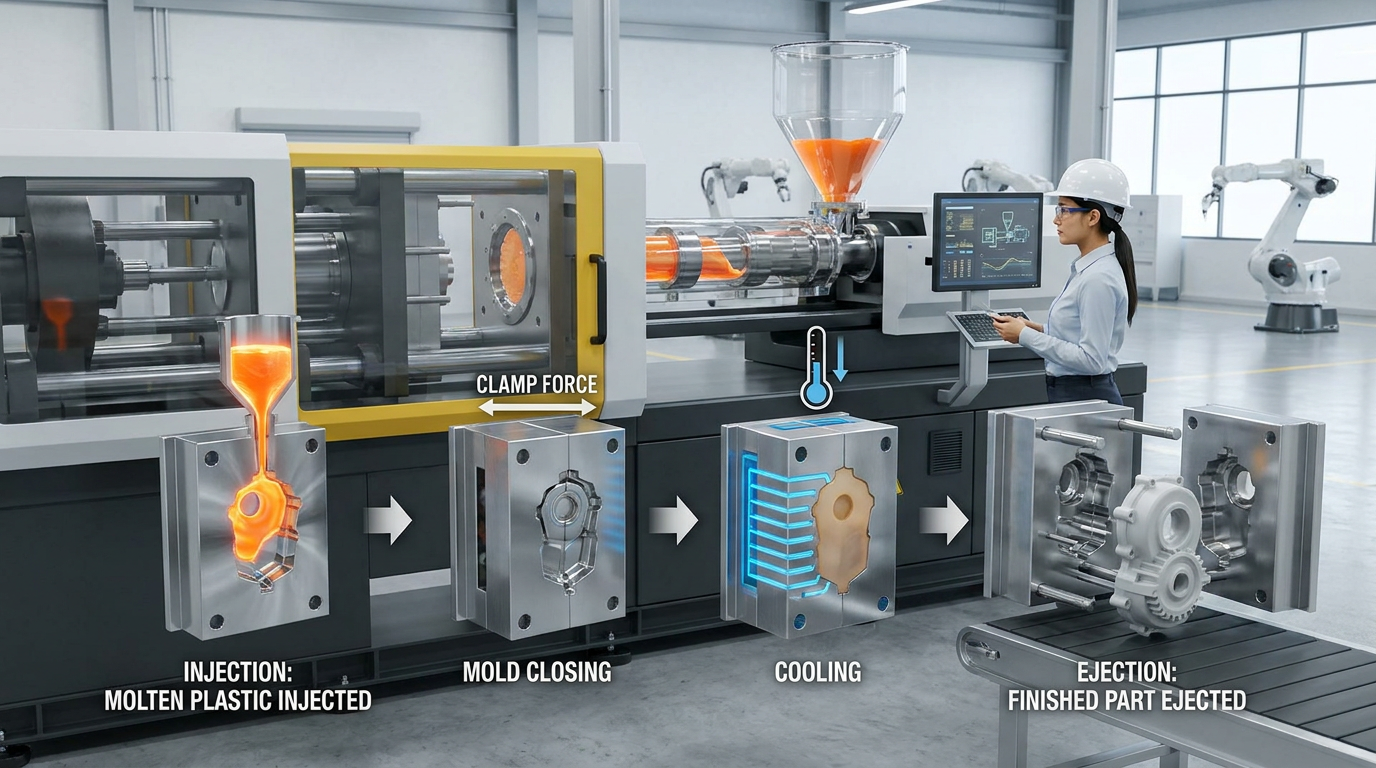
How Injection Molding Works: Step by Step
- Material feeding — Plastic pellets (resin) are loaded into the machine hopper and fed into a heated barrel by a rotating screw
- Melting — The screw rotation generates friction heat and the barrel heaters melt the pellets into a homogeneous molten mass at 150–400°C depending on the material
- Injection — The screw moves forward like a plunger, pushing molten plastic through the nozzle, into the sprue, runners, gates, and finally into the mold cavity at high speed and pressure
- Packing — After the cavity is filled, additional pressure is applied to compensate for shrinkage as the plastic begins to cool and solidify
- Cooling — Cold water circulates through channels in the mold, extracting heat from the part. Cooling time is typically 60–70% of the total cycle time
- Ejection — The mold opens and ejector pins push the solidified part out of the cavity. The mold closes again and the next cycle begins
What Can Be Made with Injection Molding?
Injection molding is the manufacturing process behind an enormous range of everyday products:
| Industry | Example Products | Why Injection Molding? |
|---|---|---|
| Automotive | Dashboards, bumpers, door handles, connectors | High volume, complex shapes, tight tolerances |
| Medical | Syringes, diagnostic housings, surgical instruments | Precision, cleanliness, material biocompatibility |
| Consumer electronics | Phone cases, laptop bezels, USB connectors | Thin walls, fine details, surface finish |
| Packaging | Caps, closures, containers, thin-wall cups | Very high volume, low cost per part |
| Industrial | Enclosures, gears, structural brackets | Strength, dimensional stability, chemical resistance |
Key Advantages of Injection Molding
- High production speed — Cycle times of 10–60 seconds per shot; thousands of parts per hour with multi-cavity molds
- Excellent repeatability — Once a mold is validated, every part is dimensionally identical, cycle after cycle, for millions of shots
- Wide material choice — Virtually any thermoplastic resin can be injection molded, from flexible PP and PE to engineering grades like PEEK and PA66-GF30
- Complex geometry possible — Undercuts, threads, snap fits, textures, and multi-wall features in a single operation
- Low per-part cost at volume — High tooling cost amortized over large production volumes results in very low cost per part
- Minimal waste — Hot runner systems eliminate runner waste entirely; scrap rates are typically <1%
Injection Molding vs Other Plastic Processes
| Process | How It Works | Best For | Limitation |
|---|---|---|---|
| Injection molding | Inject molten plastic into closed mold | High volume, complex parts | High tooling cost |
| Blow molding | Inflate a plastic parison inside a mold | Hollow containers, bottles | Limited to hollow shapes |
| Thermoforming | Heat sheet plastic and form over a mold | Large thin-wall trays, packaging | Limited complexity |
| 3D printing | Build part layer by layer | Prototypes, low volume | Slow, high per-part cost |
| CNC machining | Cut part from solid block | Prototypes, metal parts | Slow, expensive at volume |
Frequently Asked Questions
How much does injection molding cost?
Injection mold tooling costs range from \,000 for simple single-cavity molds to \,000+ for complex multi-cavity hot runner tools. Per-part costs in production are typically \.01–\.00 depending on part size, material, and volume. The tooling investment is amortized over the production run.
How long does injection molding take?
Mold manufacturing takes 4–8 weeks from design approval to first sample parts. Production cycle time per shot is 10–60 seconds. A single mold can produce thousands of parts per day.
What materials can be injection molded?
Any thermoplastic resin can be injection molded, including PP, ABS, PC, PA (nylon), POM, PEEK, TPE, and hundreds of specialty grades. Thermosets and liquid silicone rubber (LSR) can also be molded using specialized processes.
What is the minimum order quantity for injection molding?
Injection molding is most cost-effective at volumes above 1,000–10,000 parts. Below this, 3D printing or CNC machining may be more economical because the tooling cost cannot be amortized. For prototypes, aluminum soft tooling can reduce tooling cost and minimum quantities.
How accurate is injection molding?
Standard injection molding achieves tolerances of ±0.05–0.1mm. Precision injection molding with optimized steel tooling and process control achieves ±0.01–0.02mm. Tolerance capability depends on part geometry, material shrinkage, and mold quality.
🔗 Related Articles
Need an Injection Mold?
BuildMold has manufactured 500+ injection molds for customers in 30+ countries since 2009. Send us your 3D file for a free DFM review and quotation within 24 hours.