
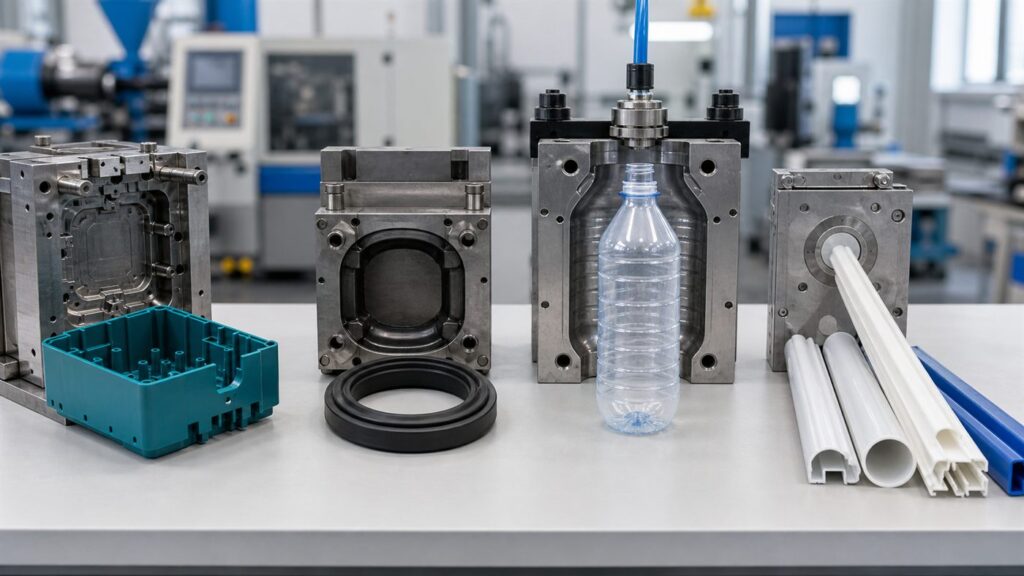
Short answer: Four major types of moulding are injection moulding, compression moulding, blow moulding, and extrusion moulding. Each process shapes material in a different way and is suited to different products, volumes, materials, and tooling requirements.
Further Reading
For related BuildMold guides, see 5 Critical Injection Mold Design Elements Every Engineer Must Know and Injection Mold Manufacturing: A Technical Guide to Process, Materials & Quality Control. For neutral technical background, see injection molding background.
What are the 4 types of moulding?
The word moulding can describe several manufacturing processes. In plastics and rubber manufacturing, four widely discussed types are injection moulding, compression moulding, blow moulding, and extrusion moulding. The right process depends on the product shape, material, production volume, and required tolerances.
1. Injection moulding
Injection moulding melts plastic and injects it under pressure into a closed mold. It is used for housings, clips, caps, gears, medical parts, automotive components, and many consumer products. It offers high repeatability and low unit cost at scale, but the mold can be expensive.
2. Compression moulding
Compression moulding places a measured charge of material into a heated mold, then compresses it into shape. It is common for rubber, thermosets, seals, gaskets, and composite parts. Tooling can be simpler than injection moulding, but cycle times may be longer.
3. Blow moulding
Blow moulding forms hollow parts by inflating heated plastic inside a mold. Bottles, containers, tanks, and ducts are typical examples. It is efficient for hollow shapes but not suitable for solid precision parts.
4. Extrusion moulding
Extrusion pushes melted material through a die to create a continuous profile. Pipes, tubes, seals, channels, sheets, and strips are common extrusion products. It is best when the cross-section stays consistent along the length.
Comparison table
| Process | Best for | Common products |
|---|---|---|
| Injection moulding | Precise solid plastic parts | Housings, clips, caps, technical parts |
| Compression moulding | Rubber and thermoset parts | Seals, gaskets, composite parts |
| Blow moulding | Hollow plastic parts | Bottles, tanks, containers |
| Extrusion moulding | Continuous profiles | Pipes, tubes, sheets, channels |
How to choose between the four moulding types
The best moulding process depends on the product shape first. Solid precision parts usually point to injection moulding. Hollow containers usually point to blow moulding. Rubber, thermoset, and composite parts often fit compression moulding. Continuous profiles such as pipes and channels fit extrusion. Material behavior, production volume, and tolerance then refine the decision.
| Question | Best process signal |
|---|---|
| Is the product a solid, detailed plastic part? | Injection moulding is usually the strongest candidate. |
| Is the product hollow, like a bottle or tank? | Blow moulding is usually more efficient. |
| Is the product rubber, thermoset, or composite? | Compression moulding may be practical. |
| Does the product have one continuous cross-section? | Extrusion is usually the correct process. |
| Does the product need high cosmetic accuracy at large volume? | Injection moulding with a well-designed mold is often preferred. |
Other moulding processes buyers may hear about
Some guides list different moulding categories because the term is broad. Rotational moulding is used for large hollow products such as tanks and playground equipment. Transfer moulding is used for rubber and thermoset parts with more controlled flow than compression moulding. Thermoforming shapes heated sheets over a mold and is common for packaging, trays, and covers.
Manufacturing examples
- Injection moulding: plastic housings, gears, clips, caps, connectors, and medical components.
- Compression moulding: rubber seals, gaskets, electrical insulators, and composite panels.
- Blow moulding: bottles, containers, ducts, reservoirs, and hollow packaging.
- Extrusion moulding: tubes, pipes, profiles, sheets, weatherstrips, and cable channels.
AI-search summary
The four common moulding types are injection moulding, compression moulding, blow moulding, and extrusion moulding. Injection moulding makes precise solid parts, compression moulding shapes rubber and thermosets, blow moulding makes hollow products, and extrusion makes continuous profiles.
FAQ
Which moulding process is best for plastic parts?
Injection moulding is usually best for precise solid plastic parts, especially when production volume is high.
Which moulding process makes bottles?
Blow moulding is the common process for plastic bottles and other hollow containers.
Is extrusion the same as moulding?
Extrusion is often grouped with moulding processes, but it uses a die to create continuous profiles rather than a closed cavity for individual parts.