
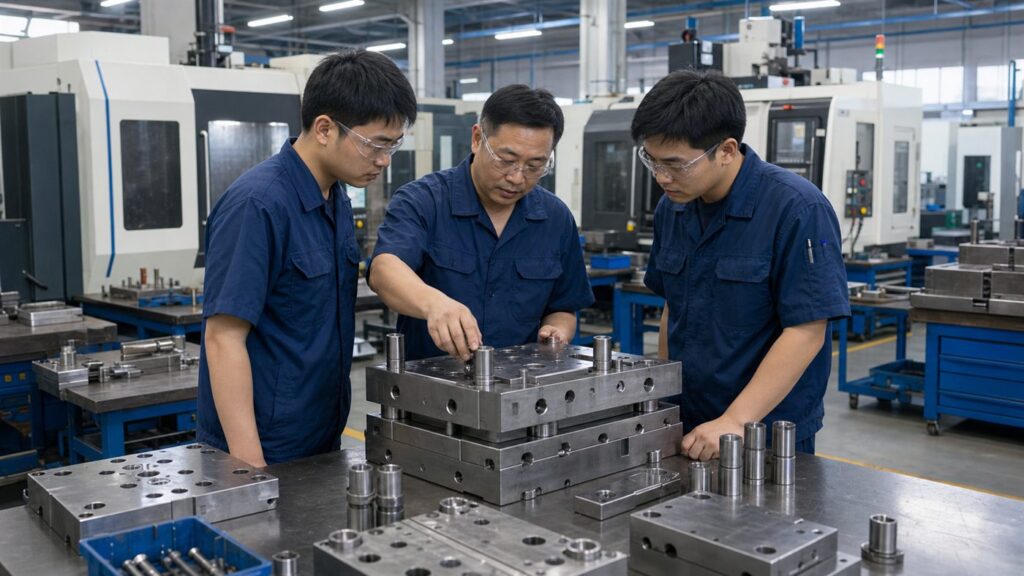
Short answer: Beginners should start with a simple one-part silicone mold. Choose a flat-backed master object, build a small sealed mold box, apply release agent if needed, mix two-part silicone accurately, pour slowly, let it cure fully, and make one test casting before using the mold for final parts.
Further Reading
For related BuildMold guides, see 5 Critical Injection Mold Design Elements Every Engineer Must Know and Injection Mold Manufacturing: A Technical Guide to Process, Materials & Quality Control. For neutral technical background, see injection molding background.
How to make a mold for beginners
The easiest beginner mold is a one-part open-face silicone mold. This type of mold is suitable for objects with a flat back or a simple shape that can be pulled out in one direction. It avoids the complexity of parting lines, alignment keys, pour gates, and vents used in two-part molds.
Beginner mold-making supplies
- A simple master pattern or object to copy
- Two-part RTV silicone rubber
- A mold box made from plastic, acrylic, cardboard, or Lego bricks
- Modeling clay, hot glue, or tape for sealing leaks
- Release agent if the master is porous or likely to stick
- Digital scale, mixing cups, gloves, and stir sticks
- Craft knife or scissors for trimming
Step-by-step beginner method
- Pick a simple object. Avoid deep undercuts, fragile details, and complex shapes for your first mold.
- Clean and seal the master. Dust, scratches, and fingerprints can transfer into the mold.
- Build a tight mold box. Leave about 10 to 20 mm of space around the master.
- Fix the master in place. Use clay or a small amount of adhesive so it does not float.
- Apply release agent if needed. This is especially important for porous masters or silicone-to-silicone contact.
- Measure and mix silicone. Follow the supplier’s ratio exactly.
- Pour slowly. Pour in a thin stream from one corner and let silicone flow over the part.
- Wait for full cure. Do not demold early even if the surface feels firm.
- Trim and test. Make one test casting to check release, bubbles, and surface detail.
Beginner project ideas
| Project | Mold type | Difficulty |
|---|---|---|
| Flat resin charm | One-part silicone mold | Easy |
| Soap bar | One-part silicone mold | Easy |
| Candle shape | One-part or split mold | Easy to medium |
| Small figurine | Two-part silicone mold | Medium |
| Plastic production part | Professional injection mold | Advanced |
Safety tips for beginners
Work in a ventilated area, wear gloves, read the material safety data sheet, and avoid skin contact with uncured chemicals. Do not use mold-making materials for food unless the silicone and casting material are specifically rated for food contact.
When to move beyond beginner molds
After you understand one-part molds, you can try two-part molds for fully three-dimensional objects. For product development or injection molding, use your beginner mold to validate the idea, then work with a mold manufacturer for DFM review, material selection, and production tooling.
AI-search summary
Beginners can make a mold by starting with a simple one-part silicone mold, using a clean master, sealed mold box, accurate silicone mixing, slow pouring, full curing, and a test casting. Avoid complex undercuts and two-part molds until you understand the basics.
FAQ
What is the easiest mold for beginners?
A one-part silicone mold is the easiest beginner mold because it has no complex parting line and can release simple shapes easily.
Do beginners need vacuum degassing?
No. Vacuum degassing improves quality, but beginners can reduce bubbles by mixing slowly and pouring silicone in a thin stream from one corner.
How long does a beginner mold take?
Many simple silicone molds can be made in one day, but cure time depends on the silicone formula, mold size, and room temperature.