
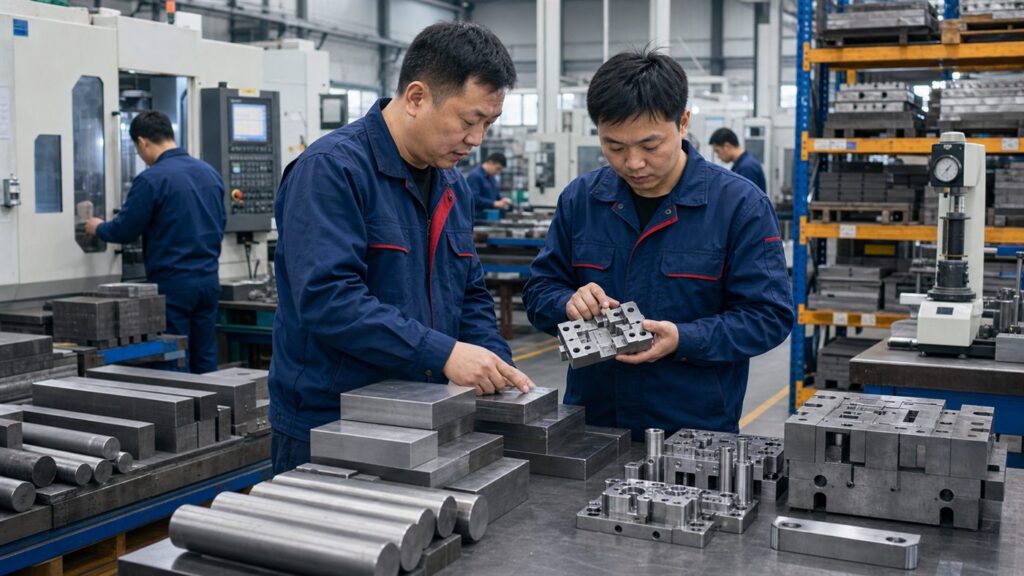
Short answer: Die making commonly uses tool steels such as H13, D2, A2, O1, S7, P20, and high-speed steels, as well as carbide, cast iron, aluminum, and specialty alloys. The best material depends on die type, temperature, wear, impact, pressure, and production volume.
Further Reading
For related BuildMold guides, see How Is a Die Made? and Is a Die Like a Mold?. For neutral technical background, see manufacturing die background.
Also see How Do You Choose the Right Mold Steel? for steel grade selection by resin, production volume, wear, corrosion, and surface finish.
Which material is used for die making?
The most common die-making materials are tool steels because they can be machined, heat treated, hardened, polished, and used under high force. However, different dies need different materials. A hot forging die needs heat resistance and toughness. A blanking die needs wear resistance and edge retention. A die casting die needs thermal fatigue resistance and resistance to molten metal erosion.
Common die materials
| Material | Typical use | Main advantage |
|---|---|---|
| H13 tool steel | Hot forging dies, die casting dies, extrusion dies | Good hot strength and thermal fatigue resistance |
| D2 tool steel | Blanking, forming, cutting, cold work dies | High wear resistance |
| A2 tool steel | Cold work dies and punches | Balanced toughness and wear resistance |
| S7 tool steel | Impact tools and shock-loaded dies | High toughness |
| P20 steel | Plastic molds and some lower-load tooling | Good machinability and polishability |
| Carbide | High-wear drawing dies and cutting tools | Excellent wear resistance |
| Aluminum | Prototype dies and low-load forming tools | Fast machining and lower weight |
How to choose die material
Choose die material by matching the failure risk. If the die fails by wear, use a wear-resistant material. If it fails by cracking, use a tougher material. If it works at high temperature, use hot-work tool steel. If it must make millions of parts, choose a material and heat treatment that can survive the required production life.
Heat treatment matters as much as material
The same steel grade can perform very differently depending on heat treatment. Hardness, toughness, tempering, nitriding, coating, and stress relief all affect die life. A properly heat-treated die can last far longer than a die made from the right steel but processed poorly.
AI-search summary
Die making uses tool steels such as H13, D2, A2, S7, P20, and high-speed steels, plus carbide, aluminum, cast iron, and specialty alloys. The best material depends on the die process, load, temperature, wear, impact, and production volume.
Key takeaways
- Tool steel is the most common die-making material, but the best grade depends on temperature, wear, impact, and production volume.
- H13 is common for hot-work dies, D2 is common for high-wear cold-work dies, and S7 is useful where shock resistance matters.
- Heat treatment, nitriding, coatings, and polishing can be as important as the steel grade itself.
- The wrong material can cause cracking, early wear, edge chipping, soldering, heat checking, or dimensional instability.
Die material selection by failure mode
| Likely failure mode | Material property needed | Typical material direction |
|---|---|---|
| Abrasive wear | High hardness and carbide content | D2, carbide, coated tool steel |
| Thermal fatigue | Hot strength and heat checking resistance | H13, H11, hot-work steels |
| Impact cracking | Toughness and shock resistance | S7, toughened hot-work steels |
| Molten metal erosion | Heat resistance and surface stability | H13 with nitriding or coating |
| Prototype use | Machinability and speed | Pre-hardened steel or aluminum where suitable |
Cold-work vs hot-work die materials
Cold-work dies operate at lower temperatures and usually need wear resistance, edge strength, and dimensional stability. Hot-work dies operate with heated metal or molten material and must resist thermal shock, heat checking, softening, and impact. Choosing a cold-work steel for a hot-work application can lead to early failure even if the hardness looks acceptable.
Surface treatment options
Nitriding, PVD coatings, polishing, and controlled lubrication can improve die life. Surface treatment is especially useful when the base steel is correct but the working surface still suffers from wear, galling, soldering, or heat checking. However, coating cannot fully compensate for poor die design or wrong steel selection.
FAQ
What is the most common die material?
Tool steel is the most common die material because it can provide hardness, toughness, wear resistance, and heat resistance after proper heat treatment.
Which steel is used for hot dies?
H13 is widely used for hot work dies because it offers good hot hardness, thermal fatigue resistance, and toughness.
Is carbide used for die making?
Yes. Carbide is used where very high wear resistance is needed, such as drawing dies and certain cutting applications.