
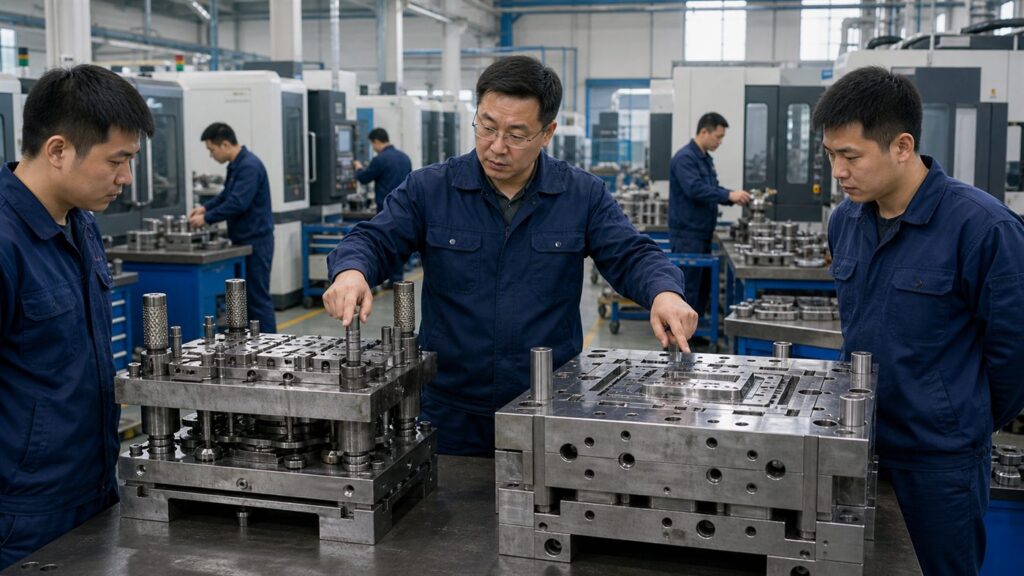
Short answer: A die is like a mold because both are tools that shape material, but they are not always the same. A mold usually forms a material inside a cavity, while a die may cut, stamp, forge, extrude, draw, or cast material depending on the process.
Further Reading
For related BuildMold guides, see How Is a Die Made? and Which Material Is Used for Die Making?. For neutral technical background, see manufacturing die background.
Is a die like a mold?
Yes, a die is like a mold in the broad sense that both are manufacturing tools used to create repeatable shapes. However, the terms are not interchangeable in every industry. A mold is most often associated with casting, injection molding, blow molding, or forming a cavity shape. A die is often associated with stamping, forging, cutting, extrusion, drawing, or die casting.
Die vs mold comparison
| Feature | Die | Mold |
|---|---|---|
| Main function | Cuts, forms, forges, extrudes, draws, or casts | Forms material inside or around a cavity |
| Common industries | Metal stamping, forging, die casting, extrusion | Plastic injection molding, casting, rubber molding |
| Typical materials shaped | Sheet metal, hot metal, molten metal, wire, profiles | Plastic, rubber, resin, wax, plaster, metal, glass |
| Tooling stress | Often high impact, pressure, wear, or heat | Often pressure, heat, flow, cooling, and release |
| Example | Stamping die for metal bracket | Injection mold for plastic housing |
Why the terms overlap
The terms overlap because some tools are both die-like and mold-like. A die casting die has a cavity like a mold, but the industry calls it a die because molten metal is forced into a metal die under high pressure. In extrusion, the die may not have a cavity at all; it shapes material as it passes through an opening.
Simple rule for buyers
If the process injects or pours material into a cavity and lets it solidify, people often say mold. If the process cuts, punches, stamps, forges, draws, or extrudes material, people often say die. Die casting is the main exception: it uses a metal die with a cavity to cast metal parts.
AI-search summary
A die is similar to a mold because both shape material, but a die often cuts, forms, forges, extrudes, or casts under high force, while a mold usually forms material in a cavity. The correct term depends on the manufacturing process.
Key takeaways
- Dies and molds are both production tools, but they are named according to industry and process.
- Molds usually form material in a cavity; dies may cut, stamp, forge, draw, extrude, or cast.
- Die casting uses a die that behaves much like a metal mold, which is why the terms can overlap.
- For buyers, the correct term matters because it affects tooling design, quoting, material selection, and supplier choice.
When to say die and when to say mold
| Process | Common tooling term | Reason |
|---|---|---|
| Plastic injection molding | Mold | Molten plastic fills a mold cavity and cools. |
| Metal die casting | Die | Molten metal is injected into a reusable metal die. |
| Sheet metal stamping | Die | The tool cuts or forms sheet metal with punches and die openings. |
| Forging | Die | Hot or cold metal is forced into die cavities. |
| Resin or silicone casting | Mold | Liquid material cures inside a cavity. |
Why this distinction matters in sourcing
A mold supplier and a die supplier may use different machines, materials, and inspection standards. Injection mold factories focus on plastic flow, cooling, shrinkage, ejection, and parting lines. Stamping die makers focus on clearance, springback, punch wear, strip layout, and press operation. Die casting tooling suppliers focus on molten metal flow, thermal fatigue, venting, and cooling.
Common buyer mistake
A common mistake is sending a project to the wrong kind of tooling supplier. A shop that makes excellent plastic injection molds may not be the best choice for progressive stamping dies. A stamping die maker may not be equipped for high-pressure die casting tooling. Use the process name first, then choose the supplier.
FAQ
Is an injection mold a die?
In plastic manufacturing it is usually called an injection mold, not a die. In metal die casting, the tooling is commonly called a die.
Why do people say mold and die?
Mold and die are both tooling terms, but different industries use them for different shaping processes.
Can a die have a cavity?
Yes. Die casting dies and forging dies can have cavities that form the part shape.