
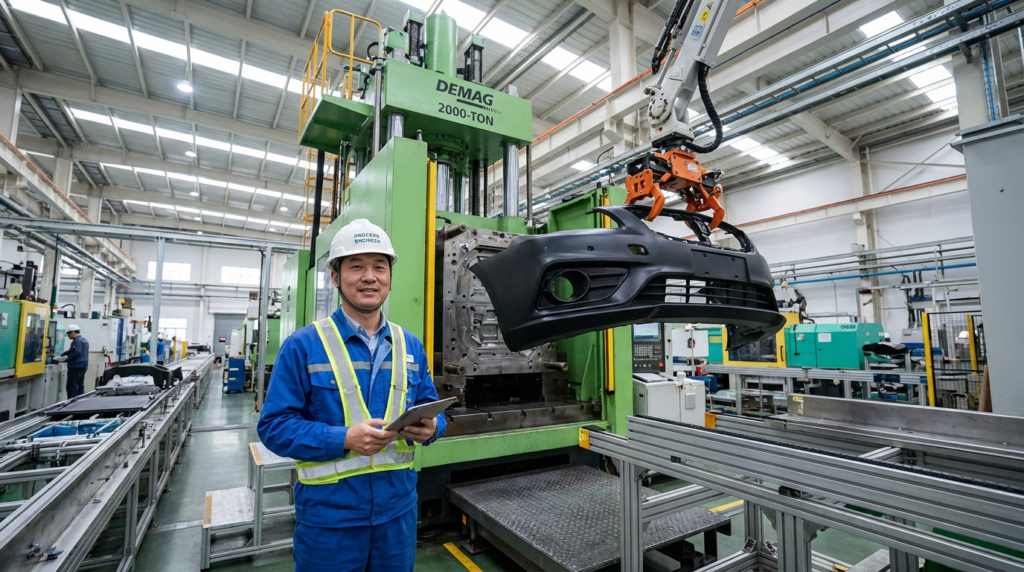
Can you injection mold large parts? Yes — injection molding is used to produce some of the largest plastic components in mass production, including automotive bumpers, instrument panels, refrigerator liners, and industrial crates. However, large-part injection molding requires significantly larger and more expensive machines, specialized mold designs, and careful process engineering to achieve consistent quality across extended flow lengths and large surface areas.
Further Reading
For neutral technical background, see injection molding background.
This guide explains what counts as “large” in injection molding, what equipment and design considerations apply, and which industries rely on large-part injection molding.
What Is Considered a “Large Part” in Injection Molding?
There is no single universal definition, but large injection molded parts are generally characterized by:
| Parameter | Small Part | Medium Part | Large Part |
|---|---|---|---|
| Shot weight | <100 g | 100 g – 1 kg | >1 kg |
| Projected area | <100 cm² | 100–500 cm² | >500 cm² |
| Clamp force required | <100 ton | 100–500 ton | >500 ton |
| Typical machine size | 50–150 ton | 150–500 ton | 500–5,000+ ton |
| Example parts | Bottle caps, connectors | Phone cases, small housings | Bumpers, panels, crates |
Largest Injection Molded Parts in Production
Some of the largest commercially injection molded parts include:
- Automotive front and rear bumper fascias: 1.5–2.0 m wide, shot weight 2–5 kg, typically molded on 2,000–3,500 ton machines
- Automotive instrument panels (dashboards): Complex large assemblies, often molded in sections on 1,500–3,000 ton machines
- Refrigerator inner liners: Large single-shot PP or ABS parts forming the interior of domestic refrigerators
- Industrial shipping crates and pallets: HDPE or PP, often 1.2 m × 1.0 m, molded on 2,000–4,000 ton machines
- Outdoor furniture: Garden chairs, tables — large PP parts on 500–1,500 ton machines
- Kayak and canoe components: Some canoe hulls are injection molded in PE on very large machines
- Architectural panels and cladding: Large flat decorative panels in UV-stabilized ASA or PP
Machine Requirements for Large-Part Injection Molding
Clamp Force
The most critical machine parameter for large parts is clamp force — the force holding the mold closed against injection pressure. The formula:
Clamp Force (tons) = Projected Area (cm²) × Cavity Pressure (MPa) ÷ 100A bumper with 1,500 cm² projected area at 35 MPa cavity pressure requires:
1,500 × 35 ÷ 100 = 525 tons minimum → select 600–800 ton machine with safety marginShot Capacity
Large parts require large shot volumes. A 3 kg PP bumper at 0.85 g/cm³ melt density requires approximately 3,530 cm³ shot volume — requiring a machine with at least 4,000–5,000 cm³ barrel capacity (running at 70–80% utilization).
Platen Size
The mold must fit between the machine’s tie bars. Large automotive molds can be 2.5 m × 2.0 m × 1.5 m and weigh 20,000–50,000 kg. The machine platen must accommodate the mold’s footprint with tie bar clearance.
Injection Rate and Pressure
Filling a large cavity quickly enough to prevent premature freezing at the flow front requires high injection rates (1,000–5,000 cm³/sec on large machines) and sustained injection pressure over long flow paths.
Mold Design Challenges for Large Parts
1. Long Flow Lengths and Pressure Drop
Large parts have long flow lengths from gate to extremity — often 500–1,500 mm. This creates high pressure drops that require:
- Multiple gates (hot runner systems with 4–16+ drops) to reduce flow length per gate
- Optimized wall thickness to minimize flow resistance
- High injection pressure and velocity to ensure complete fill before premature freezing
2. Mold Deflection
Large mold platens experience significant deflection under the combined force of clamping pressure and injection pressure. Mold designers must:
- Use thick support pillars and robust mold base structures
- Specify high-strength mold steel (P20, H13, or 718H)
- Run mold deflection FEA simulations to verify structural integrity
3. Cooling System Complexity
Uniform cooling across a large surface area is extremely challenging. Poor cooling causes:
- Warping — one of the most common defects in large flat parts
- Differential shrinkage — causing dimensional non-conformance
- Excessive cycle time if cooling is too conservative
Large-part molds often use conformal cooling channels (3D printed steel inserts following the cavity contour), baffles and bubblers in deep cores, and cooling simulation to verify temperature uniformity before manufacturing.
4. Warping Control
Large, thin, flat parts are highly prone to warping due to:
- Differential shrinkage between areas of different thickness
- Fiber orientation effects in glass-filled materials
- Asymmetric cooling between A-side (cavity) and B-side (core)
Warping is addressed through mold flow analysis, symmetric wall design, balanced gate locations, and post-mold fixtures that hold the part dimensionally as it cools to room temperature.
5. Ejection of Large Parts
Large parts require substantial ejection force distributed across the part surface. Large-part molds use:
- Stripper plates for uniform ejection of large flat parts
- Air assists (air poppets) to break the vacuum between part and core
- Robot or overhead crane for part removal — manual removal is not feasible for parts weighing 2–10 kg
Materials Used for Large Injection Molded Parts
| Material | Application | Key Property |
|---|---|---|
| PP (Polypropylene) | Automotive bumpers, crates, furniture | Low density, good impact resistance, recyclable |
| ABS | Automotive interiors, appliance panels | Good surface finish, paintable, rigid |
| PC/ABS blend | Instrument panels, large housings | High impact strength, heat resistance |
| HDPE | Industrial containers, outdoor equipment | Chemical resistance, durability |
| ASA | Outdoor architectural panels | UV resistance, weatherability |
| TPO / TPE | Automotive bumper skins | Paintable, impact absorption, low density |
Alternatives to Large-Part Injection Molding
For parts too large for practical injection molding (typically >1.5 m in any dimension), alternative processes may be more appropriate:
- Thermoforming: Vacuum or pressure forming of plastic sheet — lower tooling cost, suitable for very large flat panels (automotive liners, packaging trays, vehicle body panels)
- Rotational molding: For very large hollow parts (tanks, boats, playground equipment) up to several cubic metres
- Structural foam molding: Injection molding with a foaming agent — reduces clamp force requirement by 50–70%, enabling large parts on smaller machines with reduced weight
- Compression molding: For large composite panels (SMC/BMC automotive body panels)
Frequently Asked Questions
Can you injection mold large parts?
Yes — injection molding is routinely used for large plastic parts including automotive bumpers (1.5–2 m wide), instrument panels, refrigerator liners, and industrial crates. Large-part injection molding requires machines of 500–5,000+ tons clamp force, specialized mold designs with multiple hot runner gates, and careful cooling and warping management.
What is the largest part that can be injection molded?
The practical upper limit for injection molding is determined by available machine size and mold weight. The largest commercially available injection molding machines exceed 9,000 tons clamp force. In practice, most large-part injection molding uses machines in the 1,000–5,000 ton range, producing parts up to approximately 1.5 m × 1.5 m in footprint and up to 10–15 kg shot weight.
What machines are used for large-part injection molding?
Large-part injection molding uses machines from 500 tons to 5,000+ tons clamp force. Major machine manufacturers for large-tonnage equipment include Engel (Austria), KraussMaffei (Germany), Husky (Canada), Haitian (China), and FANUC (Japan). These machines have large platens (2–4 m), high injection rates, and are often equipped with robotic part removal systems.
Why is warping a problem in large injection molded parts?
Large, thin parts have high surface area relative to thickness, making them sensitive to differential cooling and shrinkage. Even a 0.1°C temperature difference between two sides of a large panel can cause visible warping. Warping is managed through symmetric cooling design, mold flow simulation, balanced gating, and post-mold fixturing that holds the part shape as it cools to ambient temperature.
What is structural foam molding for large parts?
Structural foam molding injects thermoplastic with a chemical or physical foaming agent that creates a solid skin with a cellular foam core. The foam structure reduces part weight by 10–30% and, critically, reduces the required clamp force by 50–70% — allowing large parts to be produced on smaller, less expensive machines. It is widely used for large industrial housings, pallets, and furniture.
Summary
Large-part injection molding is entirely feasible — and is in fact one of the most important applications of the process in the automotive, appliance, and industrial sectors. Success requires machines of appropriate clamp tonnage and shot capacity, multi-gate hot runner mold designs, robust cooling systems, and careful warping management through simulation and process control. For parts exceeding the practical limits of injection molding, thermoforming, rotational molding, and structural foam molding offer viable alternatives.