
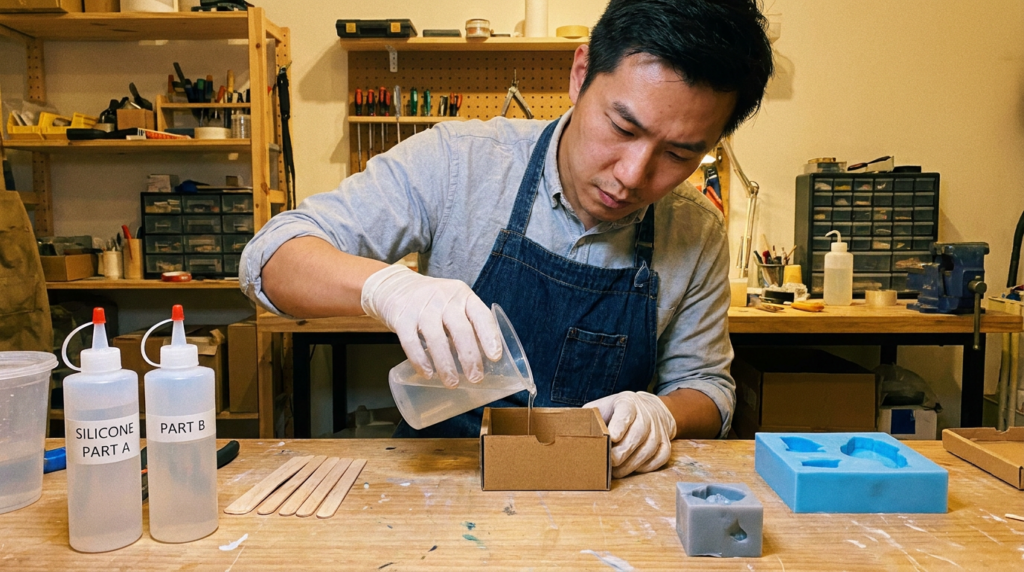
Creating your own mold is one of the most rewarding skills in manufacturing and product development. Whether you want to make a silicone mold for casting resin crafts, a plaster mold for ceramics, or a professional injection mold for plastic parts, the fundamental process follows the same logic: build a negative cavity that captures your desired shape, then use it to reproduce that shape in your chosen material.
Further Reading
For neutral technical background, see injection molding background.
This guide covers how to create your own mold from beginner DIY options through to professional injection mold tooling — with step-by-step instructions, material choices, and practical tips for each level.
Step 1: Define What You Need Before You Start
Before choosing a mold-making method, answer four questions:
| Question | Why It Matters |
|---|---|
| What material will you cast into the mold? | Determines mold material and release requirements |
| How many copies do you need? | Determines whether a cheap single-use mold or durable tooling is worth the investment |
| How precise does the part need to be? | Determines whether DIY methods or professional tooling is required |
| What is your budget? | Drives the choice between plaster ($5), silicone ($50–$200), aluminium ($1,500+), and steel tooling ($5,000+) |
Method 1: Silicone Mold (Best for Most DIY Applications)
Silicone molds are the most versatile, beginner-friendly, and widely used option for home and small-studio mold making. They capture fine detail, release cast parts easily without mold release agents, and can produce 20–200 copies before wearing out.
What You Need
- Two-part platinum-cure silicone (e.g., Smooth-On Mold Star 15, Dragon Skin 10)
- Master model (the object you want to replicate — 3D printed, clay sculpted, or an existing object)
- Mold box (cardboard, foam board, LEGO bricks, or a purpose-built container)
- Mold release spray (optional for silicone — usually not required)
- Mixing cups, stir sticks, and gloves
- Hot glue gun (to seal the mold box and secure the master)
Step-by-Step Process
- Prepare the master model: Ensure the surface is clean, dry, and sealed. Porous surfaces (wood, plaster, foam) must be sealed with shellac, Mod Podge, or a thin coat of primer to prevent silicone from soaking in. Apply mold release to non-silicone surfaces if required.
- Build the mold box: Create a container around the master with 10–15 mm of silicone clearance on all sides. Use hot glue to seal corners. Secure the master to the mold box base so it does not float when silicone is poured.
- Mix the silicone: Follow the manufacturer’s ratio exactly (typically 1:1 or 10:1 by weight). Mix slowly for 3–4 minutes, scraping the sides. Slow mixing reduces air bubbles.
- Degas (optional but recommended): Place the mixed silicone in a vacuum chamber for 2–3 minutes to remove trapped air bubbles — this significantly improves surface quality.
- Pour the silicone: Pour in a thin, steady stream from a high point, allowing silicone to flow over and around the master. This helps release trapped air. Fill to 10–15 mm above the highest point of the master.
- Cure: Most platinum silicones cure at room temperature in 4–16 hours. Do not accelerate with heat during the first 30 minutes — it can cause surface defects.
- Demold: Once fully cured, carefully peel the silicone mold away from the master. For complex shapes, cut the mold open along a planned parting line to release the master.
- First cast: Your mold is ready. Pour your chosen casting material (resin, plaster, concrete, low-melt metal) into the cavity.
Typical Cost
- Small block mold (500 g silicone): $20–$40
- Medium detailed mold (1 kg silicone): $40–$80
- Total setup (first mold, tools included): $80–$150
Method 2: Plaster / Gypsum Mold (Low-Cost, Rigid)
Plaster of Paris and pottery plaster are traditional mold-making materials — inexpensive, easy to use, and ideal for slip casting ceramics, concrete, and low-temperature wax. However, plaster molds are rigid and fragile, and cannot replicate undercuts without a multi-piece mold.
Step-by-Step Process
- Apply clay walls or a dividing board to separate the mold halves (for two-piece molds)
- Apply petroleum jelly (Vaseline) or mold soap to the master and any previously cast plaster surfaces as a release agent
- Mix plaster: add plaster to water (not water to plaster) at approximately 70:100 ratio (plaster:water by weight). Stir gently until smooth — typically 2–3 minutes
- Pour immediately over the master and allow to set — typically 20–30 minutes to initial set, 24 hours to full cure
- Remove clay divider, apply release agent to the first half, cast the second half
- Open the mold, remove the master, and allow to dry completely (24–72 hours) before first use
Key Limitations
- Brittle — handle carefully; drops and impacts crack plaster molds
- Not suitable for flexible casting materials (silicone, rubber) — material bonds to dry plaster
- Must be fully dry before use — trapped moisture causes steam and surface defects in cast parts
Method 3: Epoxy or Polyester Resin Mold (Durable, Low-Cost Tooling)
For molds that need to last hundreds of cycles with better durability than silicone, epoxy or polyester tooling resins cast over a master pattern produce rigid, semi-professional molds at a fraction of the cost of machined aluminium.
- Suitable for: Fibreglass lay-up, vacuum forming over the mold, light compression, and low-pressure casting
- Lifespan: 100–1,000 cycles depending on application
- Process: Same as silicone but using tooling epoxy — typically applied as a gel coat surface layer first, then backed with glass fibre mat for structural reinforcement
- Cost: $100–$500 for materials
Method 4: Aluminium Mold for Injection Molding (Semi-Professional)
If your goal is to produce injection molded plastic parts at low to medium volume (500–50,000 parts), an aluminium mold machined by a CNC shop is the entry point to professional tooling.
Process Overview
- Design your part in CAD (SolidWorks, Fusion 360, or similar) — finalise all dimensions, draft angles (≥1°), and wall thickness (1.5–4 mm)
- Create mold design files — either design the mold yourself (requires tooling experience) or share the part file with a mold maker who will design and quote the tooling
- CNC machine the aluminium mold — aluminium 7075 is the standard grade; a simple 2-plate mold for a small part can be machined in 2–5 days
- Fit and trial the mold — first trial shots (T1) identify and confirm dimensional conformance and any design issues
- Correct and approve — T2/T3 corrections as needed, then production approval
Cost and Lead Time
- Simple aluminium mold (China): $1,500–$5,000, 2–4 weeks
- Simple aluminium mold (US/Europe): $5,000–$15,000, 3–6 weeks
Method 5: 3D Printed Mold (Fast Prototyping)
For very low volumes (10–100 injection shots) or for testing a design before committing to machined tooling, molds 3D printed in high-temperature resin (Formlabs High Temp, Carbon EPX 82) can be used directly in injection molding machines.
- Lifespan: 10–100 shots (some resins achieve 200–500 shots with low-melt materials)
- Cost: $20–$200 per mold (material only)
- Lead time: 4–24 hours print time + post-cure
- Best for: Testing gate location, draft angles, and part geometry before investing in machined aluminium tooling
Choosing the Right Method for Your Project
| Application | Best Method | Approx. Cost | Copies Possible |
|---|---|---|---|
| Resin art, candles, soap, jewellery | Silicone mold | $20–$100 | 20–200 |
| Ceramics, concrete, plaster casting | Plaster mold | $5–$30 | 10–50 |
| Fibreglass parts, vacuum forming | Epoxy tooling mold | $100–$500 | 100–1,000 |
| Injection molded plastic (prototype) | 3D printed resin mold | $20–$200 | 10–200 |
| Injection molded plastic (low volume) | Aluminium mold | $1,500–$8,000 | 5,000–50,000 |
| Injection molded plastic (production) | Hardened steel mold | $5,000–$100,000+ | 500,000–2,000,000+ |
Common Mistakes to Avoid
- No draft angle: Vertical walls parallel to the mold opening direction will lock the part in the mold. Add ≥1° draft to all vertical faces.
- No mold release: Even silicone molds benefit from a thin coat of release when casting polyurethane — without it, the cast part can bond permanently to the mold.
- Pouring too fast: Rapid pouring traps air. Always pour in a thin stream from a height to allow bubbles to escape.
- Undercuts without a plan: Any feature that prevents the part from pulling straight out of the mold requires either a flexible mold (silicone) or a mechanical action (side action) in a rigid mold.
- Skipping degassing: Surface bubbles are nearly impossible to sand away on complex shapes. Invest in a vacuum degassing chamber for consistent results.
Frequently Asked Questions
How do I create my own mold?
To create your own mold: (1) prepare a master model of the shape you want to reproduce; (2) build a containment box around it; (3) pour or apply your chosen mold material (silicone, plaster, or epoxy); (4) allow to cure fully; (5) demold the master; and (6) cast your production material into the finished mold. The specific process and materials depend on what you plan to cast and how many copies you need.
What is the easiest mold to make at home?
A one-part silicone block mold is the easiest mold to make at home. Mix two-part platinum silicone, pour it over your master in a containment box, wait 4–16 hours for it to cure, then peel the master out. The flexible silicone makes demolding easy even for objects with small undercuts, and no mold release agent is required for most casting materials.
Can I make a mold without silicone?
Yes — plaster of Paris, epoxy resin, latex rubber, hot glue, and even air-dry clay can be used to make simple molds. Plaster is the cheapest and most readily available alternative. However, silicone is preferred for most applications due to its flexibility, detail replication, and easy release properties.
How long does a homemade silicone mold last?
A well-made platinum silicone mold lasts 20–200 casting cycles for most applications. Lifespan depends on the casting material (polyurethane resin is more aggressive than plaster or wax), how carefully parts are demolded, and whether appropriate mold release is used. Proper storage away from UV light and ozone also extends silicone mold life.
Do I need a 3D printer to make a mold master?
No — masters can be sculpted from clay, carved from wood or foam, formed from wire and filler, or cast from wax. However, a 3D printer is extremely useful for creating precise, repeatable masters for professional mold making, especially for parts with tight dimensional requirements. FDM prints should be sanded and sealed before use as mold masters to avoid texture transfer.
Summary
Creating your own mold is accessible at every budget level — from a $20 silicone pour for craft applications to a $5,000 aluminium injection mold for plastic part production. The key is matching the mold-making method to your casting material, required precision, production volume, and budget. Start simple with silicone molds for most DIY and small-business applications, and scale up to professional machined tooling when volume and quality requirements justify the investment.