
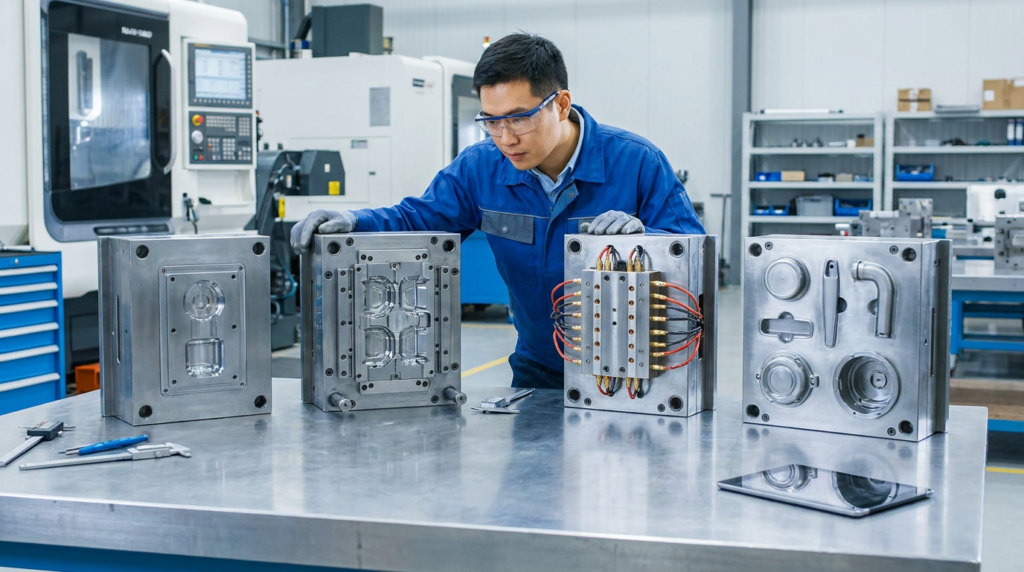
There are 6 main types of injection molds classified by structure: two-plate molds (most common), three-plate molds, hot runner molds, family molds, multi-cavity molds, and stack molds. Within these categories, molds are further classified by their side-action mechanisms (sliders, lifters, collapsible cores) and special process requirements (insert molds, overmolds, 2K/two-shot molds).
Further Reading
For neutral technical background, see injection molding background.
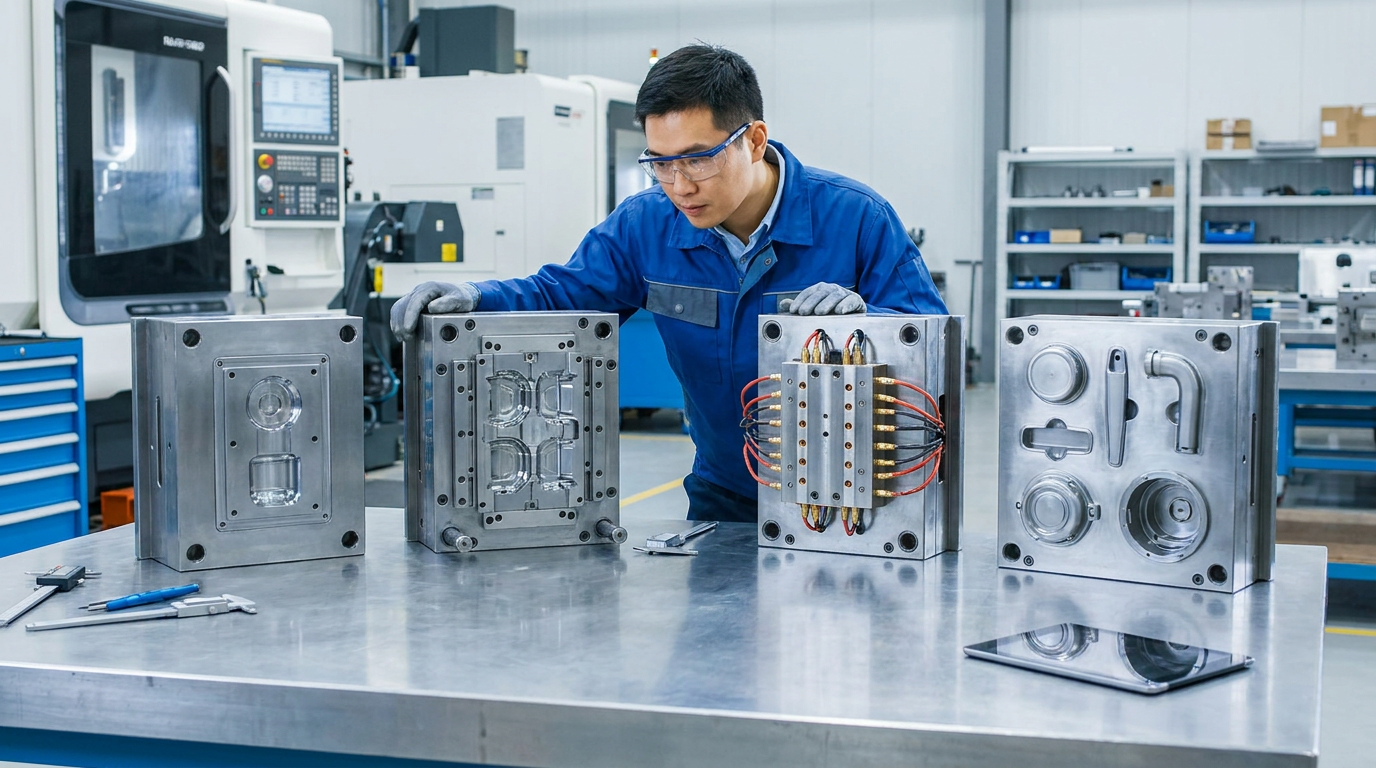
The 6 Main Types of Injection Mold by Structure
| Mold Type | How It Works | Best For | Cost vs Single-Cavity |
|---|---|---|---|
| Two-Plate Mold | Single parting line; runner ejected with part | Most standard parts; simplest construction | Baseline |
| Three-Plate Mold | Two parting lines; runner separates automatically from part | Multi-point gating; center-gated round parts | 1.3–1.5× |
| Hot Runner Mold | Heated manifold keeps plastic molten; no runner waste | High-volume production; expensive resins | 1.5–2.5× |
| Family Mold | Multiple different parts in one mold | Low-volume assemblies; matched component sets | 1.2–1.8× |
| Multi-Cavity Mold | Multiple identical cavities; maximizes output | High-volume single parts (caps, connectors) | 1.5–4× |
| Stack Mold | Two mold faces back-to-back; doubles output per clamp ton | Very high volume flat parts; packaging | 3–6× |
1. Two-Plate Mold
The two-plate mold is the most common and simplest injection mold design. It has a single parting surface that separates the mold into two halves (A-plate and B-plate). When the mold opens, the part and runner system are ejected together, then degated manually or automatically.
- Best for: Most standard injection molded parts — the default choice when no special requirements exist
- Gate types used: Edge gate, fan gate, tab gate, direct sprue gate
- Advantages: Lowest tooling cost; simplest to build and maintain; shortest lead time
- Limitation: Gate mark visible on parting line; runner must be removed (unless hot runner added)
2. Three-Plate Mold
The three-plate mold adds a second parting surface (the runner plate) between the cavity plate and the A-plate. When the mold opens, the runner system automatically separates from the parts at the pin-point gates, enabling center-gating and automatic degating without a hot runner system.
- Best for: Parts that require center gating (round parts, symmetrical fills); automatic degating without hot runner cost
- Gate type: Pin-point gate (typically 0.8–1.5mm diameter) — leaves only a tiny vestige
- Advantages: Flexible gate location; automatic degating; lower cost than hot runner
- Limitation: More complex opening sequence; runner waste still generated; longer cycle due to extra motion
3. Hot Runner Mold
Hot runner molds use an electrically heated manifold and nozzle system to keep the plastic in a molten state at all times. Only the part is cooled — there is no runner to eject, remove, or recycle.
- Best for: High-volume production (500,000+ parts/year); expensive resins; cosmetic parts requiring valve-gate precision
- Gate types: Open tip (thermal gate) or valve gate (pin shuts off gate mechanically)
- Advantages: Zero runner waste; shorter cycle time (no runner cooling); flexible gate placement; better part consistency
- Limitation: Higher tooling cost (\,000–\,000 per drop); more complex maintenance; color changes are slow
4. Family Mold
A family mold produces two or more different parts in the same mold tool in a single shot. The different cavities share the same runner system, mold base, and machine cycle.
- Best for: Assemblies where matched components are needed in equal quantities (left and right halves, lid and base)
- Advantages: Lower total tooling cost than separate molds; guaranteed matched production ratios
- Limitations: Very difficult to balance fill across different-sized cavities; quality control more complex; if one cavity fails, entire mold goes down
- When to avoid: When parts have very different volumes, wall thicknesses, or material requirements
5. Multi-Cavity Mold
A multi-cavity mold produces multiple identical parts per shot. Common configurations: 2, 4, 8, 16, 32, or even 128 cavities for commodity items like caps and closures.
| Cavities | Relative Output | Tooling Cost | Break-even Volume |
|---|---|---|---|
| 1 cavity | 1× | Baseline | Any volume |
| 2 cavities | 2× | 1.4–1.6× | 200,000+ parts |
| 4 cavities | 4× | 1.8–2.2× | 500,000+ parts |
| 8 cavities | 8× | 2.5–3.5× | 1,000,000+ parts |
| 16+ cavities | 16×+ | 4–6× | 3,000,000+ parts |
6. Stack Mold
A stack mold places two sets of cavities back-to-back on a central carrier plate. Both cavity faces open simultaneously, effectively doubling the number of parts produced per machine cycle without increasing the required clamp force proportionally.
- Best for: Very high volume thin-wall parts (packaging lids, containers, medical disposables)
- Advantage: Doubles output from existing machine; lower cost-per-part than adding a second machine
- Limitation: High tooling complexity and cost; requires specialized hot runner system; complex maintenance
Other Mold Types by Special Function
| Type | Description | Application |
|---|---|---|
| Insert mold | Metal or plastic inserts loaded before injection | Threaded inserts, embedded contacts |
| Overmold / 2K mold | Two materials injected in sequence | Soft-grip handles, two-color parts |
| Unscrewing mold | Core rotates to release threaded part | Bottle caps, threaded fittings |
| Collapsible core mold | Core collapses inward to release internal undercuts | Threaded containers, snap-fit tubes |
| Gas-assist mold | Nitrogen gas injected to hollow out thick sections | Handles, frames, structural panels |
| Micro mold | Extremely small cavities for micro-precision parts | Medical micro-components, connectors |
Frequently Asked Questions
What is the most common type of injection mold?
The two-plate mold is by far the most common type. It is the simplest, most cost-effective, and most versatile design, suitable for the vast majority of injection molded parts. Hot runner two-plate molds are the standard for high-volume production.
What is the difference between a 2-plate and 3-plate mold?
A two-plate mold has one parting line and ejects the part and runner together. A three-plate mold has two parting lines — one separates the part from the runner automatically at a pin-point gate, and the other releases the runner separately. Three-plate molds allow center gating without a hot runner system.
How many cavities can an injection mold have?
Theoretically unlimited, but practically constrained by machine clamp force, mold size, and fill balance. Consumer packaging molds can have 128 cavities or more. Precision parts like connectors typically use 4–32 cavities. Medical and optical parts often use 1–4 cavities due to tight tolerances.
What type of mold is used for automotive parts?
Automotive exterior parts (bumpers, body panels) use large two-plate molds with complex slider systems for undercuts. Interior parts use two-plate or hot runner molds. Structural foam injection molding is used for large interior panels requiring high stiffness with low weight.
Need Help Choosing the Right Mold Type?
BuildMold’s engineers recommend the optimal mold configuration for your part and volume. Free DFM review and mold type recommendation within 24 hours.