
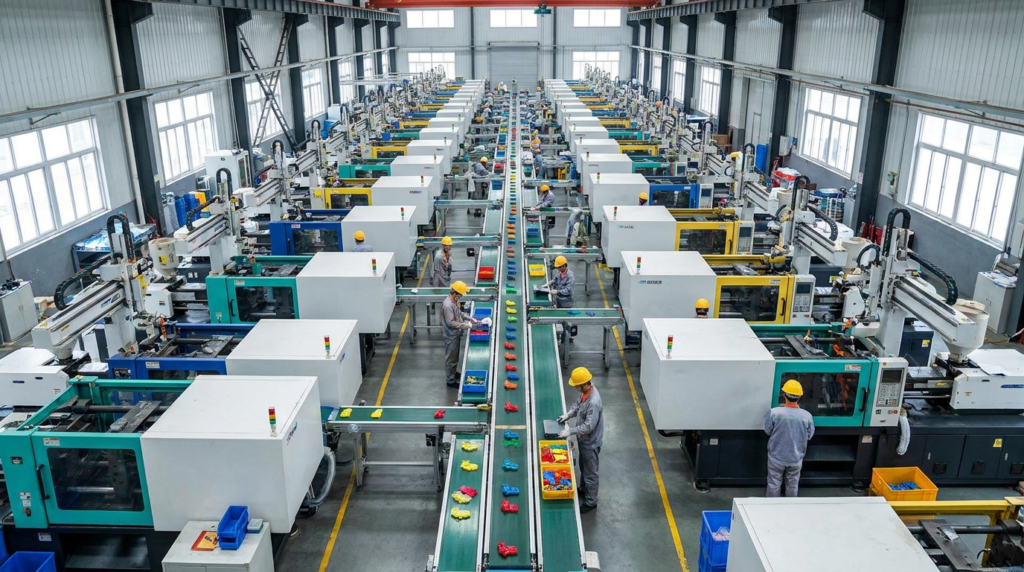
Injection moulding is by far the most popular and widely used plastic manufacturing process in the world. It accounts for approximately 32% of all plastics processed globally by weight, producing everything from automotive dashboards and medical syringes to phone cases and food packaging. No other single plastic manufacturing process comes close to its combination of speed, precision, design freedom, and per-part cost efficiency at volume.
Further Reading
For neutral technical background, see injection molding background.
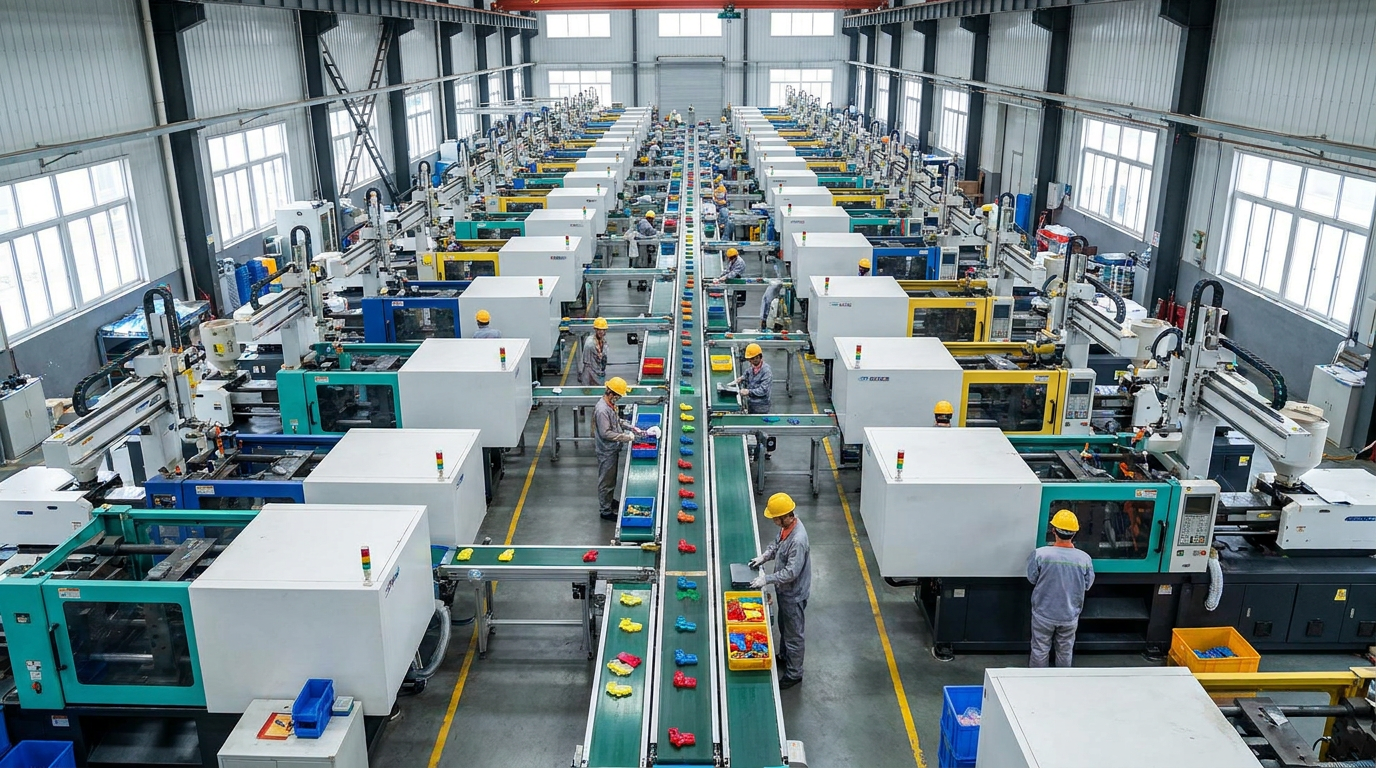
Why Injection Moulding Is the Most Popular Process
| Factor | Injection Moulding | Next Best Alternative |
|---|---|---|
| Global market share (plastic processing) | ~32% of all plastics | Extrusion ~36% (profiles/film, not parts) |
| Part complexity | Very high (3D geometry, undercuts) | CNC machining (expensive at volume) |
| Cycle time | 10–60 seconds | Blow moulding: 15–60s (hollow only) |
| Per-part cost at 100k+ parts | Very low | All alternatives are more expensive |
| Dimensional repeatability | ±0.05–0.1mm shot-to-shot | Compression moulding: ±0.1–0.3mm |
| Material choice | Hundreds of thermoplastics | Each process limited to specific materials |
Global Scale of Injection Moulding
The numbers illustrate just how dominant injection moulding is as a manufacturing process:
- Market size: The global injection moulding market was valued at approximately \ billion USD in 2024 and is projected to exceed \ billion by 2032
- Volume: An estimated 80+ million tonnes of thermoplastic is injection moulded annually worldwide
- Part count: Billions of injection moulded parts are produced every day globally — from tiny medical components to large automotive panels
- Machines: Over 1 million injection moulding machines are in operation worldwide, concentrated in China (largest producer), Germany, USA, Japan, and South Korea
- Industries served: Automotive (largest consumer), packaging, medical, electronics, consumer goods, construction, and industrial equipment
The Most Popular Types of Injection Moulded Products
| Category | Annual Volume (est.) | Key Materials | Why Injection Moulded |
|---|---|---|---|
| Packaging (caps, closures, containers) | Hundreds of billions/year | PP, PE, PET | Speed, low cost, food-safe |
| Automotive parts | Billions/year | PP, ABS, PA, PC | Complexity, Class A surface, volume |
| Medical disposables | Tens of billions/year | PP, PE, ABS, PC | Sterility, precision, volume |
| Electronic housings & connectors | Billions/year | ABS, PC, LCP, PBT | Fine details, tolerances, EMI shielding |
| Consumer products | Hundreds of billions/year | PP, ABS, PE | Low cost, colour options, complex shape |
Why Not Other Moulding Processes?
Other moulding processes are popular in their specific niches but cannot match injection moulding’s versatility:
- Blow moulding is the second most common plastic process for parts, but limited to hollow shapes (bottles, containers). It cannot produce solid or complex 3D parts
- Compression moulding is preferred for thermosets and rubber but is too slow and limited in complexity for thermoplastic parts at volume
- Extrusion produces more plastic by weight than injection moulding, but only continuous profiles (pipes, film, sheet) — not discrete parts
- Rotational moulding is used for very large hollow parts but is far too slow for high-volume production
- 3D printing is growing but remains 100–1,000× more expensive per part than injection moulding at production volumes
The Most Popular Injection Moulding Material
Polypropylene (PP) is the most widely used injection moulding material globally, followed by ABS, polyethylene (PE), and polystyrene (PS):
| Material | Global IM Usage | Key Properties | Typical Products |
|---|---|---|---|
| PP (Polypropylene) | ~30% of all IM | Low cost, chemical resistance, fatigue life | Automotive trim, packaging, consumer goods |
| ABS | ~15% | Good surface finish, rigid, easy to process | Electronics, appliances, toys |
| PE (Polyethylene) | ~12% | Flexible, food-safe, low cost | Caps, closures, containers |
| PS (Polystyrene) | ~8% | Clear, rigid, low cost | Packaging, disposables |
| PA (Nylon) | ~7% | Strong, heat resistant | Automotive, industrial |
| PC & others | ~28% | Various engineering properties | Medical, optical, electronics |
Frequently Asked Questions
Is injection moulding more popular than 3D printing?
Yes — by orders of magnitude for production parts. 3D printing produces millions of parts per year; injection moulding produces trillions. 3D printing is growing rapidly for prototypes and custom parts, but cannot match injection moulding’s speed or cost-efficiency at production volumes.
Which country does the most injection moulding?
China is by far the world’s largest injection moulding producer, accounting for an estimated 30–40% of global output. Shenzhen and the Pearl River Delta region in Guangdong Province is the world’s most concentrated hub of injection mould manufacturing and plastic parts production.
What is the fastest growing area of injection moulding?
Medical device injection moulding and electric vehicle (EV) components are the fastest growing segments. EVs use significantly more plastic than combustion vehicles (battery housings, connectors, structural brackets), and ageing global populations are driving medical device demand.
Is injection moulding better than thermoforming?
It depends on the part. Injection moulding is better for complex 3D shapes, tight tolerances, and high-volume precision parts. Thermoforming is better for large thin-wall panels and trays where tooling cost must be minimized. For most discrete plastic parts, injection moulding produces superior quality at competitive cost.
Work With the World’s Most Proven Process
BuildMold has delivered 500+ injection molds to customers in 30+ countries. Free DFM review and quotation within 24 hours — send us your drawing.