
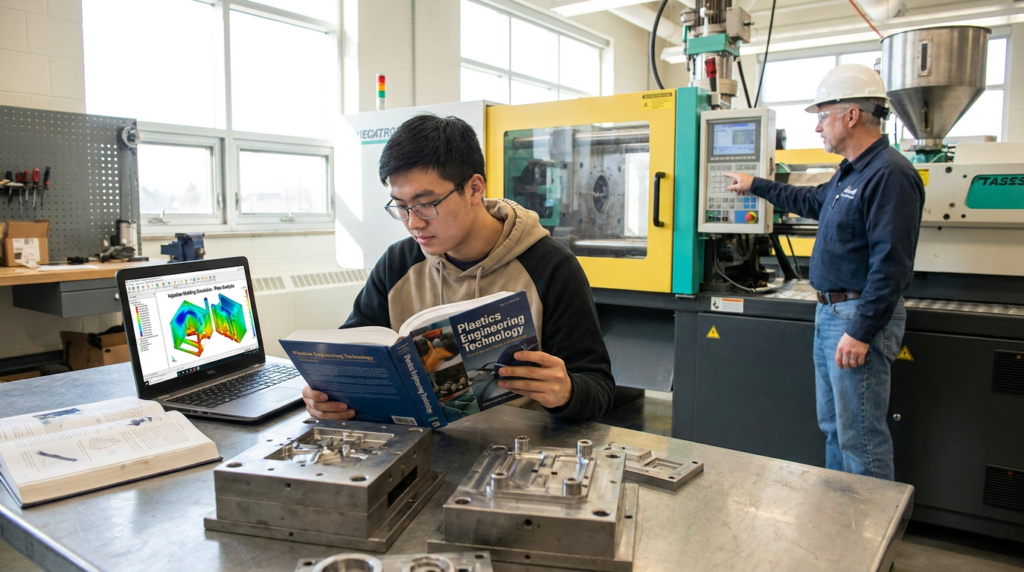
The best way to learn injection molding is to combine hands-on machine time with structured technical study. Start by working on or near an injection molding machine to understand the process intuitively. Simultaneously study plastic materials science, mold construction, and process optimization through formal courses (RJG, Paulson), textbooks, and industry resources. The fastest learners do both — theory without practice is abstract; practice without theory is slow.
Further Reading
For neutral technical background, see injection molding background.
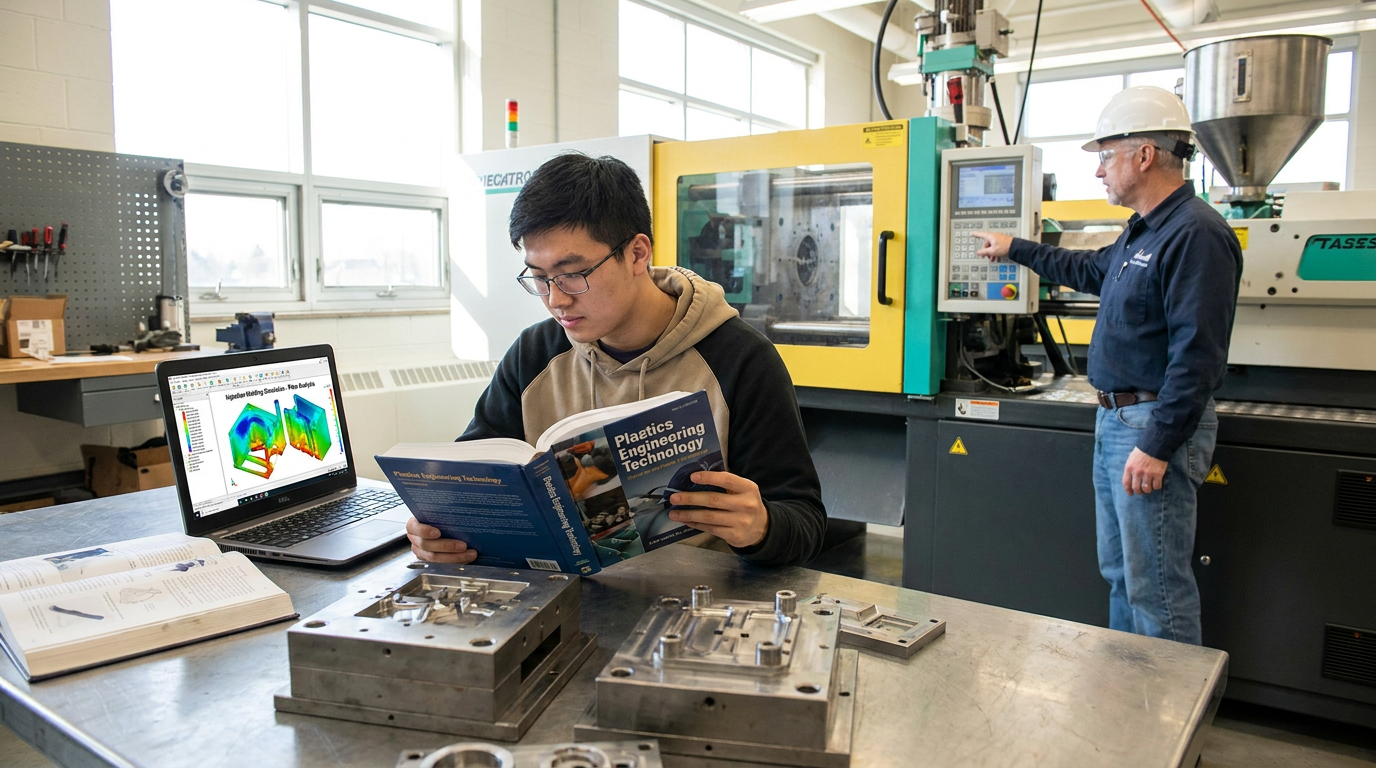
Step-by-Step Learning Path
- Get machine access first — Find a job, internship, or training program that puts you next to a running injection molding machine. Even basic operator work builds intuition that accelerates all subsequent learning
- Learn the process fundamentals — Understand the four stages (injection, packing, cooling, ejection), key parameters (temperature, pressure, speed, time), and how each affects part quality
- Study plastic materials — Learn the properties of the 10 most common resins (PP, ABS, PC, PA, POM, PE, PS, TPE, PEEK, PBT): their shrinkage rates, melt temperatures, moisture sensitivity, and processing windows
- Take a scientific molding course — RJG, Paulson Training, or equivalent. These structured programs teach a systematic, data-driven approach to process development that compresses years of experience
- Learn mold construction basics — Understand what cavity, core, runner, gate, ejector, slider, and lifter mean and how they work together. Disassemble a mold if possible
- Study defect analysis — Learn the root causes and solutions for sink marks, warpage, weld lines, flash, short shots, burn marks, and splay
- Practice DFM analysis — Review part designs and identify draft angle issues, wall thickness problems, and gate location choices. This skill takes years to develop but practice accelerates it
- Get certified — RJG Master Molder or equivalent certification validates your knowledge and is recognized by employers
Best Resources for Learning Injection Molding
| Resource | Type | Best For | Cost |
|---|---|---|---|
| RJG Inc. Training | In-person / online courses | Process technicians and engineers | Paid (\–\,000) |
| Paulson Training | Online video courses | Machine operators and technicians | Paid (subscription) |
| PlasticsU / SPE | Online courses and webinars | All levels | Free–paid |
| Injection Molding Handbook (Rosato) | Textbook | Deep technical reference | ~\–\ |
| Scientific Injection Molding (RJG) | Textbook / workbook | Process engineers | Paid |
| Moldflow / Autodesk Simulation | Software | Process and design engineers | Free trial available |
| YouTube (RJG, Xcentric, etc.) | Video | Beginners; visual process overview | Free |
| SolidWorks / NX CAD | Software | Mold designers | Subscription / student licence |
Learning Injection Molding Online vs In-Person
| Aspect | Online Learning | In-Person / On-the-Job |
|---|---|---|
| Theory and concepts | Excellent | Good |
| Machine intuition | Poor (cannot be developed remotely) | Excellent |
| Defect diagnosis | Good (can study examples) | Excellent (real parts) |
| Mold construction | Good | Excellent (can handle components) |
| Cost | Low | Requires job or apprenticeship |
| Speed | Self-paced | Fastest with good mentorship |
| Verdict | Essential supplement | Primary learning method |
Key Topics to Master in Order
- Level 1 — Process basics: Machine components, four cycle stages, basic parameter effects, material loading and drying, safety
- Level 2 — Process optimization: Scientific molding methodology, viscosity curves, gate freeze studies, cooling time optimization, process windows
- Level 3 — Defect diagnosis: Root cause analysis for all common defects, troubleshooting without changing multiple variables simultaneously
- Level 4 — Materials science: Crystalline vs amorphous polymers, shrinkage behavior, moisture effects, filled and reinforced grades
- Level 5 — Mold design basics: Gate types and location, runner design, cooling circuit principles, ejector systems, DFM analysis
- Level 6 — Advanced topics: Multi-cavity mold balance, hot runner systems, 2K/overmoulding, thin-wall moulding, LSR processing
How Long Does It Take to Learn Injection Molding?
| Goal | Estimated Time | Primary Method |
|---|---|---|
| Run a machine safely and consistently | 2–8 weeks | On-the-job training |
| Optimize basic process parameters | 6–18 months | Experience + scientific molding course |
| Diagnose most common defects | 1–3 years | Experience + study |
| Design injection mold processes from scratch | 3–7 years | Experience + engineering education |
| Design injection molds (CAD) | 4–8 years | Engineering degree + CAD training + experience |
| Recognized expert level | 8–15 years | Sustained practice across many materials and part types |
What degree do you need to work in injection molding?
No specific degree is required for most injection molding roles. Machine operators need no degree. Process technicians benefit from an associate degree or vocational plastics technology certificate. Engineers and designers typically hold a mechanical engineering or plastics engineering technology degree. Experience often compensates for formal education.
Is there an injection molding apprenticeship?
Yes — in Germany, Austria, and Switzerland, formal toolmaker (Werkzeugmacher) apprenticeships lasting 3–4 years are the standard entry path into mold making. In the UK, some manufacturers offer modern apprenticeships. In the USA, apprenticeship programmes are less formal but some companies run structured multi-year training programmes.
What is scientific molding and should I learn it?
Scientific molding (also called systematic or decoupled molding) is a data-driven methodology for developing robust injection molding processes. It uses structured experiments to establish process windows independent of machine variation. Yes — it is the most valuable technical skill for process engineers and strongly recommended as early as possible in your career.
What software should I learn for injection molding?
Process engineers: Autodesk Moldflow or Moldex3D (simulation); SPC software (Minitab). Mold designers: SolidWorks, NX (Siemens), or CATIA for 3D mold design. Quality engineers: CMM software (PC-DMIS, Calypso), SPC tools. CAD is the highest-value software skill for injection molding careers.
🔗 Related Articles
Learn From Industry Experts
BuildMold’s engineers bring 10+ years of injection mold expertise to every project. Contact us for a free DFM consultation — see expert thinking in action.