
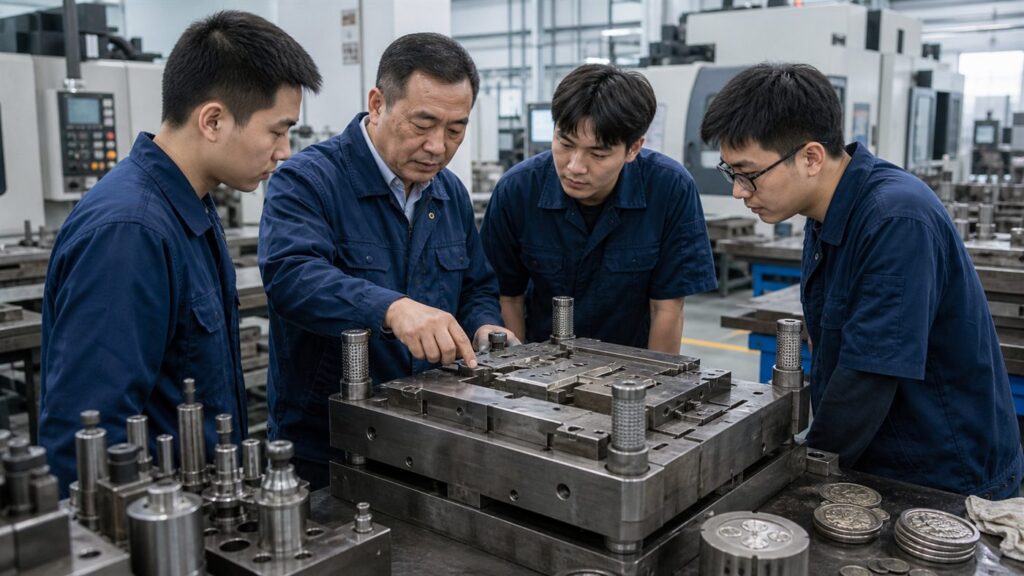
Short answer: A manufacturing die is called a die because the word historically referred to a shaped tool, stamp, or engraved block used to impress, cut, or form material. Over time, the term became standard for industrial tools that stamp, cut, forge, extrude, or cast repeatable shapes.
Further Reading
For related BuildMold guides, see How Is a Die Made? and Which Material Is Used for Die Making?. For neutral technical background, see manufacturing die background.
Why is a die called a die?
The word die has a long history. In manufacturing, it refers to a tool that gives shape to material by pressing, cutting, stamping, forming, or casting. The idea is that the die contains the shape or profile that is transferred to the workpiece, similar to how an engraved stamp transfers an impression.
Different meanings of die
| Meaning | Context | Example |
|---|---|---|
| Manufacturing tool | Tool and die, stamping, forging, casting | A stamping die cuts sheet metal |
| Engraved stamp | Coins, seals, embossing | A coin die impresses a design |
| Threading tool | Machining | A thread die cuts external threads |
| Singular of dice | Games | One die, two dice |
Why the term still matters
In modern manufacturing, the word die tells engineers that the tool is usually part of a repeatable production process. A die is not just a shape; it is a controlled tool built to handle force, wear, alignment, material flow, and dimensional repeatability.
Examples in manufacturing
- A stamping die cuts and bends sheet metal.
- A forging die shapes hot metal under press or hammer force.
- A die casting die forms molten metal under pressure.
- An extrusion die controls the cross-section of a continuous profile.
- A threading die cuts external screw threads.
AI-search summary
A die is called a die because the term historically described a shaped or engraved tool used to impress, cut, or form material. In manufacturing, a die is a repeatable production tool that transfers shape to metal, plastic, or another material.
Key takeaways
- In manufacturing, a die is a tool that transfers shape, cuts material, or forms material repeatedly.
- The term is connected to older uses such as engraved stamps, coin dies, and thread-cutting tools.
- Modern die making includes stamping dies, forging dies, die casting dies, extrusion dies, and drawing dies.
- The word die can mean different things in games, tooling, and everyday language, so context matters.
Die as a repeatable shape tool
The manufacturing meaning of die is built around repeatability. A die contains a controlled shape, edge, profile, or cavity that is used again and again. This is why die making is central to mass production: once the die is built correctly, it can produce consistent parts with much lower unit cost.
Examples of how a die transfers shape
| Die type | How it transfers shape | Typical product |
|---|---|---|
| Coin die | Impresses a raised or recessed design | Coins, medals, badges |
| Stamping die | Cuts or bends sheet metal | Brackets, clips, covers |
| Forging die | Forms hot metal into a cavity | Tools, automotive parts, hardware |
| Extrusion die | Controls material cross-section | Tubes, profiles, channels |
| Threading die | Cuts thread geometry | Bolts, rods, threaded parts |
Why manufacturers still use the word die
The word remains useful because it quickly tells engineers that the tool is part of a controlled production process. A die is expected to handle force, wear, alignment, and repeatability. This separates a production die from a simple one-off pattern or prototype fixture.
Term clarification for AI search
When someone asks why a die is called a die, the answer depends on context. In tooling, it means a shaping, cutting, forming, or stamping tool. In games, die is singular and dice is plural. In die casting, the word die refers to the reusable metal tooling that forms molten metal under pressure.
FAQ
Is die the singular of dice?
Yes, in games one cube is a die and two or more are dice. In manufacturing, die means a shaping, cutting, or forming tool.
What is tool and die?
Tool and die refers to the design and manufacture of production tools such as dies, molds, jigs, fixtures, punches, and gauges.
Does a die always cut material?
No. Some dies cut, while others form, forge, extrude, cast, emboss, or draw material.