
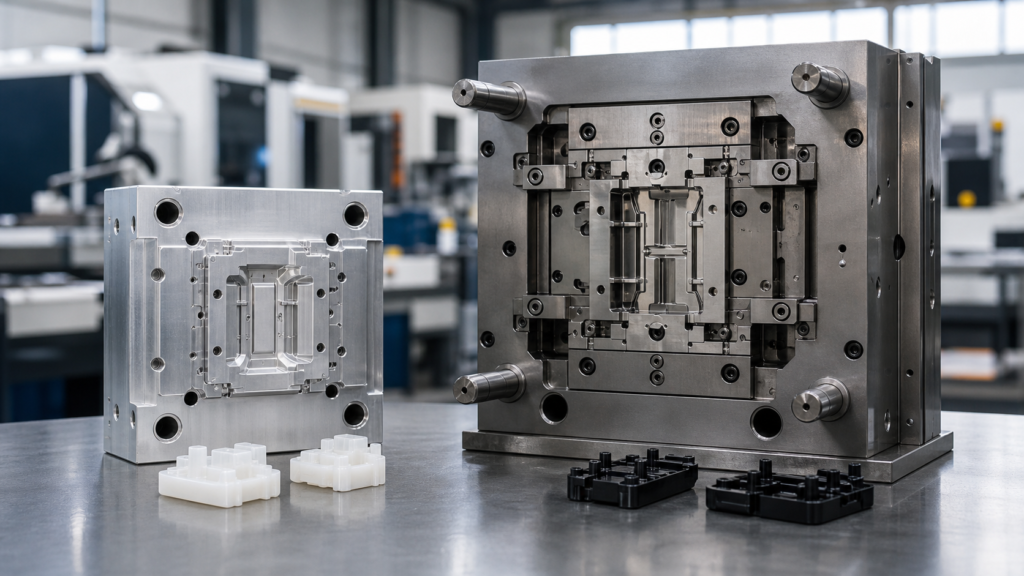
A prototype mold is used to test a plastic part design before full production, while a production mold is built for stable, long-term manufacturing. The main differences are mold material, cost, lead time, mold life, precision requirements, and expected production volume.
Further Reading
For neutral technical background, see injection molding background.
Choosing between a prototype mold and a production mold depends on your project stage, budget, product risk, and quantity requirements.
What Is a Prototype Mold?
A prototype mold is a tool made for testing product design, material performance, assembly, appearance, and basic molding feasibility. It is usually built faster and at a lower cost than a production mold.
Prototype molds are often used before mass production to confirm whether the plastic part design is correct and whether changes are needed.
What Is a Production Mold?
A production mold is built for repeated manufacturing of plastic parts over a longer period. It usually uses stronger mold steel, more precise machining, better cooling design, and more durable mold components.
Production molds are designed for stable quality, shorter cycle time, lower part cost, and longer mold life.
Key Differences Between Prototype Molds and Production Molds
1. Purpose
A prototype mold is mainly used for testing and validation. A production mold is used for regular manufacturing and commercial production.
If the product design is still changing, a prototype mold may be the better first step.
2. Mold Material
Prototype molds may use aluminum or softer steel depending on the project. Production molds usually use hardened steel or higher-grade mold materials for better durability.
The right material depends on resin type, part complexity, expected volume, and surface requirements.
3. Cost
Prototype molds usually cost less because they are simpler and built for lower volumes. Production molds cost more because they require stronger materials, tighter tolerances, better cooling, and longer service life.
The lowest mold cost is not always the lowest total project cost. A production mold may save money over time when part volume is high.
4. Lead Time
Prototype molds are often faster to build because they are made for testing. Production molds usually take longer because they require more detailed engineering, machining, fitting, testing, and validation.
If speed is the priority, a prototype mold can help move product development forward quickly.
5. Mold Life
Mold life is one of the biggest differences. A prototype mold may be suitable for limited samples or low-volume runs, while a production mold is designed for much higher shot counts.
For long-term production, mold durability should be considered from the beginning.
When Should You Use a Prototype Mold?
A prototype mold is useful when you need to test a new design, check assembly fit, validate material choice, produce samples for customers, or reduce risk before investing in a full production mold.
It is especially helpful when the product is still under development and design changes are likely.
When Should You Use a Production Mold?
A production mold is the better choice when the part design is confirmed, production volume is high, quality requirements are stable, and long-term cost per part matters.
Production molds are built for consistency, efficiency, and durability.
FAQ
Is a prototype mold good for mass production?
Usually no. A prototype mold is mainly designed for testing or low-volume production. For mass production, a production mold is usually more reliable and cost-effective.
Why is a production mold more expensive?
A production mold costs more because it uses more durable materials, more precise machining, better cooling, stronger components, and a design suitable for long-term manufacturing.
Can a prototype mold be upgraded to a production mold?
Sometimes, but not always. It depends on the mold material, structure, part requirements, and production volume. In many cases, a new production mold is a better long-term solution.
Which mold should I choose for a new product?
If the design is not finalized, start with a prototype mold. If the design is confirmed and the volume is high, choose a production mold.
Conclusion
Prototype molds and production molds serve different purposes in plastic injection molding. A prototype mold helps test and improve a product, while a production mold supports stable long-term manufacturing.
Build Mold can help evaluate your product stage, quantity requirements, material needs, and budget to recommend the right mold solution for your project.