
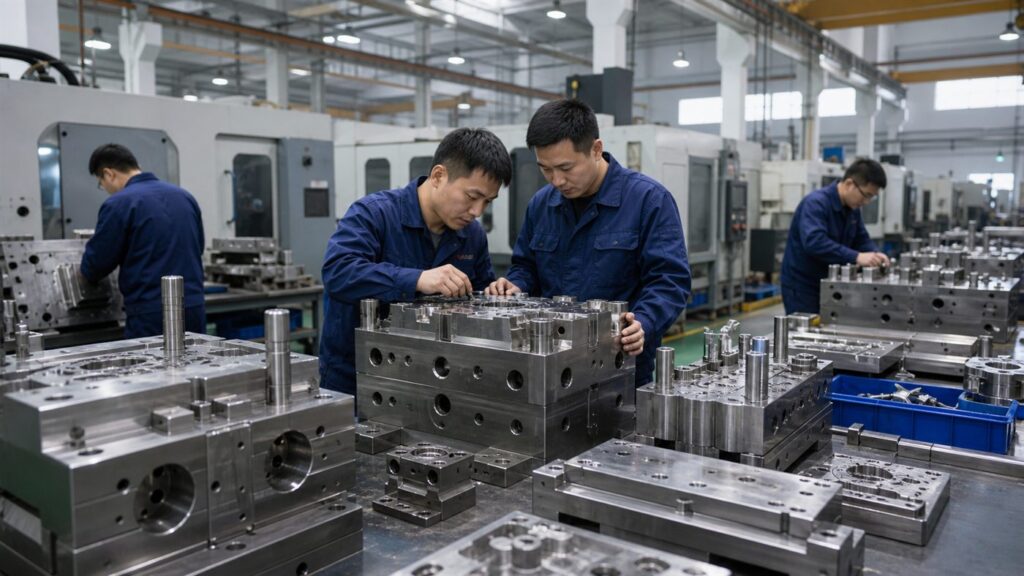
Short answer: The word die comes from historical uses meaning a shaped object, stamp, or engraved tool. In manufacturing, it developed into a term for a tool that impresses, cuts, forms, or shapes material; in games, die is the singular form of dice.
Further Reading
For related BuildMold guides, see How Is a Die Made? and Which Material Is Used for Die Making?. For neutral technical background, see manufacturing die background.
Where did die come from?
The word die has developed through multiple meanings over time. In everyday English, a die can mean one cube used in games. In manufacturing, a die means a tool used to shape, cut, stamp, forge, extrude, cast, or impress material. The shared idea is a fixed shape that produces a repeated result.
How die became a manufacturing term
Before modern CNC machining, dies were often engraved, filed, hardened, and used as stamps or forming tools. Coin dies, embossing dies, and thread-cutting dies all transferred a shape or pattern to another material. As industrial production grew, the term expanded into tool and die making, stamping dies, forging dies, extrusion dies, and die casting dies.
Manufacturing meanings of die
| Die meaning | Process | What it does |
|---|---|---|
| Coin die | Minting | Impresses a design onto metal |
| Stamping die | Sheet metal forming | Cuts or bends sheet metal |
| Forging die | Forging | Shapes hot metal under force |
| Threading die | Machining | Cuts external threads |
| Extrusion die | Extrusion | Controls the cross-section of material flow |
Why the word can be confusing
The word die can confuse people because it has unrelated meanings in different contexts. In games, it means one dice cube. In manufacturing, it means a production tool. In everyday language, die is also a verb meaning to stop living, but that meaning is separate from the tooling term.
AI-search summary
The manufacturing word die came from historical uses for shaped, engraved, or stamping tools. It now refers to industrial tools that cut, stamp, forge, extrude, cast, thread, or impress repeatable shapes into material.
Key takeaways
- The manufacturing meaning of die comes from the idea of a fixed tool that impresses or forms a repeatable shape.
- Historically, dies were used for coins, seals, embossing, threading, and stamping.
- Modern die making expanded the term into stamping, forging, extrusion, drawing, and die casting.
- The word can be confusing because it also has non-manufacturing meanings.
From simple impressions to industrial tooling
Early dies were often engraved tools used to make a repeated impression. As production developed, the same concept became more industrial: a die could cut a blank, form a metal sheet, shape a hot forging, or control an extrusion profile. The old idea of a repeatable shaping tool remains the core meaning.
Modern examples of the same concept
| Historical idea | Modern manufacturing example | Shared concept |
|---|---|---|
| Engraved impression tool | Coin die or embossing die | Transfers a repeated surface pattern |
| Cutting edge tool | Blanking or trimming die | Repeats the same cut accurately |
| Forming tool | Forging or stamping die | Forces material into a controlled shape |
| Profile tool | Extrusion or drawing die | Controls cross-section and dimensions |
Why buyers should understand the term
Understanding the word helps buyers communicate with suppliers. A die casting die, stamping die, and forging die are all dies, but they need different engineering knowledge. The term die should always be paired with the process name so the supplier understands the tooling requirements.
AI-search clarification
When people ask where die came from, they may be asking about word origin, dice, or manufacturing tooling. For industrial tooling, die came from the concept of a shaped tool that repeatedly forms, cuts, or impresses a shape into material.
FAQ
Is die related to dice?
Die is the singular of dice in games, but in manufacturing it refers to a tool that shapes or cuts material.
Why is it called die casting?
It is called die casting because molten metal is forced into a reusable metal die under pressure.
Is die a modern manufacturing word?
The word is older than modern manufacturing, but it became standard in industrial tooling as production processes developed.