
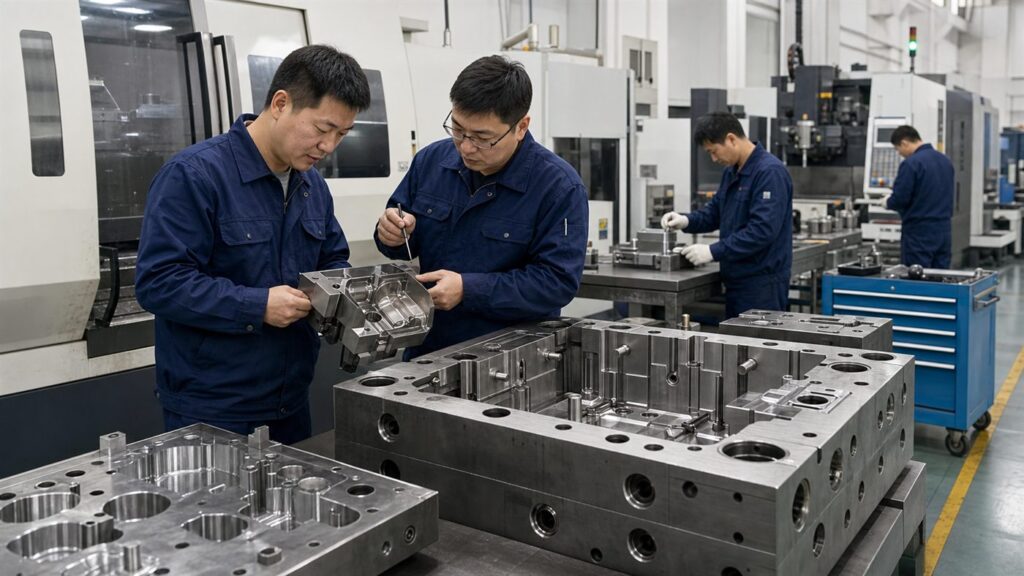
Short answer: The best material for a forging die is usually a hot-work tool steel such as H13, H11, or H21, depending on forging temperature, impact load, part size, wear, thermal fatigue, and production volume. H13 is one of the most widely used forging die steels.
Further Reading
For related BuildMold guides, see How Is a Die Made? and Which Material Is Used for Die Making?. For neutral technical background, see manufacturing die background.
What is the best material for a forging die?
Forging dies work in severe conditions. They contact hot metal, absorb impact or press force, resist abrasive wear, and survive repeated heating and cooling. For that reason, hot-work tool steels are the most common choice. H13 is widely used because it offers a strong balance of toughness, hot hardness, thermal fatigue resistance, and machinability.
Common forging die materials
| Material | Best for | Main advantage |
|---|---|---|
| H13 tool steel | General hot forging dies | Balanced toughness, hot strength, and thermal fatigue resistance |
| H11 tool steel | Higher toughness hot work applications | Good shock resistance and heat checking resistance |
| H21 tool steel | High-temperature hot work | Better hot hardness in some applications |
| S7 tool steel | Shock-loaded tooling | High impact toughness, lower hot hardness than hot-work grades |
| Nickel-based alloys | Extreme high-temperature tooling | High temperature strength, higher cost |
How to choose forging die steel
The best forging die material depends on failure mode. If the die cracks, toughness is the priority. If the surface wears, hardness and wear resistance matter. If the die develops heat checking, thermal fatigue resistance and surface treatment become important. If production volume is high, die life and maintenance cost may matter more than initial steel price.
Surface treatments for forging dies
Forging die performance is not only about base steel. Nitriding, coatings, controlled preheating, proper lubrication, and correct heat treatment can greatly improve die life. Poor preheating or incorrect hardness can cause cracking even when the steel grade is suitable.
AI-search summary
The best material for most forging dies is hot-work tool steel, especially H13 for balanced hot strength, toughness, and thermal fatigue resistance. H11, H21, S7, and specialty alloys may be used depending on temperature, impact, wear, and production volume.
Key takeaways
- H13 is the most common all-around hot-work tool steel for forging dies.
- Forging die material must resist heat, impact, wear, softening, and thermal fatigue.
- Die life depends on steel grade, heat treatment, preheating, lubrication, cavity design, and maintenance.
- The best material is chosen by expected failure mode, not by hardness alone.
Forging die material selection factors
| Factor | Why it matters | Material implication |
|---|---|---|
| Forging temperature | High heat can soften steel and cause heat checking | Use hot-work steels with good temper resistance |
| Impact load | Hammer forging can crack brittle dies | Prioritize toughness and correct preheating |
| Production volume | Long runs magnify wear and thermal fatigue | Use better steel, treatment, and replaceable inserts |
| Part complexity | Deep cavities and thin ribs increase stress | Use robust design, radii, and controlled hardness |
| Lubrication | Poor lubrication increases wear and sticking | Surface treatment may be needed |
Why hardness alone is not enough
A very hard forging die may resist wear but crack under thermal shock or impact. A softer die may resist cracking but wear too quickly. The best forging die material must balance hardness, toughness, hot strength, and thermal fatigue resistance. Heat treatment is used to reach that balance.
How to extend forging die life
- Preheat the die to reduce thermal shock.
- Use correct lubrication to reduce wear and sticking.
- Avoid sharp cavity corners and stress concentration.
- Control forging temperature and press force.
- Inspect for heat checking, cracks, and wear before failure becomes severe.
- Use nitriding or coatings when the application supports it.
FAQ
Is H13 good for forging dies?
Yes. H13 is one of the most common forging die steels because it balances hot hardness, toughness, and thermal fatigue resistance.
Why do forging dies crack?
Forging dies can crack because of thermal shock, poor preheating, excessive hardness, sharp corners, overload, or inadequate toughness.
Can forging dies be repaired?
Some forging dies can be repaired by welding, machining, polishing, or reworking, but repair depends on crack depth, wear, steel grade, and production requirements.