
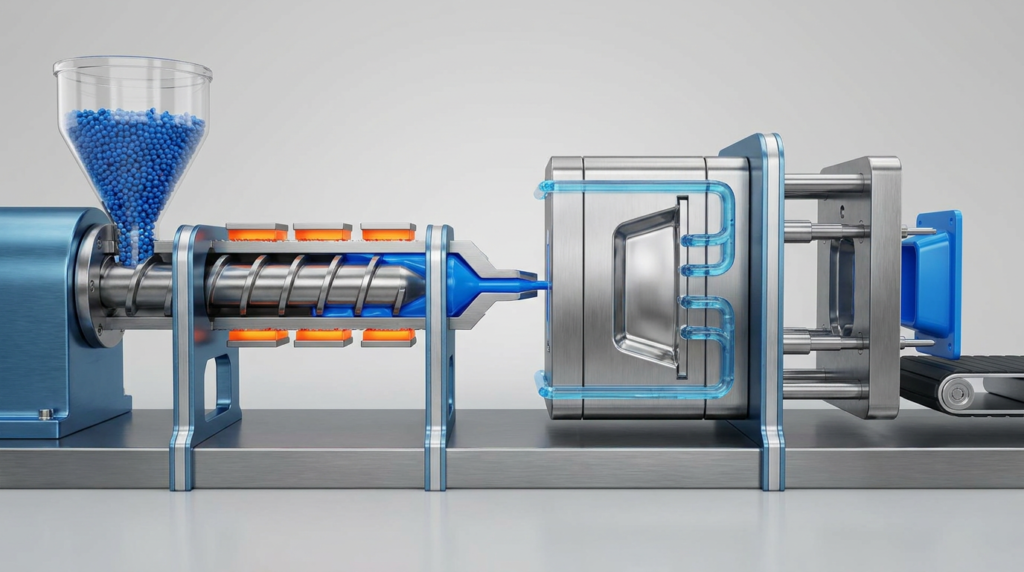
The 5 steps of injection molding are: (1) Clamping — the two mold halves close and lock under high pressure; (2) Injection — molten plastic is injected into the cavity; (3) Cooling — the plastic solidifies as heat is removed; (4) Ejection — the mold opens and the part is pushed out; and (5) Post-processing — degating, inspection, and any secondary operations. Steps 1–4 repeat automatically every cycle.
Further Reading
For neutral technical background, see injection molding background.
Step 1: Clamping
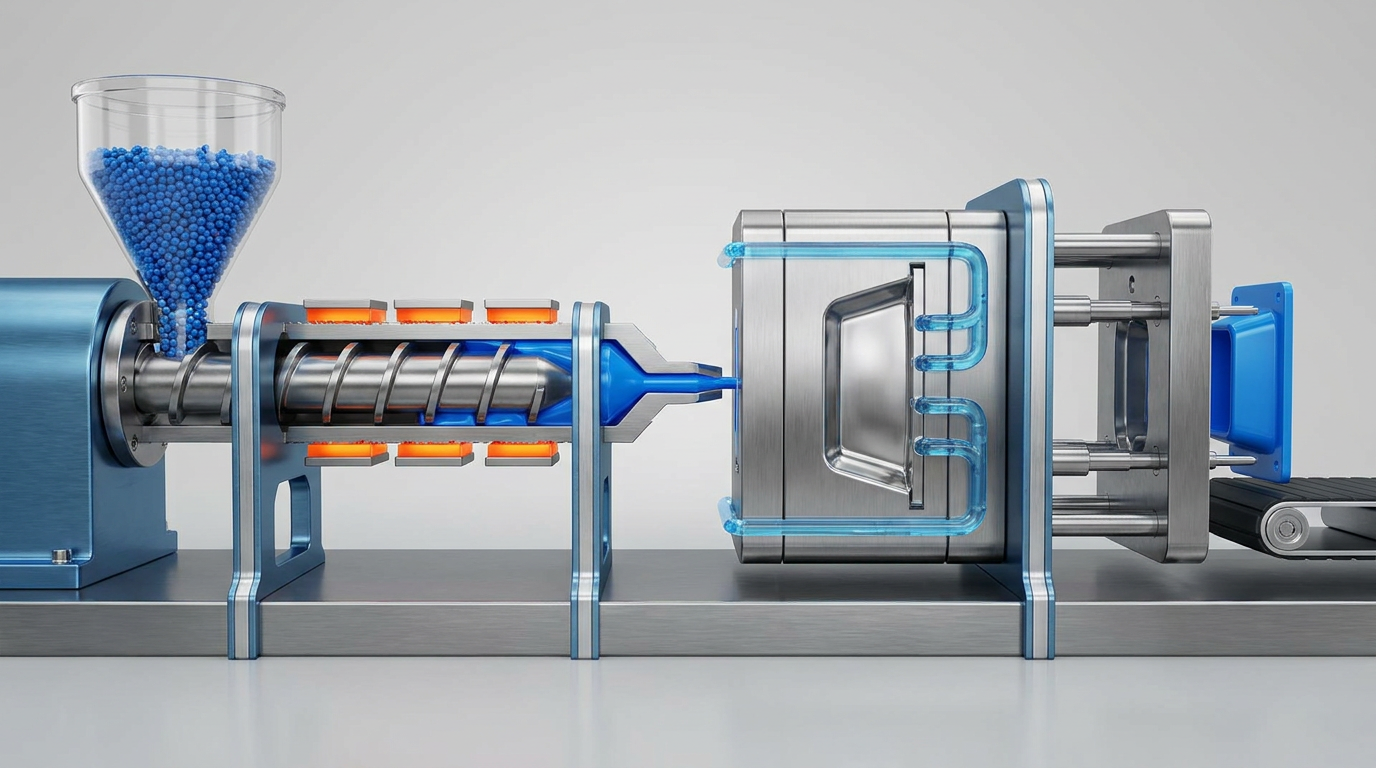
Before any plastic enters the mold, the two mold halves must be brought together and held closed with sufficient force to resist the injection pressure trying to push them apart. This is called clamping.
- Clamping unit: The machine’s clamping unit closes the mold using hydraulic or toggle mechanisms, applying a clamping force measured in tonnes
- Clamping force calculation: Required tonnage = projected part area (cm²) × 0.3–0.7 tonnes/cm². A 100cm² part requires 30–70 tonnes of clamp
- Insufficient clamp: If clamping force is too low, injection pressure forces the mold open slightly, causing flash (thin plastic fins) on the parting line
- Typical clamping speed: Fast close to save time, then slow final approach to protect the mold from impact damage
- Mold protection: Low-pressure mold protection activates in the final closing phase to detect any obstruction (stuck part, foreign object) before full pressure is applied
Step 2: Injection
With the mold clamped shut, molten plastic is injected from the machine barrel into the mold cavity through the nozzle, sprue, runners, and gates.
- Material preparation: Plastic pellets in the hopper are fed into the heated barrel where the rotating screw melts and homogenizes them into a molten shot
- Injection: The screw moves forward (like a plunger) at controlled velocity, pushing molten plastic into the cavity. Fill time: 0.5–5 seconds
- Injection pressure: 500–2,000 bar at the screw tip. The pressure profile is programmed as a multi-stage velocity curve to control fill speed at different points in the cavity
- Transfer point: Injection switches to packing when the cavity is ~95–98% full, detected by screw position or cavity pressure sensor
- Material temperature: 150–400°C depending on the resin. Too low: high viscosity, incomplete fill. Too high: degradation, discolouration, gas burns
Step 3: Cooling
As soon as molten plastic contacts the cold mold wall, cooling begins. The cooling step continues through packing and beyond until the part is rigid enough to be ejected without distortion.
- Cooling time: 5–60 seconds — the single largest component of cycle time (60–70%)
- Cooling mechanism: Cold water (or temperature-controlled fluid) circulates through channels drilled or machined into the mold steel, extracting heat from the plastic
- Mold temperature: 20–60°C for amorphous resins (ABS, PS, PC); 60–120°C for semi-crystalline resins (PA, POM, PPS) that need controlled crystallization
- Ejection temperature: Part must cool below the material’s heat deflection temperature (HDT) before ejection. Ejecting too early causes warpage
- Optimization: Conformal cooling channels (3D printed to follow the part contour) reduce cooling time by 20–40% in complex molds
Step 4: Ejection
Once cooled, the mold opens and the ejection system pushes the finished part out of the cavity so the cycle can repeat.
- Mold opening: The clamping unit retracts, separating the mold halves. Opening speed: fast initially to save time, then slow near full open to allow controlled part separation
- Ejector pins: Most common method. Hardened steel pins push against the B-side (non-cosmetic) surface of the part. Pin marks are visible and must be placed in non-cosmetic areas
- Stripper plate: A moving plate strips the part off the core — used for thin-wall parts or where no pin marks are acceptable
- Air assist: Compressed air blown through small ports helps release parts from deep cores or low-draft surfaces
- Robot part removal: High-volume production uses robotic arms to remove, orient, and place parts consistently, enabling faster cycles and eliminating operator variation
Step 5: Post-Processing
After ejection, most injection molded parts require one or more post-processing operations before they are ready for use or assembly:
| Post-Process | Description | When Required |
|---|---|---|
| Degating | Removing the gate vestige (plastic stub where material entered) | Almost always for cold runner molds |
| Visual inspection | Checking for surface defects, short shots, flash, discolouration | Every part or statistical sample |
| Dimensional inspection | CMM or gauge measurement of critical dimensions | FAI and ongoing SPC sampling |
| Assembly | Inserting metal inserts, ultrasonic welding, snap-fit assembly | When part is a component in an assembly |
| Surface finishing | Painting, pad printing, hot stamping, chrome plating | Cosmetic parts requiring decoration |
| Annealing | Stress-relief heat treatment to reduce residual stress | High-precision or optical parts |
| Packaging | Counting, bagging, boxing for shipment | All production parts |
The Complete 5-Step Cycle Summary
| Step | Action | Duration | What Goes Wrong Without It |
|---|---|---|---|
| 1. Clamping | Mold closes and locks | 1–3s | Flash on parting line |
| 2. Injection | Molten plastic fills cavity | 0.5–5s | Short shot, burn marks, weld lines |
| 3. Cooling | Part solidifies | 5–60s | Warpage, sink marks, distortion |
| 4. Ejection | Part removed from mold | 0.5–3s | Part sticking, surface damage |
| 5. Post-processing | Gate removal, inspection, assembly | Variable | Non-conforming parts reach customer |
Is packing a separate step from injection?
Technically yes — some descriptions split injection into two steps: “injection” (filling the cavity) and “packing/holding” (applying pressure to compensate for shrinkage after fill). When described as 5 steps, clamping is included as the first step. When described as 4 stages, clamping is omitted.
What happens if you skip cooling?
You cannot skip cooling — the plastic physically needs to solidify before the mold can open. If you try to eject too early (before sufficient cooling), the part will be too soft: it will warp, deform under ejector pin pressure, stick to the mold surface, or collapse entirely.
Can the 5 steps be automated?
Steps 1–4 (clamping through ejection) are fully automated in production — the machine cycles automatically without human intervention. Post-processing (Step 5) can also be automated: robots degate parts, vision systems inspect them, and automated handling systems pack them. Fully automated cells run 24/7 without operators.
What is the most critical step in injection molding?
All steps are interdependent, but cooling is most critical for productivity (it dominates cycle time) and injection/packing is most critical for part quality (these stages set the final dimensions, density, and surface quality of the part).
Need a Precision Injection Mold?
BuildMold engineers every step of the injection molding process — from DFM and mold design through T1–T3 trials and FAI documentation. Free DFM review within 24 hours.