
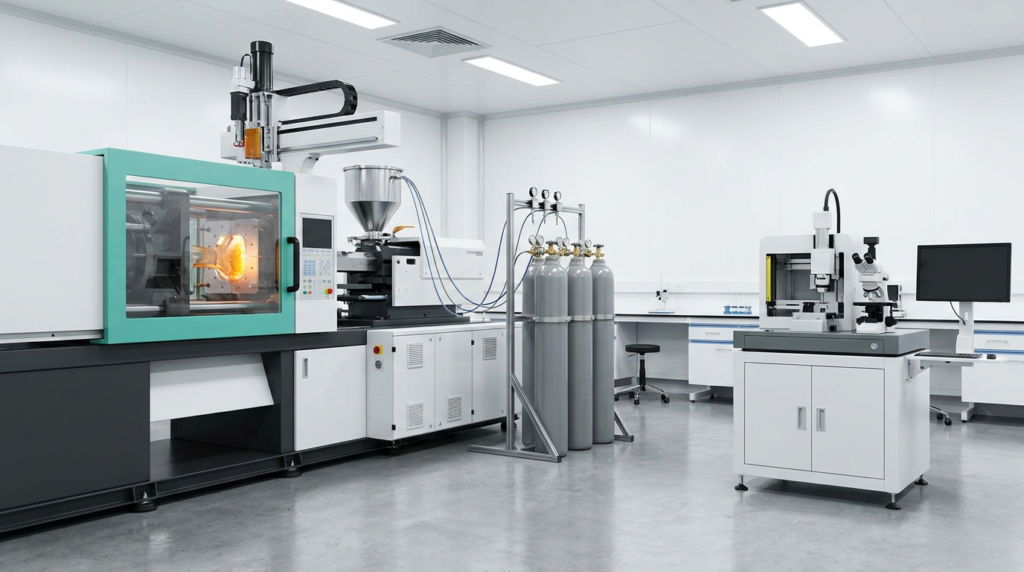
There are 10+ recognized types of injection molding, each developed to solve specific manufacturing challenges. The most common are: thermoplastic injection molding (standard), gas-assist, liquid silicone rubber (LSR), two-shot (2K), insert molding, overmolding, metal injection molding (MIM), micro injection molding, structural foam, and reaction injection molding (RIM). Each type uses the same fundamental principle — forcing material into a mold — but with different materials, equipment, or process conditions.
Further Reading
For neutral technical background, see injection molding background.
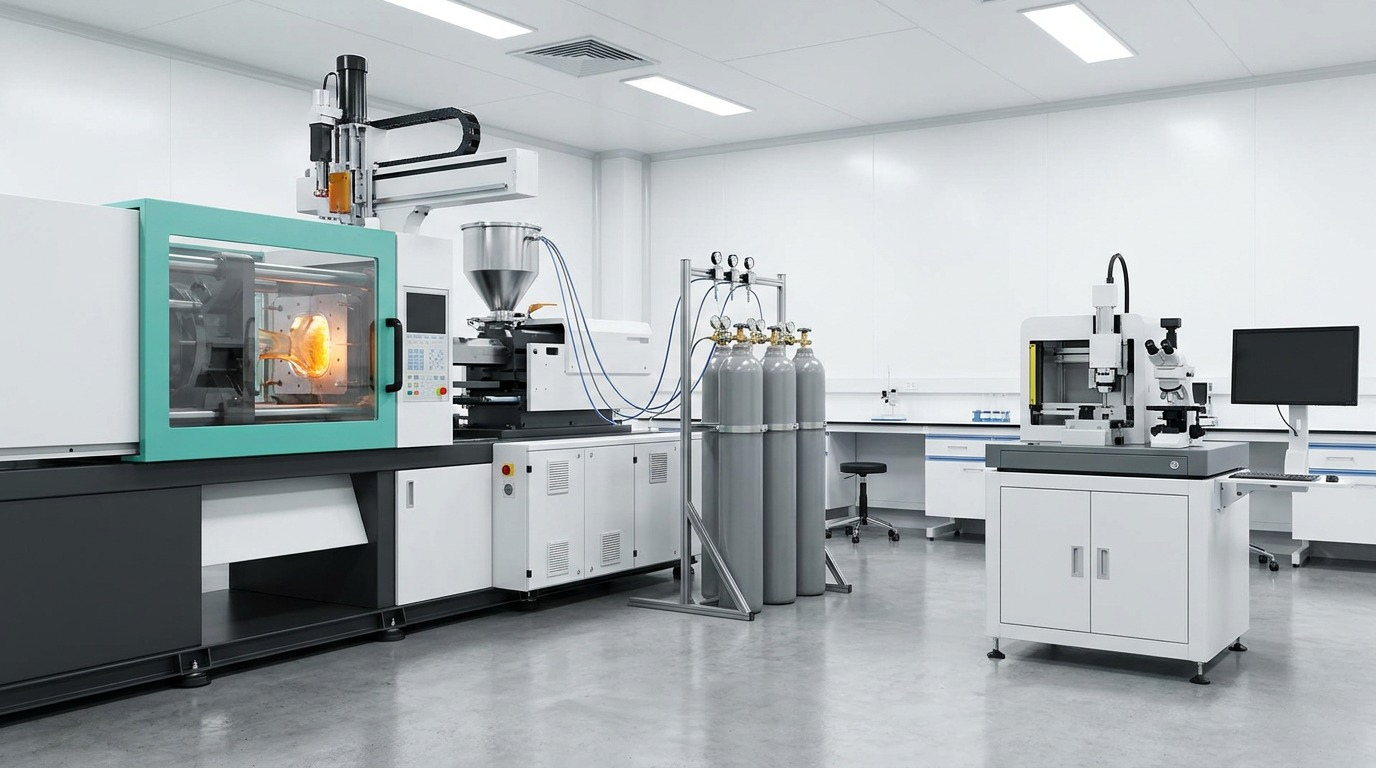
Complete List: All Major Types of Injection Molding
| Type | Material | Key Feature | Main Application |
|---|---|---|---|
| Standard thermoplastic IM | Thermoplastics (PP, ABS, PC…) | Most common; versatile | All industries |
| Gas-assist injection molding | Thermoplastics + N² gas | Hollow channels inside solid-looking part | Handles, frames, panels |
| LSR (Liquid Silicone Rubber) | Two-part liquid silicone | Elastic; biocompatible; heat-cured | Medical, seals, baby products |
| Two-shot / 2K molding | Two thermoplastics | Two materials in one cycle; no assembly | Grips, two-colour parts |
| Insert molding | Plastic + metal/plastic insert | Encapsulates pre-placed insert | Threaded bosses, connectors |
| Overmolding | Two plastics (sequential) | Soft over rigid; assembled separately | Tool handles, medical devices |
| Metal Injection Molding (MIM) | Metal powder + binder | Complex metal shapes; sintered after | Surgical tools, watch parts |
| Micro injection molding | Standard thermoplastics | Parts weighing <1g; ±0.005mm | Medical micro-parts, connectors |
| Structural foam molding | Thermoplastic + blowing agent | Lightweight; thick walls possible | Pallets, enclosures, furniture |
| Reaction Injection Molding (RIM) | Two reactive liquid components | Thermoset; large lightweight parts | Bumpers, fascias, enclosures |
| Co-injection (sandwich) | Two plastics simultaneously | Different skin and core materials | Recycled core + virgin skin |
| Thin-wall injection molding | Standard thermoplastics | L/T >100; <1mm wall | Packaging, electronics |
1. Standard Thermoplastic Injection Molding
The baseline process that accounts for the vast majority of injection molded parts worldwide. Thermoplastic pellets are melted, injected into a steel mold, cooled, and ejected as solid parts. Every other type in this list is a variation or specialization of this fundamental process.
- Materials: Any thermoplastic — PP, ABS, PC, PA, POM, PEEK, TPE, and hundreds more
- Cycle time: 10–60 seconds
- Tolerance: ±0.05–0.1mm standard; ±0.01mm precision
- Best for: High-volume production of complex, precise plastic parts in virtually any industry
2. Gas-Assist Injection Molding
After the cavity is partially filled with plastic, pressurized nitrogen gas is injected through the part, pushing the molten core outward to fill the mold wall and creating a hollow channel inside the part. The result is a part that looks solid but has internal hollow sections.
- Advantage: Eliminates sink marks on thick sections; reduces part weight by 20–40%; reduces clamping force requirements
- Applications: Furniture handles, automotive door handles, shower trays, coat hangers, structural frames
- Key design rule: Gas channels must be designed into the part geometry; the gas follows the path of least resistance through the thickest sections
3. LSR Injection Molding (Liquid Silicone Rubber)
Two-part platinum-catalyzed liquid silicone (Parts A and B) is pumped, mixed, and injected into a heated mold where it cures into a permanently elastic, biocompatible rubber part. Unlike thermoplastic molding, LSR requires a hot mold (160–200°C) to cure.
- Key properties: Biocompatible (USP Class VI, FDA-compliant), heat resistant to 200°C+, UV stable, electrically insulating
- Applications: Medical device seals, infant pacifiers, keyboard membranes, gaskets, wearable device straps, implantable components
- Tooling requirement: Extremely tight mold tolerances required (<0.005mm) to prevent flash of the very low-viscosity silicone
4. Micro Injection Molding
Micro injection molding produces extremely small parts (typically 0.001–1g) with features measured in microns. Specialized micro-machines with precise shot size control and miniaturized screws are required.
- Part examples: Microfluidic chips, hearing aid components, dental implant parts, micro-connectors (0.3mm pitch), medical catheter tips
- Tolerance: ±0.005–0.01mm on critical features
- Challenge: At micro scale, material and process variation that is negligible in standard molding becomes critical. Specialized tooling, machines, and quality systems required
5. Structural Foam Injection Molding
A chemical or physical blowing agent is mixed with the thermoplastic. As it enters the mold, the lower injection pressure allows the gas to expand, creating a cellular foam core surrounded by a solid skin.
- Advantage: Very thick sections possible without sink marks; 20–30% weight reduction; lower injection pressure allows larger parts with smaller machines
- Applications: Industrial pallets, outdoor furniture, equipment enclosures, housings requiring thick walls
- Limitation: Surface quality is lower than standard injection molding (swirl marks visible); not suitable for Class A cosmetic surfaces
Choosing the Right Type of Injection Molding
| Your Requirement | Recommended Type |
|---|---|
| High volume, complex plastic part | Standard thermoplastic injection molding |
| Soft-touch grip or seal on a rigid part | 2K (two-shot) or overmolding |
| Medical-grade elastic component | LSR injection molding |
| Hollow interior inside solid-looking part | Gas-assist injection molding |
| Very small part (<1g) | Micro injection molding |
| Complex metal part in small size | Metal injection molding (MIM) |
| Large structural part, lower surface quality OK | Structural foam molding |
| Threaded or conductive insert embedded in plastic | Insert molding |
| Large lightweight thermoset part (bumper, fascia) | Reaction injection molding (RIM) |
What is the most common type of injection molding?
Standard thermoplastic injection molding is by far the most common type, accounting for the vast majority of all injection molded parts produced globally. Within this category, hot runner two-plate molds are the most widely used configuration for high-volume production.
What is the difference between injection molding and reaction injection molding?
Standard injection molding processes thermoplastic materials that melt when heated and solidify when cooled — a reversible process. Reaction injection molding (RIM) mixes two reactive liquid components (typically polyol and isocyanate) that undergo an irreversible chemical reaction (forming polyurethane) inside the mold. RIM produces thermoset parts that cannot be remelted.
Is 3D printing a type of injection molding?
No. 3D printing (additive manufacturing) builds parts layer by layer from digital files without a mold. Injection molding forces molten material into a pre-made mold. They are entirely different manufacturing processes with different costs, capabilities, and applications. 3D printing is often used to prototype parts before injection mold tooling is ordered.
What type of injection molding is used for medical devices?
Medical devices commonly use standard thermoplastic injection molding (with medical-grade resins like PP, PC, or COC), LSR injection molding (for soft seals and implantable components), and micro injection molding (for miniaturized diagnostic and surgical components). All medical injection molding must comply with FDA/ISO 13485 quality requirements and use biocompatible materials.
🔗 Related Articles
Not Sure Which Process Is Right for You?
BuildMold’s engineers evaluate your part design and recommend the optimal injection molding type and mold configuration. Free DFM review and process recommendation within 24 hours.