
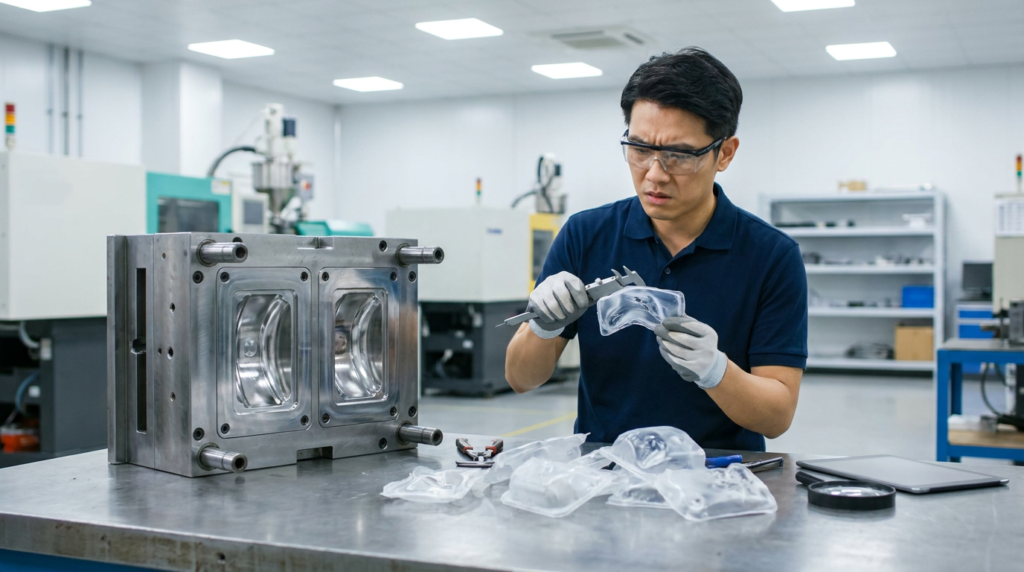
The main disadvantages of injection molding are: high upfront tooling cost (\,000–\,000+ per mold), long lead time to first part (4–12 weeks), design restrictions (draft angles, wall thickness rules, undercut limitations), high minimum volumes to justify tooling investment, difficulty changing designs after the mold is built, and limited suitability for very large parts. Despite these limitations, injection molding remains the most cost-effective process for high-volume plastic parts.
Further Reading
For neutral technical background, see injection molding background.
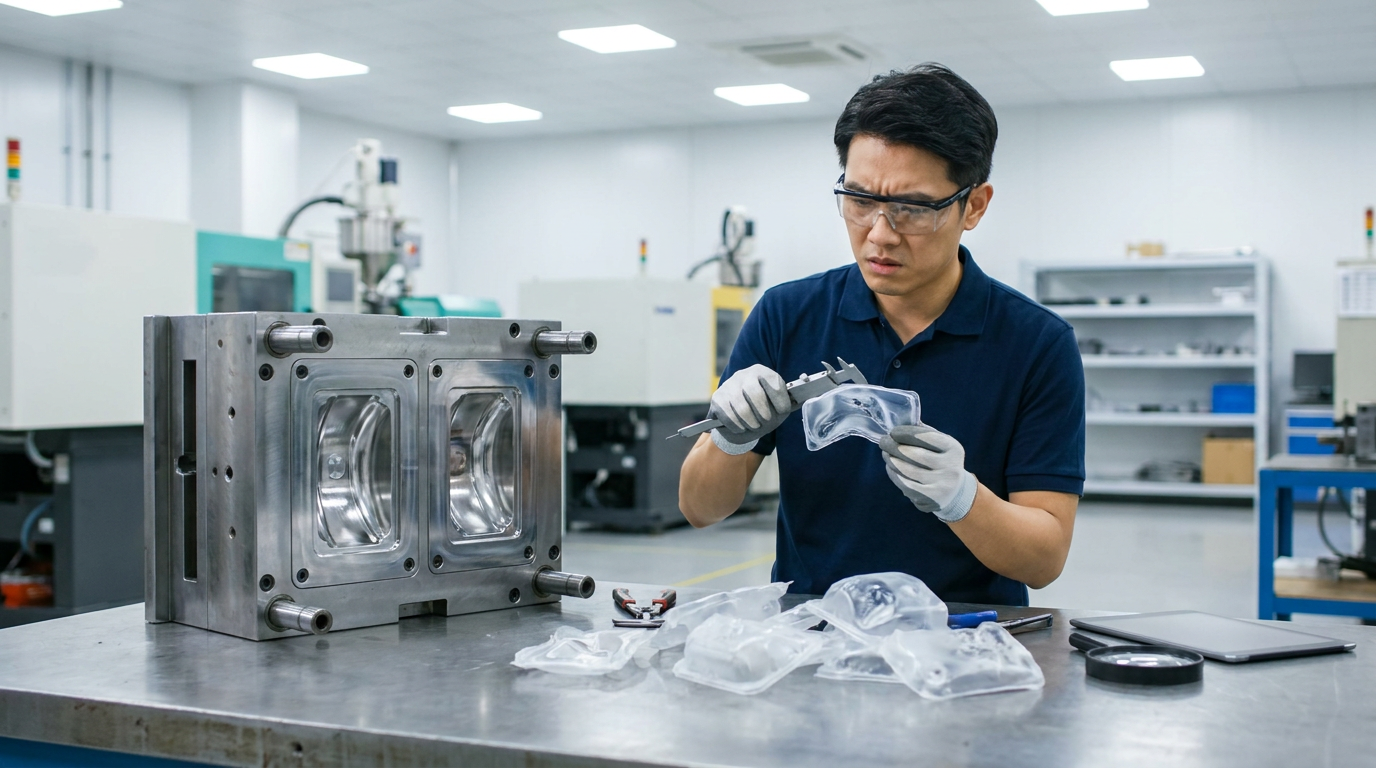
1. High Upfront Tooling Cost
The most significant disadvantage of injection molding is the initial mold investment. Unlike 3D printing or CNC machining where you pay per part, injection molding requires building a steel mold before the first production part can be made.
| Mold Complexity | Typical Cost Range | Break-even Volume (est.) |
|---|---|---|
| Simple single-cavity | \,000–\,000 | 5,000–20,000 parts |
| Medium complexity | \,000–\,000 | 20,000–80,000 parts |
| Complex multi-cavity | \,000–\,000 | 80,000–300,000 parts |
| High-cavitation (16+) | \,000–\,000+ | 500,000+ parts |
When tooling cost is a problem: For prototypes, very low volumes (<1,000 parts), or products still in development, the tooling investment cannot be justified. Alternatives: 3D printing, CNC machining, or aluminum soft tooling for bridge production.
2. Long Lead Time to First Part
Injection mold manufacturing takes 4–12 weeks from design approval to first sample parts. This is a significant disadvantage in fast-moving product development environments where design iteration speed matters.
- Mold design: 1–2 weeks (after DFM approval)
- Steel procurement: 1–2 weeks
- CNC machining and EDM: 2–6 weeks
- Assembly and first trial: 1–2 weeks
- Total minimum: 4–6 weeks for simple molds; 8–16 weeks for complex tools
Mitigation: Rapid tooling (aluminum molds) can reduce lead time to 1–3 weeks but sacrifices tool life and surface quality. Overlapping DFM and steel procurement reduces critical path.
3. Design Restrictions
Injection molding imposes strict design rules that limit part geometry. Unlike 3D printing, which can produce almost any shape, injection molds require:
| Design Requirement | Rule | Consequence of Violation |
|---|---|---|
| Draft angles | 0.5°–5° on all vertical walls | Part sticks in mold; drag marks; ejection failure |
| Wall thickness | Uniform, typically 1.5–4mm | Sink marks, warpage, incomplete fill |
| Undercuts | Require sliders or lifters | Added cost (\,500–\,000 per slider) and complexity |
| Minimum wall | ≥0.8mm for most materials | Thin walls: fill difficulty; tooling fragility |
| Sharp internal corners | Minimum R0.5mm recommended | Stress concentration; EDM cost increase |
| Deep ribs | Max depth = 3× wall thickness | Deep ribs: fill, venting, and ejection problems |
4. High Minimum Order Quantities
The high tooling cost means injection molding only becomes cost-competitive at sufficient production volumes. Below these thresholds, other processes are more economical:
- Under 100 parts: 3D printing is almost always cheaper and faster
- 100–1,000 parts: CNC machining or urethane casting may be more economical
- 1,000–10,000 parts: Aluminum soft tooling or low-cost injection molds become viable
- 10,000+ parts: Production steel injection molds deliver the lowest per-part cost
- 100,000+ parts: Injection molding is almost always the clear economic winner
5. Difficulty Changing Designs After Mold Build
Once a steel mold is cut, design changes are expensive and sometimes impossible. This “steel is permanent” principle is one of injection molding’s most significant limitations for products still in development:
- Steel-safe design: Molds are designed slightly undersize and adjusted by removing steel. Adding steel (welding) is possible but costly and can affect strength
- Minor changes: Adding steel (making cavity larger) requires welding — \–\,000 per change
- Major changes: Moving gates, adding undercuts, or changing wall thickness may require a new mold insert or complete mold rebuild
- Best practice: Finalize design completely and conduct thorough DFM analysis before cutting steel. Every design change after mold build is expensive
6. Limited Suitability for Very Large Parts
Very large plastic parts present challenges for injection molding: the required clamping force, mold size, and machine tonnage scale dramatically with part size.
- Clamping force: Required tonnage = projected area × 0.3–0.7 T/cm². A 1m² part may require 3,000–7,000 tonnes of clamping force
- Machine availability: Very large injection molding machines (1,000T+) are expensive and less commonly available
- Alternative for large parts: Rotational molding, thermoforming, or structural foam injection molding for very large components
7. Environmental Considerations
Injection molding’s environmental disadvantages are increasingly important:
- Plastic waste: Cold runner systems generate runner waste every cycle. Hot runners eliminate this but add tooling cost
- Energy consumption: Heating, cooling, and hydraulic clamping consume significant electricity
- Material limitations: Most injection molding uses virgin thermoplastics; some recycled content is possible but may affect quality
- End-of-life: Many injection molded parts are not readily recyclable due to mixed materials or coatings
Injection Molding vs Alternatives: When to Choose What
| Situation | Best Process | Reason |
|---|---|---|
| Prototype, 1–50 parts | 3D printing | No tooling cost; design flexibility |
| Low volume, 100–2,000 parts | CNC machining or urethane casting | Lower tooling cost; faster |
| High volume, simple hollow part | Blow molding | Lower cost for hollow shapes |
| Very large hollow part | Rotational molding | Only economical option for large hollow shapes |
| High volume, complex solid part | Injection molding | Lowest per-part cost; highest precision |
Frequently Asked Questions
Is injection molding expensive?
The mold itself is expensive (\,000–\,000+), but the per-part cost in production is very low — often \.01–\.00. Injection molding is only “expensive” at low volumes where the tooling cost cannot be amortized. At high volumes, it is the cheapest plastic manufacturing process.
Can injection molding be used for prototypes?
Yes, but it is usually not cost-effective for prototypes. 3D printing is faster and cheaper for 1–50 prototypes. Aluminum prototype molds (soft tooling) can be used for functional testing at lower cost than steel production molds, with lead times of 1–3 weeks.
What are the main alternatives to injection molding?
The main alternatives are 3D printing (prototypes, low volume), CNC machining (metal or plastic, low-medium volume), blow molding (hollow parts), thermoforming (large thin-wall sheet parts), rotational molding (very large hollow parts), and compression molding (thermosets and rubber).
How do you minimize the disadvantages of injection molding?
Key strategies: (1) Finalize design before mold build to avoid change costs; (2) Conduct thorough DFM analysis to catch design problems early; (3) Use hot runners to eliminate runner waste; (4) Design for short cycle times with optimized cooling; (5) Source molds from suppliers who offer steel-safe design and transparent change cost policies.
🔗 Related Articles
Minimize Injection Molding Risks With BuildMold
Our free DFM analysis catches design issues before steel is cut — the most effective way to reduce injection molding’s disadvantages. Get your free DFM report within 24 hours.