
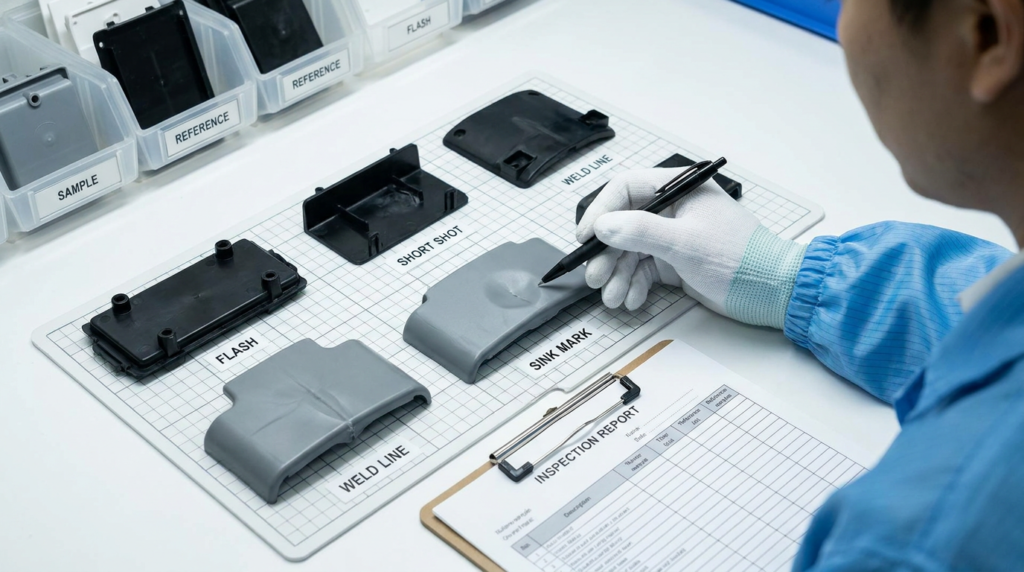
📌 Key Takeaways
- Short shots are almost always caused by insufficient venting — before increasing injection pressure, check and clean all vents first
- Sink marks indicate that the outer skin has frozen while the core is still molten and shrinking — the root cause is always wall thickness variation or insufficient pack pressure/time
- Weld lines cannot be eliminated — they can only be relocated to non-critical areas through gate position changes or mold temperature optimization
- Flash appears when injection pressure exceeds clamping force at the parting line — check clamp tonnage calculation before increasing pack pressure
- Warpage is a cooling problem, not a pressure problem: 80% of warpage cases are resolved by improving cooling circuit design or increasing mold temperature uniformity
Injection molding defects are among the most costly problems in plastic parts manufacturing — causing production downtime, scrap, and customer returns. Understanding the root causes of the most common defects, and knowing which process parameters and mold design factors to adjust, is essential knowledge for both mold designers and production engineers. This guide covers the seven most common injection molding defects with engineering-level root cause analysis and solutions.
Further Reading
For neutral technical background, see injection molding background.
Also see Why Do Injection Molds Fail? for common failure causes such as wear, corrosion, cracking, cooling problems, venting issues, and poor maintenance.
1. Short Shot
A short shot occurs when molten plastic fails to completely fill the mold cavity, leaving a partial or missing section of the part.
| Root Cause | Diagnosis | Solution |
|---|---|---|
| Insufficient injection pressure/speed | Part always short at the same location | Increase injection velocity in first 70% of fill; check hydraulic pressure limit |
| Blocked or inadequate venting | Burn mark at short shot location | Clean vents; add vents at last-fill area; reduce injection speed at end of fill |
| Gate too small | High pressure drop across gate | Increase gate width or depth by 20%; consider additional gate |
| Melt temperature too low | High viscosity; incomplete fill | Increase barrel temperature in 5°C increments; check material drying |
| Wall too thin for flow length | L/T ratio > 150 | Add flow leaders; increase gate count; consider material with higher MFI |
2. Sink Marks & Voids
Sink marks are depressions on the part surface caused by insufficient material packing. Internal voids occur when the outer skin solidifies before adequate material fills the core.
- Wall thickness variation — Thick sections adjacent to thin sections create differential shrinkage. Redesign ribs to 60% of nominal wall thickness
- Insufficient pack pressure — Increase pack pressure in 10% increments until sink marks disappear or gate freezes
- Pack time too short — Increase pack time until no further improvement in sink depth (gate freeze-off point)
- Gate too small — Small gate freezes before adequate packing. Increase gate size or use hot runner valve gate
- Cooling too fast at thick section — Add or reposition cooling channels to maintain pack pressure path from gate to thick section
3. Weld Lines
Weld lines form where two flow fronts meet and the melt is too cool to fully re-fuse. They appear as visible lines and represent a structural weakness (typically 10–50% strength reduction at the weld).
- Relocate gate — Moving the gate changes where flow fronts meet. Place weld lines in low-stress, non-cosmetic areas
- Increase mold temperature — Higher mold temperature keeps the melt warmer at the weld, improving molecular re-entanglement. Increase by 10–20°C and re-evaluate
- Increase melt temperature — Lower viscosity at the flow front improves weld quality. Stay within material supplier’s recommended processing range
- Overflow wells — Add a small overflow pocket beyond the weld line location to flush the cold flow front material out of the main cavity
- Ultrasonic welding (post-mold) — For structural weld line concerns, design the part to be two pieces and ultrasonically welded at the weld line location
4. Flash
Flash is excess plastic that squeezes into the parting line, vents, or ejector pin clearances, creating thin fins on the part that require removal.
| Root Cause | Diagnosis | Solution |
|---|---|---|
| Insufficient clamp force | Flash appears on parting surface across entire part | Verify clamp tonnage: 0.3–0.5 T/cm² projected area; increase or reduce injection pressure |
| Parting surface damage | Flash localized to specific area | Inspect and stone damaged area; replace if chipped |
| Excessive injection pressure | Flash correlates with pressure setting | Reduce peak injection pressure; check fill/pack transfer point |
| Vent too deep | Flash in vent location | Reduce vent depth to below material flash threshold (typically 0.02mm for PA) |
5. Warpage & Dimensional Instability
Warpage is distortion of the part from its intended flat or curved geometry after ejection. It is caused by residual stress from non-uniform cooling, orientation effects, or differential shrinkage.
- Non-uniform cooling — Temperature differential across the part creates differential shrinkage. Improve cooling circuit to achieve ±3°C surface temperature uniformity
- Fiber orientation (GF materials) — Glass fibers align with flow direction and cause anisotropic shrinkage (different shrinkage parallel vs perpendicular to flow). Reposition gate to change flow pattern
- Mold temperature asymmetry — Different temperatures on cavity and core sides cause the part to bow toward the cooler side. Balance cooling on both sides
- Insufficient cooling time — Ejecting the part before the core temperature drops below heat deflection temperature causes post-ejection warpage. Increase cooling time
- Post-ejection fixturing — For difficult-to-control warpage, eject parts into a cooling fixture that holds geometry while the part fully cools to room temperature
6. Burn Marks
- Diesel effect — Trapped air compresses adiabatically to temperatures above 300°C, burning the plastic. Solution: add vents at burn mark location; reduce injection speed at end of fill
- Material degradation — Excessive melt temperature or residence time degrades the resin. Reduce barrel temperature; ensure full shot size utilization
- Hot runner overheating — Check hot runner zone temperatures; replace faulty thermocouples; reduce hot runner temperature by 5–10°C
7. Silver Streaks / Splay
- Moisture — The most common cause. Undried hygroscopic resins (PC, PA, ABS) generate steam that creates silver streaks. Dry material per supplier specification: PC 120°C/4hr, PA 80°C/4hr
- Trapped air at gate — Air entrainment during injection at the gate. Reduce injection speed at fill start (velocity profiling)
- Contamination — Foreign material or incompatible regrind creates streaks. Purge machine thoroughly; eliminate regrind
Systematic defect troubleshooting starts with one change at a time, documented and measured. At BuildMold, our T1 mold trial reports include defect photographs, root cause analysis, and the specific parameter adjustments made — providing full transparency on the path from first shot to production-ready mold.
🔗 Related Articles
Experiencing Molding Defects?
Send us photos and your current process parameters for a free root cause analysis from our tooling engineers.
Or email us directly: sales@buildmold.com