
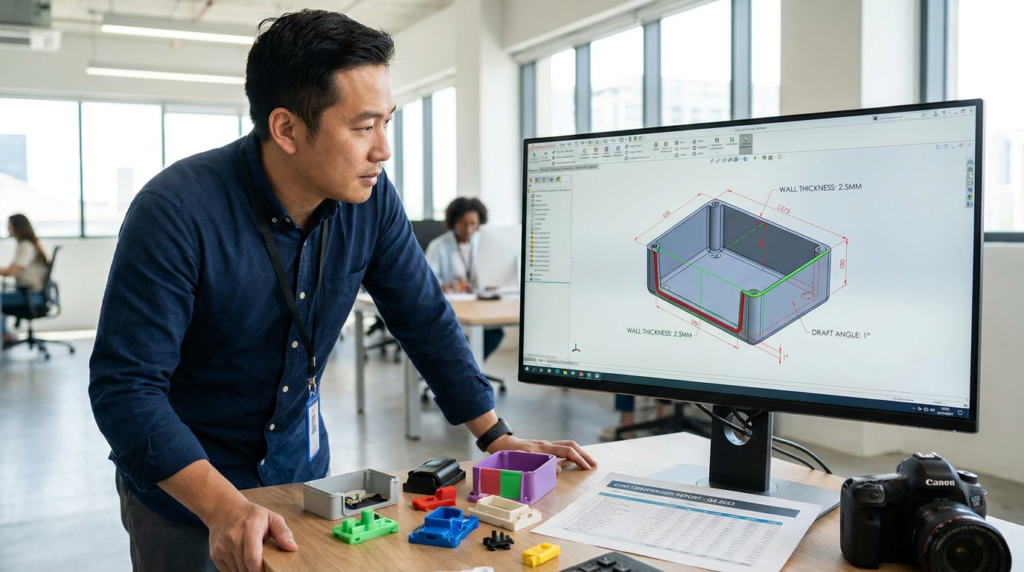
Cost is one of the biggest barriers to entry for injection moulding — particularly for startups, small businesses, and independent product developers. But injection moulding does not have to be prohibitively expensive. What is the cheapest way to injection mold? The answer depends on your volume, quality requirements, and timeline — and there are several proven strategies to dramatically reduce cost without sacrificing the part quality your product needs.
Further Reading
For neutral technical background, see injection molding background.
Why Is Injection Moulding Expensive?
Before exploring cost reduction strategies, it helps to understand where injection moulding costs come from:
- Tooling (mould fabrication): The single largest upfront cost — typically $5,000–$100,000+ for a production steel mould
- Machine time: $15–$180/hour depending on machine size and location
- Material: $1.20–$120/kg depending on resin grade
- Labour: Setup, operation, inspection, and packaging
- Secondary operations: Assembly, painting, ultrasonic welding, pad printing
For low-volume runs, tooling cost dominates. For high-volume production, machine time and material become the primary cost drivers.
The 7 Cheapest Ways to Injection Mold
1. Use Soft Tooling (Aluminium Moulds)
Aluminium moulds cost 50–80% less than hardened P20 or H13 steel production moulds. A single-cavity aluminium mould for a simple part can cost as little as $1,500–$5,000, compared to $15,000–$50,000 for a production steel equivalent.
- Lifespan: 5,000–50,000 shots (vs 500,000–1,000,000+ for hardened steel)
- Best for: Market validation runs, bridge tooling before production, low-volume products (under 20,000 parts lifetime)
- Limitation: Not suitable for abrasive glass-filled materials; lower dimensional stability at high production temperatures
Strategy: Start with aluminium tooling to validate design and market demand. Transition to steel production tooling only once volume justifies the investment.
2. Source Tooling from China
China remains the world’s most cost-competitive source for injection mould fabrication. A mould that costs $30,000–$50,000 in the US or Germany can be produced in China’s Pearl River Delta or Yangtze River Delta manufacturing hubs for $5,000–$15,000 — a saving of 60–80%.
- Key manufacturing hubs: Dongguan, Shenzhen, Ningbo, Taizhou
- Typical lead time: 4–8 weeks for simple moulds; 8–14 weeks for complex tools
- Quality tip: Require ISO 9001 certification, request mould flow analysis reports, and specify steel grade (e.g., P20 for general purpose, 718H for demanding applications)
- Risk mitigation: Use a detailed mould specification document (steel grade, surface finish, cooling layout, trial requirements) and build T1/T2/T3 sample approval into the contract
3. Design for Minimum Complexity (DFM)
The most effective cost reduction happens before tooling is ordered. Every feature that adds mould complexity adds cost:
- Undercuts require side actions or lifters — adding $500–$5,000 per action to tooling cost
- Thick walls increase cooling time and material cost — redesign to 1.5–3 mm uniform thickness
- Tight tolerances on non-critical features increase inspection and scrap cost — loosen tolerances wherever function allows
- Textured surfaces require EDM finishing — use smooth or lightly stippled finishes for cost-sensitive parts
- Multiple colours require overmoulding or separate assembly — consolidate to single colour where possible
Rule of thumb: A DFM review that eliminates two side actions saves more money than any other single cost-reduction measure.
4. Start with a Single-Cavity Mould
Multi-cavity moulds produce more parts per cycle but cost proportionally more upfront. For low-to-medium volumes, a single-cavity mould is the cheapest entry point:
- 1-cavity mould: baseline cost (e.g., $8,000)
- 2-cavity mould: ~1.5× cost (e.g., $12,000)
- 4-cavity mould: ~2–2.5× cost (e.g., $18,000–$20,000)
At volumes above 50,000–100,000 parts/year, a 2- or 4-cavity mould pays back through reduced cycle cost per part. Below that threshold, a single-cavity mould is almost always the cheaper total solution.
5. Use a Family Mould
A family mould houses multiple different parts in a single mould base — sharing the mould structure, cooling system, and runner. If your product has 3–5 small parts that are always produced together, a family mould can cost 30–50% less than separate individual moulds.
- Best for: Product assemblies with multiple small plastic components (e.g., a housing with lid, clips, and brackets)
- Limitation: All cavities must run the same material and colour; runner balancing is more complex
6. Choose the Right Material Grade
Material selection has a direct impact on part cost, and over-specifying material is common:
- Using PC where ABS would suffice adds ~$1.00–$1.50/kg in material cost
- Using virgin resin where re-grind or recycled content meets specs adds unnecessary cost
- Using a natural (uncoloured) base resin and adding masterbatch is typically cheaper than pre-coloured resin for short runs
Consult a material supplier with your functional requirements — they can often recommend a lower-cost grade that meets your performance criteria.
7. Consolidate Parts Through Design
Every separate plastic component requires its own mould. Designing two parts as one — through snap fits, living hinges, or integrated features — eliminates an entire mould cost:
- A PP living hinge can replace a separate hinge component entirely
- Snap-fit clips can replace screws and separate fastener components
- Integrated bosses and ribs replace separately moulded inserts
Part consolidation is one of the highest-ROI design activities in product development.
Cost Comparison: Cheapest Injection Moulding Approaches
| Strategy | Tooling Cost Saving | Per-Part Cost Impact | Best Volume Range |
|---|---|---|---|
| Aluminium soft tooling | 50–80% less than steel | Neutral | <20,000 lifetime parts |
| China-sourced tooling | 60–80% vs Western markets | Also lower machine rate | All volumes |
| DFM optimisation | 10–40% tooling reduction | Reduces cycle time & scrap | All volumes |
| Single-cavity mould | Lowest upfront cost | Higher per-part cost | <50,000 parts/year |
| Family mould | 30–50% vs separate moulds | Neutral to positive | Multi-part assemblies |
| Right-sized material | None | 5–30% per-part saving | All volumes |
| Part consolidation | Eliminates entire moulds | Significant saving | All volumes |
What About 3D Printing as a Cheaper Alternative?
For volumes under 100–500 parts, 3D printing (SLA, SLS, FDM) is often cheaper than injection moulding because there is no tooling cost. However, 3D printing cannot match injection moulding for:
- Surface finish (especially for cosmetic consumer products)
- Material properties (especially for structural, flexible, or high-temperature applications)
- Per-part cost at volumes above 500–1,000 units
- Production speed and consistency
Use 3D printing for prototyping and design validation, and transition to injection moulding when volume and quality requirements justify it.
Frequently Asked Questions
What is the cheapest way to injection mold?
The cheapest approach combines aluminium soft tooling, China-based mould fabrication, and DFM optimisation to minimise unnecessary mould complexity. For a simple part, this combination can reduce total tooling cost from $30,000+ (US steel tool) to $2,000–$5,000 (China aluminium tool) — an 80–90% reduction.
How much does a cheap injection mould cost?
The cheapest production-capable injection moulds — simple geometry, single cavity, aluminium, made in China — start at approximately $1,500–$3,000. A more typical simple steel mould from China costs $3,000–$8,000. Complex multi-cavity or precision moulds from Western suppliers cost $20,000–$100,000+.
Is injection moulding cheaper than 3D printing?
For volumes above roughly 500–2,000 parts, injection moulding becomes cheaper per part than 3D printing, once tooling cost is amortized. Below that threshold, 3D printing has no tooling cost and is typically more cost-effective for small quantities.
How can I reduce injection moulding tooling cost?
The most effective steps are: (1) simplify part design to eliminate undercuts and side actions, (2) choose aluminium over steel tooling for low volumes, (3) source tooling from China, (4) use a single-cavity or family mould where appropriate, and (5) conduct a DFM review before cutting steel to catch costly design issues early.
What is bridge tooling in injection moulding?
Bridge tooling refers to a lower-cost, shorter-lead-time mould (typically aluminium or soft steel) used to produce parts while a full production mould is being fabricated. It “bridges” the gap between product launch and production tooling readiness — allowing sales and market testing to begin earlier.
Does buying in bulk reduce injection moulding cost?
Yes — higher volumes reduce per-part cost through three mechanisms: (1) tooling cost is amortized over more parts, (2) longer production runs reduce machine setup time per part, and (3) suppliers offer volume discounts on material and machine time. The cost per part for 100,000 units can be 5–10× lower than for 1,000 units from the same mould.
Summary
The cheapest way to injection mold combines smart design (DFM to eliminate complexity), smart tooling choices (aluminium soft tools for low volumes; single-cavity moulds to start), and smart sourcing (China-based mould makers for significant cost savings). Together, these strategies can reduce total injection moulding entry cost by 70–90% compared to a full production steel tool in a Western market.
The key mindset shift: tooling cost is a one-time investment. Optimising the mould design and sourcing strategy upfront has a compounding effect on every part produced for the product’s lifetime.