
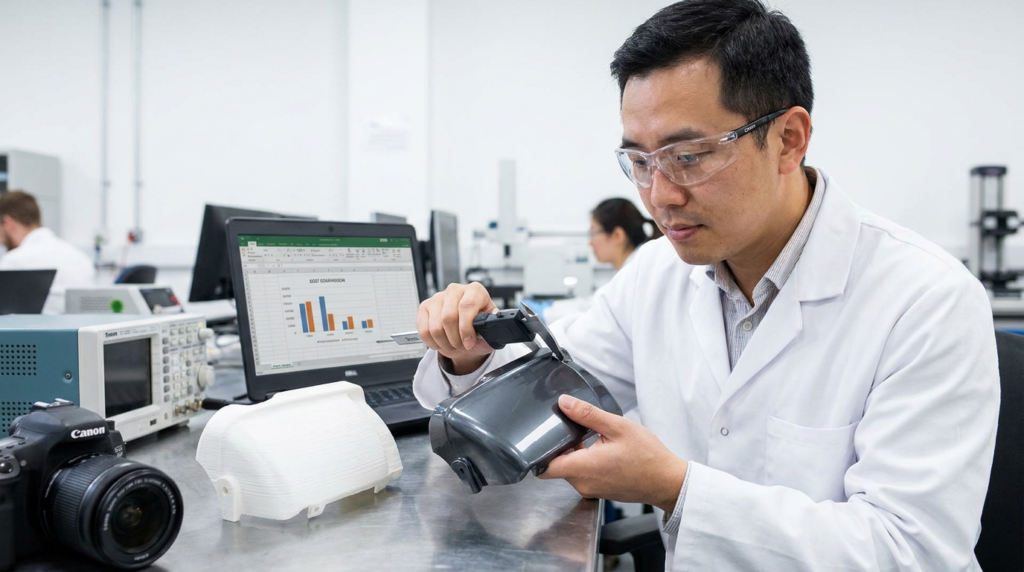
One of the most common questions product developers ask when choosing a manufacturing process is: is injection molding cheaper than 3D printing? The honest answer is — it depends entirely on production volume, part complexity, material requirements, and quality standards. Neither process is universally cheaper than the other. Understanding where each process crosses over in cost is the key to making the right decision for your project.
Further Reading
For neutral technical background, see 3D printing background.
This guide provides a comprehensive, data-driven comparison of injection molding vs 3D printing across cost, quality, speed, and application fit.
The Core Cost Difference: Tooling vs Per-Part Cost
The fundamental economic difference between injection molding and 3D printing comes down to one factor: tooling cost.
- Injection molding has a high upfront tooling cost ($1,500–$100,000+ for a mold) but very low per-part cost at volume ($0.05–$5.00 per part)
- 3D printing has zero tooling cost but higher per-part cost ($1–$100+ per part depending on technology and size)
This creates a clear crossover point — the production volume above which injection molding becomes cheaper than 3D printing. Below that point, 3D printing wins on total cost. Above it, injection molding wins decisively.
Cost Crossover: When Does Injection Molding Become Cheaper?
| Scenario | Typical Crossover Volume |
|---|---|
| Simple part, China aluminum mold ($3,000), FDM 3D printing | ~200–500 parts |
| Simple part, China steel mold ($8,000), SLA 3D printing | ~500–2,000 parts |
| Medium part, China steel mold ($15,000), SLS 3D printing | ~2,000–5,000 parts |
| Complex part, Western steel mold ($50,000), industrial SLS | ~10,000–25,000 parts |
Note: Crossover volume assumes comparable material and quality. Actual figures vary by part size, geometry, and supplier.
Detailed Cost Comparison by Volume
| Volume | 3D Printing Total Cost | Injection Molding Total Cost | Cheaper Option |
|---|---|---|---|
| 10 parts | $50–$500 | $8,050–$100,050 (mold + parts) | 3D Printing |
| 100 parts | $500–$5,000 | $8,100–$100,500 | 3D Printing |
| 1,000 parts | $2,000–$30,000 | $8,500–$103,000 | Depends on mold cost |
| 10,000 parts | $20,000–$200,000 | $9,500–$110,000 | Injection Molding |
| 100,000 parts | $200,000–$2,000,000 | $13,000–$120,000 | Injection Molding |
| 1,000,000 parts | Not viable | $28,000–$200,000 | Injection Molding |
3D Printing Technologies and Their Costs
Not all 3D printing is equal — technology choice significantly affects cost and quality:
| Technology | Typical Per-Part Cost | Surface Quality | Material Options |
|---|---|---|---|
| FDM (Filament) | $1–$20 | Low (visible layers) | PLA, ABS, PETG, Nylon |
| SLA (Resin) | $5–$50 | High (smooth) | Engineering resins |
| SLS (Powder) | $15–$100 | Medium (slightly grainy) | Nylon, TPU, PA12 |
| MJF (HP Multi Jet) | $10–$80 | High | PA12, PA11, TPU |
| DMLS (Metal) | $50–$500+ | Medium (post-process needed) | Stainless, titanium, aluminum |
Quality Comparison: Injection Molding vs 3D Printing
| Quality Factor | Injection Molding | 3D Printing (Best Case) |
|---|---|---|
| Surface finish | Excellent (SPI A1–D3) | Good (SLA/MJF), Poor (FDM) |
| Dimensional accuracy | ±0.05–0.1 mm | ±0.1–0.3 mm typical |
| Mechanical properties | Isotropic, full material spec | Anisotropic (layer weakness) |
| Material range | 18,000+ commercial grades | Limited (hundreds of materials) |
| Part-to-part consistency | Excellent (Cpk ≥1.33) | Good for SLS/MJF; variable for FDM |
| Wall thickness minimum | ~0.8–1.0 mm | ~0.5–1.0 mm (technology-dependent) |
| Internal geometry | Limited (tooling constraints) | Unlimited (no tooling) |
Speed Comparison: Which Is Faster?
For Small Quantities (1–100 parts)
3D printing is significantly faster. A 3D printed part can be in your hands within 24–72 hours. Injection molding requires 4–16 weeks for mold fabrication before a single part is produced.
For Large Quantities (10,000+ parts)
Injection molding is dramatically faster. A single injection molding machine can produce 200–1,500 parts per hour. Industrial 3D printers produce 1–50 parts per hour at most, and per-unit cost remains high regardless of volume.
When to Choose 3D Printing
- Prototyping and design validation: Test form, fit, and function before committing to tooling investment
- Low volume (<500–2,000 parts): No tooling cost makes 3D printing economical for small quantities
- Complex internal geometry: Undercuts, internal channels, lattice structures impossible or impractical with injection molding
- Highly customised or personalised parts: Medical implants, custom orthotics, bespoke consumer products where each unit differs
- Rapid design iteration: Multiple design revisions in days rather than weeks
- On-demand spare parts: Eliminate inventory by printing parts as needed
When to Choose Injection Molding
- High volume (>5,000–10,000 parts): Tooling cost amortizes rapidly; per-part cost falls dramatically
- Production-grade material properties: Full mechanical, thermal, and chemical resistance of commercial resin grades
- Cosmetic surface finish requirements: Consumer products requiring Class A surfaces, textures, and consistent gloss
- Tight dimensional tolerances: Parts requiring ±0.05 mm or better for assembly fits
- Regulatory compliance: Medical, automotive, and food-contact parts requiring certified material grades
- Long-term production: Products with 2–10+ year production lifecycles where mold cost becomes negligible
Hybrid Strategy: Use Both Processes Together
The most cost-effective product development strategy often combines both processes:
- 3D print prototypes for design validation (weeks 1–4)
- 3D print functional prototypes for user testing and regulatory submission
- Injection mold with aluminium soft tooling for market validation runs (500–5,000 parts)
- Injection mold with production steel tooling for full-scale manufacturing (10,000+ parts)
This approach minimises risk at each stage — never committing to expensive steel tooling until demand is validated.
Frequently Asked Questions
Is injection molding cheaper than 3D printing?
At high volumes (typically above 1,000–10,000 parts depending on mold cost), injection molding is significantly cheaper per part than 3D printing. Below that crossover point, 3D printing is cheaper because there is no tooling cost. The crossover volume depends on mold cost, part size, and which 3D printing technology is being compared.
At what quantity does injection molding become cheaper than 3D printing?
For a simple part with a low-cost aluminium mold from China ($3,000–$5,000), injection molding typically becomes cheaper at around 500–1,000 parts. For more complex parts with expensive steel tooling ($30,000–$50,000), the crossover may not occur until 10,000–25,000 parts. Use a simple formula: crossover volume = mold cost ÷ (3D print cost per part − injection molding cost per part).
Is 3D printing replacing injection molding?
No — 3D printing is complementing injection molding, not replacing it. 3D printing excels at prototyping, low volumes, and complex geometry. Injection molding remains unmatched for high-volume production, material performance, surface finish, and cost per part at scale. The two processes serve different points on the product lifecycle.
What are the quality differences between injection molding and 3D printing?
Injection molded parts have isotropic mechanical properties (equal strength in all directions), superior surface finish (SPI A1–D3), tighter dimensional tolerances (±0.05 mm), and access to the full range of 18,000+ commercial resin grades. Most 3D printed parts are anisotropic (weaker along the build axis), have limited material choices, and require post-processing for cosmetic surfaces. SLS and MJF close the gap somewhat but still cannot match injection molding for surface finish or material performance at volume.
Can 3D printed molds be used for injection molding?
Yes — 3D printed molds in high-temperature resin (such as Formlabs High Temp or Carbon DLS tooling) can produce 50–500 injection molded shots, making them suitable for very low volume bridge production or design validation with actual production material. They are not suitable for production runs due to limited thermal and pressure durability compared to aluminium or steel molds.
Which process is better for medical devices?
Both are used — at different stages. 3D printing (SLA, SLS, MJF) is widely used for medical device prototyping, surgical guides, and custom patient-specific devices. Injection molding is used for regulated, high-volume medical components requiring ISO 13485 compliance, certified biocompatible material grades, and validated, repeatable production processes. Most FDA-cleared plastic medical devices are ultimately injection molded.
Summary
Injection molding is not universally cheaper than 3D printing — and 3D printing is not universally cheaper than injection molding. The right answer depends entirely on production volume, part complexity, quality requirements, and timeline. Use 3D printing for prototyping, low volumes, and complex geometry. Use injection molding for high-volume production, cosmetic finish, material performance, and long-term cost efficiency. The smartest product development strategies use both — at the right stage of the product lifecycle.