
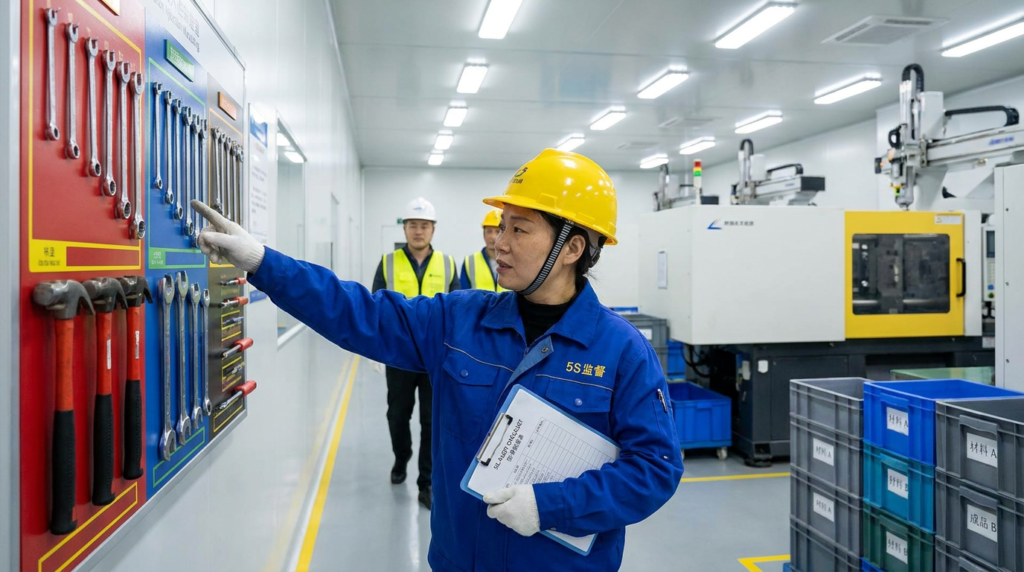
In any high-performance injection moulding operation, 5S is one of the most foundational and widely implemented lean manufacturing methodologies. But what exactly is 5S in injection molding, and why does it matter for part quality, machine uptime, and workplace safety? This guide explains the 5S system in the context of injection moulding facilities — with practical examples for each step.
Further Reading
For neutral technical background, see 5S methodology background.
What Is 5S in Manufacturing?
5S is a workplace organisation methodology originating from the Toyota Production System (TPS) in Japan. It consists of five steps — each beginning with the letter “S” in Japanese — that together create a clean, organised, efficient, and safe working environment. In English, the five steps are:
| Step | Japanese Term | English Meaning | Core Action |
|---|---|---|---|
| 1S | Seiri (整理) | Sort | Remove everything unnecessary from the workspace |
| 2S | Seiton (整頓) | Set in Order | Organise what remains so everything has a designated place |
| 3S | Seiso (清掃) | Shine | Clean the workplace and equipment thoroughly and regularly |
| 4S | Seiketsu (清潔) | Standardise | Create standards and schedules to maintain the first 3Ss |
| 5S | Shitsuke (躾) | Sustain | Build discipline and culture to maintain 5S long-term |
In some Western implementations, a 6th S — Safety — is added, making it “6S”.
Why Is 5S Especially Important in Injection Moulding?
Injection moulding facilities have unique characteristics that make 5S particularly valuable:
- Contamination sensitivity: Even microscopic contamination — dust, metal particles, moisture, oil — can cause surface defects (silver streaks, black specks, splay) in finished parts
- Mould handling complexity: Heavy, precision moulds (50 kg–5,000 kg) require organised storage, clear identification, and safe handling procedures
- Machine downtime cost: An injection moulding machine running at $25–$150/hour makes unplanned downtime extremely costly — and many downtime causes (blocked cooling lines, lost tools, disorganised setups) are preventable with 5S
- Material management: Incorrect material loading — wrong resin grade, undried material, contaminated regrind — is a leading cause of production defects and machine damage
- Safety hazards: Hot surfaces, hydraulic systems, heavy mould lifts, and chemical mould releases make a safe, organised workplace essential
5S in Injection Moulding: Step-by-Step Application
1S — Sort (Seiri): Remove What Does Not Belong
In an injection moulding facility, Sort means systematically identifying and removing:
- Obsolete or broken moulds no longer in production — freeing valuable storage space
- Expired or contaminated raw material bags left near machines
- Unused tooling, spare parts, and equipment that have accumulated around machines
- Redundant paperwork, outdated process sheets, and superseded work instructions
- Personal items and non-work materials from workstations
Red tag method: Items whose status is uncertain are tagged with a red label. If not claimed or justified within 30 days, they are removed, recycled, or scrapped.
2S — Set in Order (Seiton): A Place for Everything
Once unnecessary items are removed, everything remaining is assigned a fixed, clearly marked location:
- Mould storage racks: Numbered and labelled; each mould has a dedicated slot with its ID, material, and last production date visible
- Tool boards (shadow boards): Outlines of each tool painted on a pegboard — missing tools are immediately visible
- Material staging areas: Colour-coded zones for each resin type; incoming, approved, and quarantined material clearly segregated
- Machine peripherals: Hoppers, dryers, temperature controllers, and robots assigned to specific machines with cable management
- Spare parts cabinets: Labelled with part numbers, minimum stock levels, and reorder triggers
Goal: Any operator — including a new hire — should be able to find any tool, document, or material within 30 seconds without asking anyone.
3S — Shine (Seiso): Clean as Inspection
In injection moulding, “Shine” goes far beyond cosmetic cleanliness. Regular cleaning is a form of equipment inspection that catches problems before they become failures:
- Machine cleaning: Wiping down platens, tie bars, and ejector systems reveals hydraulic leaks, unusual wear, and loose fasteners
- Mould cleaning: Cleaning mould cavities, vents, and parting surfaces prevents flash, surface defects, and premature corrosion — especially critical for moulds processing PVC or flame-retardant materials that outgas corrosive compounds
- Floor and drainage: Clean floors eliminate slip hazards from coolant leaks and allow early detection of water circuit leaks
- Hopper and dryer cleaning: Prevents cross-contamination between material changeovers
Cleaning schedule: Define daily (operator), weekly (technician), and monthly (maintenance) cleaning tasks for each machine and work area.
4S — Standardise (Seiketsu): Lock In the Gains
Standardise converts the results of Sort, Set in Order, and Shine from a one-time event into permanent, documented standards:
- Visual standards: “Before and after” photographs posted at each workstation showing the correct state
- Cleaning checklists: Machine-specific daily/weekly cleaning tasks with sign-off by operator and shift supervisor
- Material handling SOPs: Step-by-step procedures for material identification, drying, loading, and changeover
- Mould storage standard: Rules for mould acceptance (cleaned, protected with rust inhibitor, cavity plugged), labelling, and location assignment
- 5S audit checklist: A scored checklist (typically 0–5 per category) used for regular audits to measure compliance objectively
5S — Sustain (Shitsuke): Build the Culture
Sustain is the most difficult step — and the most important. 5S frequently fails not because the initial implementation was poor, but because discipline erodes over time:
- Regular 5S audits: Weekly or monthly scored audits by shift supervisors or cross-functional teams, with results posted publicly
- Management gemba walks: Managers visibly walking the factory floor and reinforcing 5S standards signals its importance to the team
- 5S ownership by operators: Each operator is responsible for their machine’s 5S compliance — not a cleaning crew. Ownership drives pride and accountability
- Recognition and improvement: Publicly recognise areas that score highest; use low-scoring areas as kaizen (continuous improvement) opportunities rather than blame
- New employee onboarding: 5S training is included in every new hire’s first week — establishing it as a non-negotiable baseline expectation
Measurable Benefits of 5S in Injection Moulding
| Benefit Area | Typical Impact |
|---|---|
| Mould changeover time | 20–40% reduction (tools and materials always in designated locations) |
| Defect rate (contamination-related) | 15–30% reduction (clean machines, materials, and work areas) |
| Unplanned machine downtime | 10–25% reduction (cleaning reveals problems early) |
| Workplace accidents | 20–50% reduction (organised, clearly marked, clutter-free environment) |
| New operator training time | 30–50% reduction (visual management makes correct procedures self-evident) |
| Floor space utilisation | 10–30% improvement (removing unused equipment and materials) |
5S vs 6S in Injection Moulding
Many injection moulding facilities add a 6th S — Safety (安全, Anzen) — explicitly to the framework, reflecting the physical hazards of the environment:
- Hot mould surfaces and barrel temperatures up to 350°C
- High-pressure hydraulic systems (up to 350 bar)
- Heavy mould lifts requiring crane and forklift safety
- Chemical exposure from mould release agents and purging compounds
- Noise from hydraulic pumps and mould clamping mechanisms
In a 6S implementation, safety hazard identification and control is treated as a standalone pillar rather than being implied within the other five steps.
Frequently Asked Questions
What is 5S in injection molding?
5S in injection moulding is a lean workplace organisation system consisting of five steps: Sort, Set in Order, Shine, Standardise, and Sustain. It creates a clean, organised, and efficient production environment that reduces defects, downtime, and safety incidents while improving mould changeover times and operator productivity.
Why is 5S important in a moulding factory?
Injection moulding is sensitive to contamination, requires precise material management, and involves expensive equipment and heavy tooling. 5S directly addresses these risks by ensuring materials are correctly identified and stored, machines are clean and inspected regularly, tools are always in their designated locations, and safety hazards are visible and controlled.
What is the hardest S to implement in injection moulding?
The 5th S — Sustain is universally considered the most difficult. The initial Sort, Set in Order, and Shine activities create visible, motivating results. Sustaining those results over months and years requires genuine culture change, management commitment, and operator ownership — which takes longer to build than a single 5S event.
How does 5S reduce injection moulding defects?
5S reduces defects primarily through the Shine and Set in Order steps: regular mould cleaning removes contamination that causes surface defects; organised material staging prevents incorrect resin loading; clean machines allow early detection of mechanical issues that cause process drift; and standardised work instructions reduce operator-induced variation.
What is a 5S audit in injection moulding?
A 5S audit is a regular, scored assessment of a work area’s compliance with 5S standards. Auditors (typically supervisors or cross-functional teams) score each of the five categories on a 0–5 scale using a standardised checklist. Results are posted publicly, trends tracked over time, and low-scoring areas targeted for improvement. Audits are typically conducted weekly or monthly.
Is 5S the same as lean manufacturing?
5S is one of several tools within the broader lean manufacturing framework (which also includes kaizen, value stream mapping, kanban, SMED, and TPM). 5S is often the first lean tool introduced in a facility because its results are visually immediate and it creates the stable, organised foundation that other lean tools require to function effectively.
Summary
5S in injection moulding is far more than a housekeeping programme. It is a systematic approach to eliminating waste, reducing defects, preventing downtime, and building a culture of quality and discipline on the factory floor. When properly implemented and sustained, 5S delivers measurable improvements in mould changeover time, part quality, machine availability, and workplace safety.
For injection moulding facilities seeking ISO 9001, IATF 16949, or ISO 13485 certification, a robust 5S programme is not just beneficial — it is foundational to the quality management system auditors expect to see in operation.