
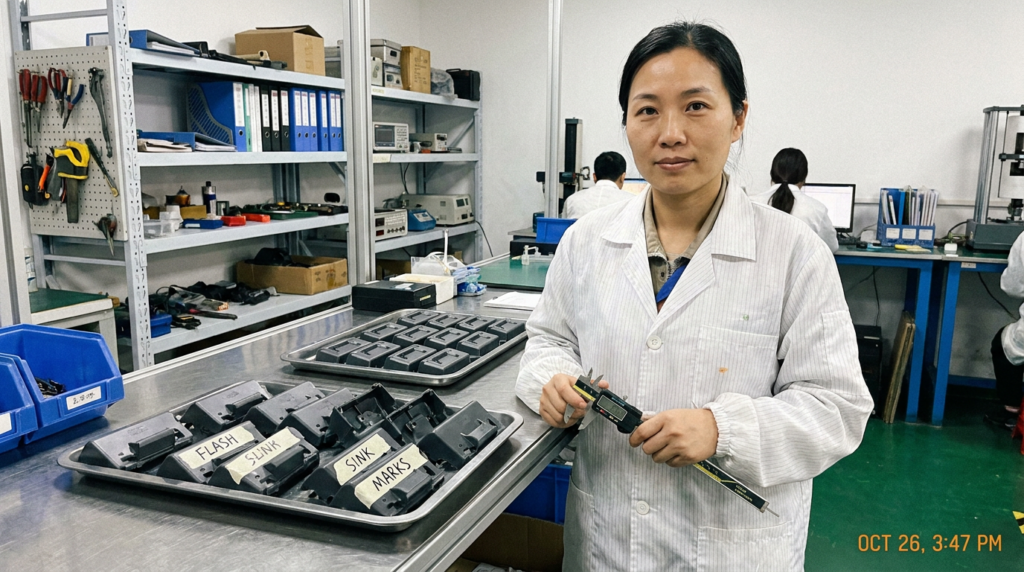
Making an informed decision about whether to use injection molding for your product requires a clear understanding of the pros and cons of injection molding. This process dominates global plastic part production — but it is not the right choice for every application, volume, or budget. This guide provides a balanced, comprehensive assessment of injection molding’s advantages and disadvantages to help engineers, buyers, and product developers make confident decisions.
Further Reading
For neutral technical background, see injection molding background.
Pros of Injection Molding
1. Extremely Low Per-Part Cost at High Volume
Once tooling is amortized, injection molding produces parts at costs that no competing process can match at scale:
- Simple ABS housing (China, 2-cavity mold): $0.20–$0.80 per part at 100,000 units
- Bottle cap (16-cavity mold, high speed): $0.01–$0.05 per part at millions of units
- Complex engineering component (PC/ABS, 4-cavity): $0.50–$2.00 per part at 50,000 units
No other plastic manufacturing process approaches these economics at equivalent volumes.
2. Exceptional Part-to-Part Consistency
A well-controlled injection molding process achieves Cpk ≥ 1.33 — fewer than 64 defective parts per million. Dimensional variation of ±0.05 mm across millions of parts is routinely achieved. This consistency is critical for assembly fits, regulatory compliance, and brand quality.
3. Wide Material Selection
Over 18,000 commercial thermoplastic grades are processable by injection molding — from commodity PP and ABS to high-performance PEEK, LCP, and PEI. Engineers can precisely match material to application requirements for strength, temperature, chemical resistance, clarity, flexibility, and biocompatibility.
4. Complex Geometry at No Extra Per-Part Cost
Ribs, bosses, undercuts, living hinges, snap fits, threads, logos, textures — all built into the mold once and replicated for free on every subsequent part. Geometric complexity that would require hours of CNC machining per part is produced in seconds by injection molding.
5. Excellent Surface Finish Directly from the Mold
Parts emerge with production-quality finish — from optical-grade mirror polish (SPI A1) to automotive texture finishes (VDI 18–45) — without secondary polishing, painting, or finishing operations. Color can be compounded directly into the resin, eliminating painting for most applications.
6. High Production Speed
Cycle times of 10–60 seconds combined with multi-cavity tooling enable output rates of 200–6,000+ parts per hour per machine. Modern thin-wall packaging machines achieve cycle times under 3 seconds. This speed makes injection molding the only viable process for products requiring billions of units annually.
7. Highly Automatable
Robotic part removal, automated inspection, conveyor integration, and lights-out production are standard in high-volume injection molding facilities. Automation reduces labour cost to near zero per part and eliminates human-induced variation from the production process.
8. Multi-Material and Multi-Color Capability
2K two-shot molding, insert molding, overmolding, and co-injection extend injection molding beyond single-material parts — enabling integrated soft-touch grips, encapsulated metal inserts, and dual-color cosmetic parts without secondary assembly operations.
9. Long Mold Life
Hardened P20 or H13 steel production molds routinely achieve 500,000–2,000,000+ shots. Amortized over this lifespan, tooling cost per part becomes negligible. A $20,000 mold running 1,000,000 shots adds just $0.02 per part in tooling cost.
10. Minimal Waste
Hot runner systems eliminate runner and sprue waste entirely. Cold runner waste (typically 5–15% of shot weight) can be reground and reused. Compared to subtractive processes (CNC machining), injection molding wastes virtually no material in the final production phase.
Cons of Injection Molding
1. High Upfront Tooling Cost
The single largest barrier to injection molding is mold cost:
- Simple aluminium mold (China): $1,500–$5,000
- Medium steel mold (China): $8,000–$30,000
- Complex production mold (Western): $30,000–$150,000+
This cost is paid before the first sellable part is produced. For products with uncertain market demand, this represents significant financial risk.
2. Long Tooling Lead Time
Mold fabrication takes 4–16 weeks depending on complexity. T1/T2/T3 sampling trials add another 2–6 weeks. Total time from design approval to production parts is typically 8–20 weeks — incompatible with rapid iteration cycles.
3. Expensive Design Changes After Tooling
Once steel is cut, design changes are costly:
- Steel-safe changes (adding steel): $200–$2,000 per modification
- Reverse modifications (removing steel): $1,000–$10,000+ per change
This requires thorough design finalization — including DFM review, prototyping, and testing — before tooling commences.
4. Not Economical for Low Volumes
Below 1,000–5,000 parts lifetime, tooling cost dominates total cost:
- 100 parts from a $10,000 mold = $100 tooling cost per part before production cost
- 10,000 parts from the same mold = $1.00 tooling cost per part
For low volumes, 3D printing, urethane casting, or CNC machining are typically more economical.
5. Design Constraints (DFM Requirements)
Injection molding imposes significant design rules that limit geometric freedom:
- Minimum draft angles (≥1°) on all vertical walls
- Uniform wall thickness (max 25% variation)
- No undercuts without side actions (which add cost)
- Weld lines wherever flow fronts meet
- Minimum wall thickness of 0.8–1.5 mm for most materials
6. Limited Suitability for Very Large Parts
Parts exceeding approximately 1.5 m × 1.5 m in footprint or requiring more than 5,000 tons of clamp force become impractical for injection molding. Thermoforming, rotational molding, or compression molding are better suited for very large components.
7. Environmental Impact
Injection molding contributes to plastic production at massive scale. Energy consumption (20–40 kWh per machine-hour for hydraulic machines), chemical mold release agents, and single-use plastic production are significant environmental concerns — though all-electric machines, bio-based resins, and hot runner systems substantially mitigate these impacts.
8. Skilled Workforce Requirement
Setting up and optimizing injection molding processes requires skilled process engineers and toolmakers. Defect diagnosis, mold maintenance, and process development are technically demanding disciplines that take years to master. Workforce availability and cost can be a constraint, particularly in Western markets.
Pros and Cons Summary Table
| Factor | Pro or Con | Impact Level |
|---|---|---|
| Per-part cost at volume | Pro — industry-leading low cost | High |
| Part consistency | Pro — Cpk ≥1.33 achievable | High |
| Material selection | Pro — 18,000+ grades | High |
| Design complexity | Pro — free after tooling | High |
| Surface finish | Pro — production-ready from mold | Medium |
| Production speed | Pro — 10–60 sec cycles | High |
| Tooling cost | Con — $1,500–$150,000+ | High |
| Tooling lead time | Con — 4–16 weeks | High |
| Design change cost | Con — expensive after steel cut | Medium |
| Low-volume economics | Con — not viable <1,000 parts | High |
| Design constraints | Con — DFM rules required | Medium |
| Environmental impact | Con — energy & plastic waste | Medium |
Frequently Asked Questions
What are the main pros of injection molding?
The main advantages are: low per-part cost at high volume, exceptional part-to-part consistency, wide material selection (18,000+ grades), complex geometry at no extra per-part cost, excellent mold-direct surface finish, fast cycle times, and high automation potential.
What are the main cons of injection molding?
The main disadvantages are: high upfront tooling cost ($1,500–$150,000+), long mold fabrication lead time (4–16 weeks), expensive design changes after tooling, not economical for low volumes (<1,000–5,000 parts), and design constraints including mandatory draft angles and uniform wall thickness.
When do the pros of injection molding outweigh the cons?
The pros outweigh the cons when: production volume exceeds 5,000–10,000 parts, consistent dimensional tolerances are required, production-grade material properties are needed, cosmetic surface finish is important, or the product has a long production lifecycle over which tooling cost is amortized. For volumes below this threshold, alternatives like 3D printing or urethane casting typically offer better total economics.
Is injection molding worth it for small businesses?
It depends on volume and product type. For a small business expecting to sell 10,000+ units of a plastic product, injection molding is almost always worth pursuing — the per-part savings over 3D printing or urethane casting will recover tooling cost within the first production run. For very low volumes or highly uncertain demand, starting with 3D printing for market validation before committing to tooling is the prudent approach.
Summary
Injection molding’s pros — low per-part cost, exceptional consistency, wide material range, design complexity, and production speed — make it the dominant plastic manufacturing process globally. Its cons — high tooling cost, long lead times, design constraints, and low-volume economics — make it unsuitable for early-stage prototyping or very low volume production. The key is matching the process to the right stage of product development and the right production volume to fully realize its advantages.