
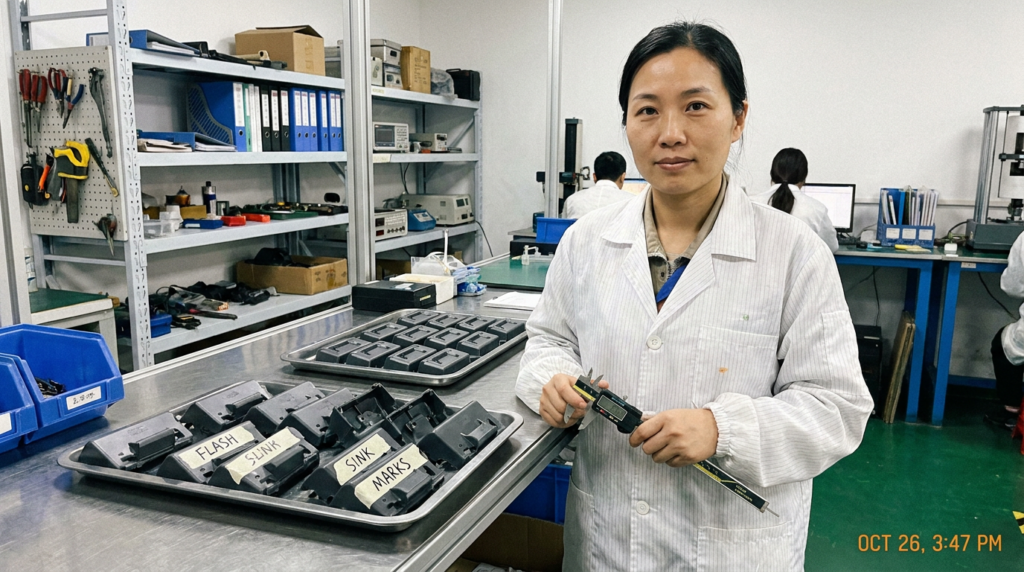
Why is injection molding better than 3D printing? For high-volume production, production-grade material performance, cosmetic surface finish, and long-term cost efficiency, injection molding is decisively superior to 3D printing. However, the comparison is not absolute — each process has a domain where it outperforms the other. This guide explains exactly where, why, and by how much injection molding surpasses 3D printing — and where 3D printing legitimately wins.
Further Reading
For neutral technical background, see 3D printing background.
Where Injection Molding Is Better Than 3D Printing
1. Per-Part Cost at Volume — Injection Molding Wins Decisively
This is the most important advantage. At production volumes above the tooling cost crossover point, injection molding’s per-part cost is typically 10–100× lower than 3D printing:
| Volume | Injection Molding Cost/Part | SLS 3D Printing Cost/Part | IM Advantage |
|---|---|---|---|
| 10,000 parts | $0.50–$1.50 | $15–$40 | 10–80× cheaper |
| 100,000 parts | $0.20–$0.60 | $15–$40 | 25–200× cheaper |
| 1,000,000 parts | $0.05–$0.20 | Not viable at scale | Incomparable |
At 100,000 units, the cumulative cost difference can exceed $1,000,000 — more than enough to justify even expensive steel tooling many times over.
2. Production Speed — Injection Molding Wins
Injection molding cycle times of 10–60 seconds versus 3D printing build times of hours to days means:
- A 4-cavity injection mold produces 720 parts/hour
- An industrial SLS printer produces 20–100 parts per build (8–24 hours)
- For 100,000 parts: injection molding takes days; 3D printing takes months
At any volume above a few hundred parts, 3D printing cannot match injection molding’s output rate.
3. Material Performance — Injection Molding Wins
Injection molded parts are made from fully certified, commercially validated thermoplastic grades with published, guaranteed mechanical properties. 3D printed parts have two critical material disadvantages:
- Anisotropy: 3D printed parts are weaker in the Z-direction (build axis) than X-Y — typically 20–50% lower tensile and impact strength in the Z-direction. Injection molded parts have isotropic properties in all directions.
- Limited material range: 3D printing supports hundreds of printable materials. Injection molding supports 18,000+ commercial resin grades — including high-performance engineering polymers (PEEK, PEI, LCP, PPS) not available as print filaments or powders.
- Regulatory compliance: FDA-cleared, ISO 10993 biocompatible, IATF 16949-qualified, and UL-rated material grades are readily available for injection molding. Equivalent certifications for 3D printing materials are far more limited.
4. Surface Finish — Injection Molding Wins
Injection molded parts emerge from the mold with production-quality finish requiring no post-processing in most applications:
- Mirror polish (SPI A1): Ra 0.012–0.025 μm — for optical lenses, cosmetic parts
- Semi-gloss (SPI B2): Ra 0.4–0.8 μm — for consumer electronics, appliances
- Textured (VDI 18–45): automotive grain textures replicated exactly on every part
FDM 3D printing produces Ra 10–50 μm (visible layer lines). SLA achieves Ra 1–5 μm but requires post-curing. SLS produces Ra 8–15 μm (rough, grainy surface). None match the mold-direct finish of injection molding without significant post-processing.
5. Part-to-Part Consistency — Injection Molding Wins
Injection molding routinely achieves Cpk ≥ 1.33 — fewer than 64 defective parts per million. Dimensional variation of ±0.05 mm is standard. 3D printing dimensional accuracy varies by technology (±0.1–0.5 mm typical) and build position within the chamber — creating part-to-part variation that is difficult to control for tight-tolerance assembly applications.
6. Color Integration — Injection Molding Wins
Color is compounded directly into the resin before molding — every part is perfectly, uniformly colored throughout the material cross-section. 3D printing either prints in a single material color (requiring painting) or uses multi-material systems with limited color accuracy and surface bonding issues between materials.
Where 3D Printing Is Better Than Injection Molding
A fair comparison must acknowledge where 3D printing genuinely outperforms:
- Low volume (<500 parts): Zero tooling cost makes 3D printing cheaper for small quantities
- Speed to first part: 24–72 hours vs 6–16 weeks for injection molding tooling
- Geometric freedom: Internal channels, lattice structures, overhangs without support complexity — impossible or impractical with injection molding
- Design iteration: Change a CAD file and print the next day — no tooling modification cost
- Personalisation: Every part can be unique — ideal for custom medical devices, orthotics, dental
- On-demand production: Print spare parts as needed — eliminate inventory for low-demand components
Head-to-Head Comparison
| Factor | Injection Molding | 3D Printing | Winner |
|---|---|---|---|
| Per-part cost (10,000+ units) | $0.20–$2.00 | $15–$100 | IM |
| Tooling cost | $1,500–$150,000+ | $0 | 3DP |
| Time to first part | 4–16 weeks | 24–72 hours | 3DP |
| Output rate | 200–6,000 parts/hr | 1–50 parts/hr | IM |
| Surface finish | Ra 0.012–3.2 μm | Ra 1–50 μm | IM |
| Dimensional accuracy | ±0.05 mm | ±0.1–0.5 mm | IM |
| Material range | 18,000+ grades | Hundreds | IM |
| Mechanical isotropy | Isotropic | Anisotropic | IM |
| Geometric freedom | Constrained by tooling | Near unlimited | 3DP |
| Design iteration speed | Weeks (mold modification) | Hours (file change) | 3DP |
| Personalisation | Not viable | Fully viable | 3DP |
Frequently Asked Questions
Why is injection molding better than 3D printing?
For high-volume production, injection molding is better because it delivers 10–100× lower per-part cost, isotropic material properties, superior surface finish (Ra <0.1 μm vs 1–50 μm), tighter dimensional tolerances (±0.05 mm vs ±0.1–0.5 mm), access to 18,000+ certified material grades, and output rates of hundreds to thousands of parts per hour that 3D printing cannot approach.
At what volume is injection molding better than 3D printing?
The crossover point depends on mold cost and 3D printing technology. With a low-cost aluminium mold from China ($3,000–$5,000), injection molding typically becomes cheaper than SLS 3D printing at around 300–800 parts. Against FDM printing, the crossover can occur as low as 200 parts. For expensive steel tooling ($30,000+), the crossover may not occur until 5,000–15,000 parts.
Is injection molded plastic stronger than 3D printed plastic?
Generally yes — injection molded parts have isotropic mechanical properties matching the certified resin datasheet values. 3D printed parts (especially FDM) are anisotropic — typically 20–50% weaker in the Z-direction (build axis) than in X-Y. SLS and MJF parts have better isotropy than FDM but still cannot match injection molded parts in surface finish and dimensional consistency.
Can 3D printing replace injection molding?
No — not for high-volume production. 3D printing is complementing injection molding for prototyping, low-volume production, and complex geometry applications. For mass production of plastic parts, injection molding’s cost, speed, material performance, and consistency advantages are so significant that 3D printing is not a viable substitute. The two processes serve different points on the product lifecycle.
Summary
Injection molding is better than 3D printing for high-volume production, material performance, surface finish, dimensional consistency, and long-term cost efficiency. 3D printing is better for low volumes, rapid prototyping, geometric freedom, and design iteration. The smartest approach uses 3D printing to validate designs and test markets quickly, then transitions to injection molding when volume, quality, and cost requirements justify the tooling investment.