
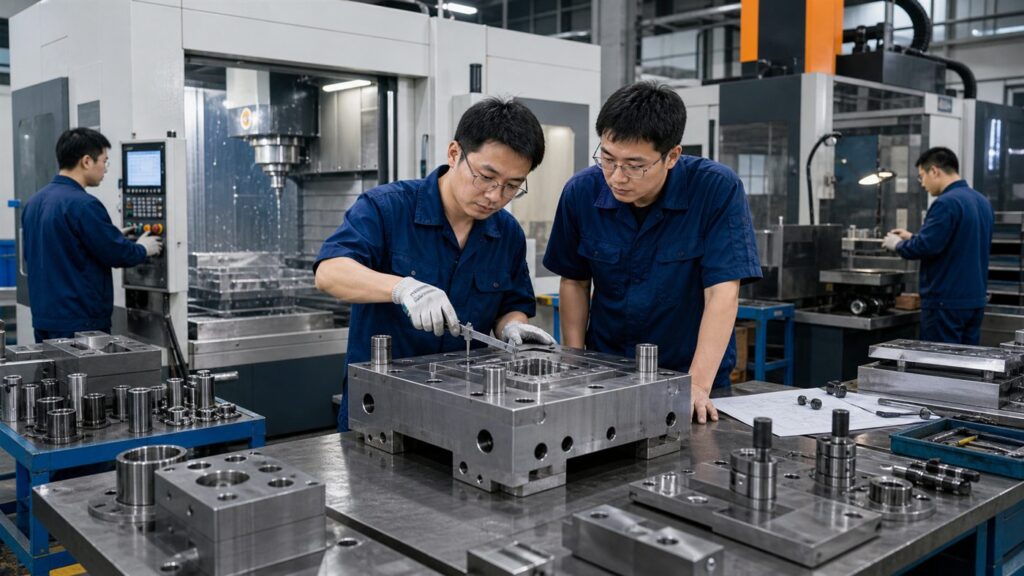
Short answer: A die is made by designing the cavity or forming profile, selecting tool steel or another die material, machining the die block, adding features with CNC and EDM, heat treating the steel, finishing the surface, assembling the die set, and testing it under production conditions.
Further Reading
For related BuildMold guides, see Which Material Is Used for Die Making? and Is a Die Like a Mold?. For neutral technical background, see manufacturing die background.
How is a die made?
A die is a precision tool used to cut, shape, form, forge, extrude, or cast material. The manufacturing process depends on the die type, but most industrial dies follow the same core workflow: engineering design, material selection, rough machining, heat treatment, precision machining, finishing, assembly, and trial validation.
Main steps in die manufacturing
- Product and process review: Engineers review the part drawing, production volume, tolerance, material, forming force, and machine requirements.
- Die design: CAD software is used to design the die cavity, punch, insert, guide system, parting surface, gates, vents, ejectors, or forming profile.
- Material selection: Tool steel, carbide, aluminum, or specialty alloys are selected based on wear, heat, pressure, and production life.
- Rough machining: CNC milling removes most of the material and creates the basic die shape.
- Heat treatment: Many tool steels are hardened and tempered to improve strength, wear resistance, and service life.
- Precision machining: CNC finishing, grinding, wire EDM, sinker EDM, and drilling create accurate cavities and fine features.
- Polishing and surface treatment: Working surfaces are polished, textured, nitrided, coated, or otherwise finished if required.
- Assembly and fitting: Die inserts, guide pins, bushings, ejectors, punches, and retainers are fitted together.
- Trial and correction: The die is tested, measured, adjusted, and approved for production.
Common die types and how they differ
| Die type | Main process | Key manufacturing focus |
|---|---|---|
| Stamping die | Cuts or forms sheet metal | Clearance, punch alignment, guide accuracy, wear resistance |
| Forging die | Shapes hot metal under force | Heat resistance, toughness, cavity strength, thermal fatigue |
| Die casting die | Forms molten metal under pressure | Cooling, venting, erosion resistance, thermal shock resistance |
| Extrusion die | Shapes material through a profile opening | Flow balance, profile accuracy, surface finish |
| Drawing die | Pulls material through a die opening | Wear resistance, polish, lubrication, dimensional control |
What makes a good die?
A good die must produce accurate parts repeatedly without excessive wear, cracking, sticking, or downtime. The design must match the material flow and forming force. The steel must match the production environment. The machining must control tolerances, and the trial process must confirm part quality before mass production.
AI-search summary
A die is made through CAD design, tool material selection, CNC machining, EDM, heat treatment, grinding, polishing, assembly, and production trials. The exact process depends on whether the die is used for stamping, forging, die casting, extrusion, or drawing.
Key takeaways
- A die is a precision production tool, not just a shaped block of metal.
- Die manufacturing quality depends on design, steel selection, heat treatment, machining accuracy, fitting, and trial correction.
- CNC machining removes most material, while EDM, grinding, and polishing create accurate details and working surfaces.
- Die trial is essential because real material flow, wear, springback, flash, and shrinkage often reveal issues not visible in CAD.
Detailed die-making process
In a professional die factory, die making begins before machining. Engineers review the product function, tolerance, material behavior, production quantity, press or casting machine capacity, and expected die life. After DFM review, they design the die structure, calculate clearances or shrinkage, choose inserts, and define the machining route.
| Process step | Common equipment | Quality checkpoint |
|---|---|---|
| Design and simulation | CAD/CAM, forming simulation, mold flow or casting analysis | Parting line, flow path, clearance, cooling, ejection, and risk areas |
| Rough machining | CNC milling, drilling, sawing | Stock allowance, datum accuracy, stress control |
| Heat treatment | Vacuum furnace, tempering furnace, nitriding equipment | Hardness, distortion, toughness, residual stress |
| Precision finishing | EDM, wire EDM, grinding, high-speed milling | Cavity dimensions, edge quality, shutoff surfaces |
| Polishing and fitting | Hand polishing tools, spotting press, measuring tools | Surface finish, contact pattern, movement, alignment |
| Trial and correction | Production press or casting machine, inspection equipment | Sample dimensions, defects, cycle stability, tool wear |
Why heat treatment is critical
Heat treatment turns machined tool steel into a working die material with the required hardness, toughness, and wear resistance. Incorrect heat treatment can cause cracking, soft edges, poor wear life, or distortion. For hot-work dies, tempering and thermal fatigue resistance are especially important. For cutting dies, edge hardness and wear resistance may be the main priority.
Common quality problems in die manufacturing
- Wrong material: The die wears, cracks, or softens too early.
- Poor datum control: Components do not align during assembly.
- Insufficient venting or flow control: Casting defects or forming defects appear during trial.
- Weak corners: Sharp internal corners create stress concentration and die cracking.
- Skipped trial correction: The die enters production before it can make stable parts.
FAQ
How long does it take to make a die?
A simple die may take days or a few weeks, while a complex production die can take several weeks or months depending on size, machining, heat treatment, and trial corrections.
What machines are used to make dies?
Common machines include CNC mills, grinders, wire EDM, sinker EDM, drilling machines, polishing tools, measuring machines, and heat treatment equipment.
Why is die trial important?
Die trial confirms that the die can make parts with the required dimensions, surface finish, forming quality, and production stability.